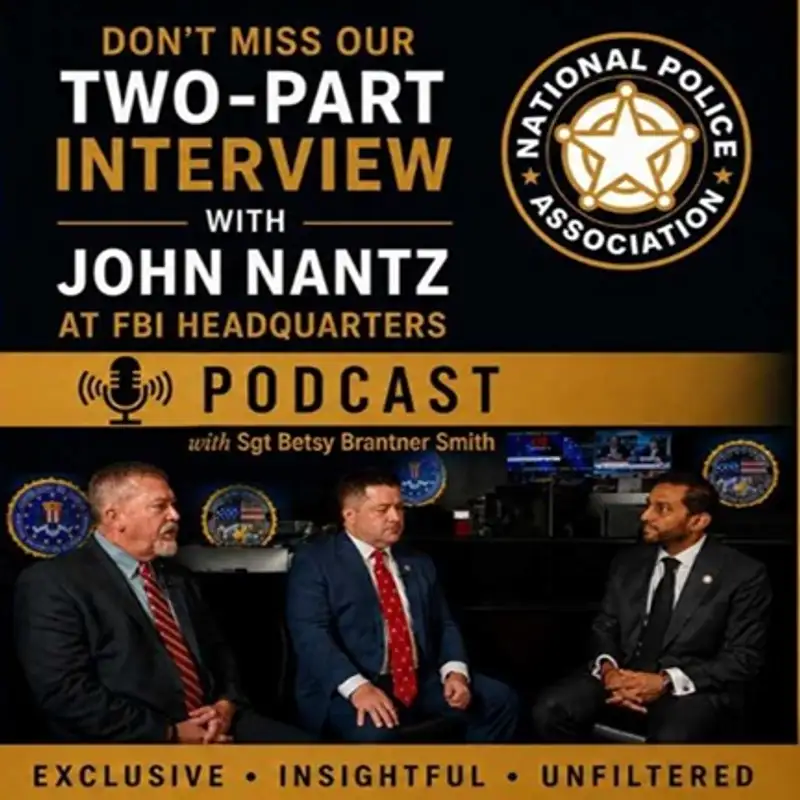
The National Police Association Podcast with Guest, John Nantz, FBI Supervisory Special Agent (Ret.) Part 1
Hi, this is Sergeant Betsy Brantner Smith with the National Police Association, and this is the National Police Association Podcast. I am I know I always talk about how excited I am. I'm really excited about this because I brought my friend John Nantz back. You know him if you have been watching and listening to the podcast for a while, but he just had a really incredible experience with the director of the FBI. He and his friend, Chris Hinkle, were able to spend an extraordinary amount of time with FBI director, Kash Patel.
Betsy Smith:And they covered so many topics. So I just wanted to bring John on to talk about how this all came about, how he came to get all of this incredible information, and then I want every one of you to go and watch this interview because I've been at a conference for twenty nine years. I learned stuff about the Federal Bureau of Investigation that I didn't know. So I'm really excited to bring back John Nantz. This guy, he's a retired FBI agent.
Betsy Smith:He was a boss. He's columnist for town hall now, and this guy spends more time on cable news than I do. So, John, welcome back to the show.
John Nantz:Well, thank you very much for having me. It always is a real pleasure getting to talk to you, and yeah, I'm looking forward to what we have to talk about today, especially.
Betsy Smith:So you and Chris Hinkle sat down with FBI Director Cash Patel. Now, the National Police Association, we were the first law enforcement organization to endorse Kash Patel for the FBI director, and one of the things that he had initially said when he was first tapped to be the director, even before he was confirmed, he said, You know what we're gonna do with the FBI? We're gonna let cops be cops. And that just endeared him really to the law enforcement world here in The United States. So talk about how you came to sit down with director Patel, and then let's get into the to the meat and potatoes of that interview.
John Nantz:Yeah. Well, I like how you're pointing out his statement about letting cops be cops. And we'll go back to the beginning here. But I want to underscore a bit of the conversation we had that was later on in the interview, which had to do precisely with the FBI's posture with regard to JTTF, the Joint Terrorism Task Force individuals, and with our partnerships with state and local law enforcement, which are so very important. And Patel really emphasized that during the interview.
John Nantz:And I get asked that question a lot in regard to the Nancy Guthrie case. Like, why doesn't the FBI just go in and steamroll the sheriff, or whatever his name is.
Betsy Smith:No, Chris Nantz.
John Nantz:Yeah, Rauke, that's right, Nantz. Arpaio is a good guy.
Betsy Smith:He is. So
John Nantz:I thought that was really, really good that Patel has that attitude that some of our most valuable relationships are with our state and local law enforcement partners, and that the FBI is very much handicapped if those aren't healthy, vibrant relationships. So I was very, very encouraged to hear that, too, initially, because Patel was, to me, very much an unknown entity. And not the typical sort of DOJ pedigreed though he was a DOJ attorney, but he wasn't like the civil rights attorneys that tend to be incredibly liberal or the quote unquote empty suits that we had been getting for decades. I wouldn't quite put Mueller in that empty suit category, but certainly Comey, and without doubt Christopher Wray, absolutely fit that category. But as far as how this came to be, I wrote a town hall column, and it was titled The End of the Empty Suit Era.
John Nantz:And Kesh Patel's public relations individuals saw that and liked the piece, and that formed a relationship. And Cash saw the piece, and he really enjoyed it as well. And Chris and I have had that relationship and have had the privilege of giving individuals, Patel and other people in his circle, some input from a retiree perspective, which is a huge change. Christopher Wray, Comey, certainly, they had no interest in listening to the retired community, what our perspectives were. So again, this is another one of Patel's sort of reform efforts is listening to individuals from the retired community.
Betsy Smith:And why wouldn't you, as the director, why wouldn't you listen to people who had done the job for decades and decades. Know, that's why I never understood, you and I were talking before the show started, that you know I know many people in the training world who are retired FBI and for the last fifteen years have been talking about how frustrated they had been starting really in the Obama administration, where you know these groups of retired FBI agents would you know write letters and memos and very professionally suggest, Why don't you look at this? Why don't you do that? How about this? And the frustration would just continue to mount because no one would listen to them.
Betsy Smith:And obviously, director Patel has flipped the script on that. Well,
John Nantz:think it came from an attitude of elitism, frankly. And these guys kind of came from a very elitist mindset and an elitist culture, both Christopher Wray and Comey. Again, Mueller was a bit of a different animal. I wouldn't quite put him in the same category as those two, but that has definitely changed. And to your point, why wouldn't you want to tap a resource like that And at least give them a hearing, right?
John Nantz:So that's what's happening now. That was not happening before. And literally, Chris and I got a text message one day inviting us to come to headquarters and spend a couple of hours with Director Patel. And I was literally blown away by that. Me?
John Nantz:Why Chris? Why the two of us? And it was a tremendous privilege to do that and to have that kind of time with the director.
Betsy Smith:So I have to ask you a practical question. So when you get invited to do that, and so you're going to FBI Headquarters in Washington, DC, right? Or did you go to Quantico? You went to DC, right?
John Nantz:Our headquarters, yeah.
Betsy Smith:So do you have to re up your security clearance when you do that? How does that work?
John Nantz:No, well, my security clearance or anybody's security clearance after they leave federal service kind of stays active for five years. So I'm within the four year period. I think Chris is outside of that with the six year period. But don't have to you don't have to renew your classification accesses to do that. You simply get a pass, an escorted pass.
John Nantz:So you have to be escorted wherever you go throughout the building. So you could go to FBI Headquarters if you're invited to go. And as long as you're escorted, can tour parts of the building. Of course, there's the FBI tour, and that's a whole other thing. So the FBI tour has been completely revitalized, revamped.
John Nantz:This is all Patel, which is a tremendous change. Because I think it's important for the public to be able to see, well, what FBI has been doing for this country for over one hundred years of its existence? So you can do the tour now and check out all the cool stuff. I mean, there are artifacts from the Dillinger era, kind of the classic G Man sort of era, all the way up to modern times. One part of the tour that I really used to enjoy years ago was the progression of the FBI badges.
John Nantz:So you could see what the first Bureau of Investigation badge looked like, and then the evolution to what it is today. So a good lot stuff. And this is what I will say, that I think leadership is in the details. So I felt very welcome back inside headquarters, which even as an employee years ago, I didn't really get that feeling. Nobody wants to go to headquarters, especially back then when so many FBI resources were being accreted to headquarters environment.
John Nantz:I think it was very unhealthy, created a lot of problems. And you could definitely feel that in the atmosphere in the building from the employees. Well, I didn't spend a lot of time with employees. So I mean, this is just my opinion coming back. It felt like there was more of an optimistic sort of a spirit at headquarters, which is another big change.
Betsy Smith:Well, that was one of the things that Director Patel talked about. And you guys did a great job of really bringing him out, you know? And he obviously that's why I want everybody to watch this interview because Kash Patel was very comfortable with you guys. And and I think that you know, because you you see him do, you know, media interviews and and stuff, and he has to be so careful when he's talking to somebody, you know, on cable news or or whatever. But you guys, when I was watching the three of you, it was very much a a camaraderie atmosphere, and and that speaks to you and Chris and your backgrounds and of course just your demeanors, but one of the things that Director Patel talked about was it's all about the field and exactly what you just said, where it seemed like, and we all saw this in the last decade or so, that there was too much concentration in what was happening at headquarters.
Betsy Smith:And in the field, especially smaller field offices, and you know that firsthand, that the field kind of got pushed to the side a little bit. And now that obviously has changed.
John Nantz:Well, was purposeful. That concentration of resources and emphasis at the headquarters level was purposeful because you couldn't have a crossfire hurricane investigation being conducted out in the field. There's simply too many layers of experienced leadership in the field for an investigation of that nature to continue. And the only reason why you could have that is because it was very close hold at the headquarters level with literally a handful of senior executive service individuals who were clearly politicized and had clear agendas to quote unquote get Trump. And that was all due largely in part to this overemphasis of headquarters.
John Nantz:I think it goes back to that sort of elitist attitude. We're the top of the food chain. We really know how to steer the ship. And in the field, they're just kind of maybe knuckle draggers, and we'll let them do the of the journeyman sort of cases and that type of stuff. But the really important stuff we're going to handle here at headquarters.
John Nantz:But that has all changed. Patel has pushed people out to the field. And as you have said, and as he said during the interview, the emphasis now is at the field office level, which is a very healthy thing. You'd think at headquarters there'd be more layers of approval, but that's not how it works. Because literally, you had the DAD.
John Nantz:You had individuals like Strzok and McCabe who were running an investigation, investigating a presidential candidate based on absolute fabrications. As we now know, the Steele dossier was a complete and total fabrication, created as disinformation by the Clinton campaign. And you're basing an investigation, and you're perjuring yourself to the FISA court based on this stuff. So I can't tell you how it's such a breath of fresh air to have someone like Patel. And when I first heard the name Patel being in the running for the directorship, I'm kind of like, well, who I know he wrote Government Gangsters and all that, but who really is this guy?
Betsy Smith:He seemed like, oh, it's that social media guy. I I I had that same thought, you know? And, again, I had read the book, and I knew what happened to him.
John Nantz:Right.
Betsy Smith:But, yeah, you're you're like you're like, wait. What? And but then you look into his background.
John Nantz:Mhmm.
Betsy Smith:And, you know, look at his career, and you're like oh yeah, know, this was a great selection. And you know, you bring up Crossfire Hurricane and the SEAL dossier. I mean again, going back, so many things that a lot of people when we bring these things up will poo poo and say wow you know that that's so long ago yeah no no no it's not so long ago and and again we need this is one of the one of the reasons why your interview is so important, and this is one of the reasons why Kash Patel is the director for this time in our country's history, is because the FBI has to get that kind of stuff out into the open, deal with it, and let the American people know that this will never happen again when you bring up, you know, Lisa Page and Peter Strzok and and Strzok, you know, people like like me, you know, real cops, look at that guy and just think, ugh. You know? The fact that this guy was in the same profession I am makes me ill.
Betsy Smith:And, you know, so, yeah, that sunlight needs to be shown on all of that, then we can get it behind us.
John Nantz:Well, that that kind of raises something interesting to me, which is the social media aspect of Patel's sort of new administration. And he's come under a lot of criticism for that from the retired community, really, because we're not used to that sort of thing. We're used to an FBI director in a suit standing in front of a podium giving a press conference. That's what we're used to. But I think Patel has been very smart, and his team very forward leaning with regard to getting information out to the public.
John Nantz:And the FBI's rapid response account is a tremendous resource. And I mentioned this in the interview because critics, supporters, people that are just curious, whatever, they can go to the FBI rapid response account, and they can see exactly what the bureau is doing for them. And they do a lot of really cool graphic presentations, so it's not just like raw numbers and that type of thing. So it's really accessible to everybody. And the watchword, it seems, of Patel's tenure has been transparency.
John Nantz:He's had the bureau provide Congress, I think, 50,000 pages of documents. I saw just earlier today on X, somebody was complaining about something that has not been released yet, and it's like, well, I'm sure it's coming because knowing Patel, he's not hiding anything, Nothing. You know? Even if it's embarrassing, he's not hiding it.
Betsy Smith:Well, I think this is the thing. And and we saw this, you know, in during my generation. Very often, you know, when the FBI came, you know, you had a bank robbery or whatever, and you were dealing with the FBI. A lot of times in the field, they would tell local law enforcement, you know, well, we got it now, you know, bug off. And darn you guys.
Betsy Smith:And and now what I'm hearing in the field from local law enforcement is and I and you guys talked about this in in the interview as well, is the the task forces are proliferating, you know, and they're being much more open in the way that local law enforcement is brought in and the way that local law enforcement is treated, and it's much more of a partnership than this multi tiered, I'll let you local thugs know when I need you kind of a thing, and that was one of the other things that really impressed me. Again, this goes back to what we were talking about, where, you know, let cops be cops. And I think that in the field, too, it sounds like the agents are being treated like they're part of community local law enforcement because that's I think one of you know, everybody who thinks of the FBI is, you know, all these guys in suits at headquarters. But in reality, FBI insert they're out there. They're in small towns, and and they're working on just all kinds of things, not just bank robberies and big complicated financial investigations.
Betsy Smith:Plus you guys live in those communities very often too.
John Nantz:Yeah, well he talked about the importance of this regional concept and also reducing the lag time with regard to the onboarding of Joint Terrorism Task Force law enforcement agents. Because it used to be required that they all have a top secret security clearance, which is a much lengthier background check investigation. So it was creating this huge backlog. And I can't remember the exact number, but I think was in the hundreds. Were back with trying to get people on.
John Nantz:And so he's reduced it to just simply having a secret clearance. So if you're working on something that requires a TS, top secret clearance, that can be handled. But they've reduced that backlog to zero. So again, another tremendous accomplishment. And this isn't like feathers for Patel to put in his hat necessarily.
John Nantz:These are advancements and accomplishments for the American people because if you've got your full complement of JTTF individuals, then you're able to more effectively address the threats that are developing out there in that law enforcement environment.
Betsy Smith:One of the things you guys talked about too was, and I was fascinated by this, was the regional SWAT teams for the FBI. You don't usually think about the FBI when we're talking about SWAT, and when your normal citizen thinks about SWAT, they're either thinking of a TV show or they're thinking of these big guys who are just sort of sitting in an office waiting to jump into you know, a big truck and go to, you know, whatever and blow a door off or something. Talk about what's happening on the tactical aspect of the FBI.
John Nantz:Well, I was on FBI SWAT in Miami for several years, and so that question really kind of struck home for me because I was very, very interested in some of these changes. So yeah, the FBI has SWAT teams that are located in every major field office. And they have smaller components out in some of the residential agencies or the smaller offices that are satellite offices of the main office in particular area. So the FBI also has a full time, very much of an enhanced sort of, I don't even know if you can call them SWAT really, because a lot of these guys come from tier one military units. And it's called the Hostage Rescue Team or HRT.
John Nantz:And their specialty is, as the name implies, Hostage rescue. And that team came about, I think, in the '80s, mid '80s, in response to some of the hostage crises that we were dealing with back then. So I've worked with them some. I've trained with them some back in the day, and a great group of guys. In fact, James Galliano, if you know James from
Betsy Smith:I know James.
John Nantz:He's a former HRT guy. So that's the kind of caliber kind of level guy that you're talking about. So a lot of respect for them and for what they do, and not to take away from what the people are doing at the field office level. But it's SWAT, just like local law enforcement has SWAT. And sometimes when we're serving high risk arrest warrants, people that are known to be armed and dangerous, that type of thing, or a barricaded subject, those are all SWAT missions.
John Nantz:So the really great thing about the way Patel has kind of readjusted some of this stuff, with regard to the way SWAT used to be run, it difficult at times getting appropriate funding from SERG because the field office really had a lot of input as to how SWAT was run. And typically SWAT is overseen by an ASAC, an Assistant Special Agent in Charge. That's not frontline management. It's more mid level management. And you have all these competing interests, too.
John Nantz:Of course, FBI agents are first and foremost. They're case agents. So if you're a SWAT agent, you still have a case, though, that you have to deal with. And you've got a supervisor that you've to deal with who wants his cases investigated and resolved in a timely manner. And sometimes SWAT interests and those interests you know what?
John Nantz:It's not sometimes. A lot of times, those two interests conflict. So by creating a full time STL senior team leader position, which is the guy who is in charge of that SWAT team, by making that guy full time, gives him the opportunity him or her gives them the opportunity to deal with the front office a little more effectively, I think, in trying to mitigate some of those conflicting interests. So that's a very good thing. And then the other big piece of it is the money.
John Nantz:Everything costs money. People don't think about that. But SWAT needs and Cash talked about this in particular when he went to visit the Miami field office, which were the NODs or the night vision devices. And those guys were in there. They're all in pieces.
John Nantz:They're trying I know exactly what he's talking about. They've been in Swatlocker many, many times. And those guys are in there trying to beg, borrow, and steal to try to have functioning, decent equipment. It's not like FBI SWAT is just poor or poverty stricken, but a lot of this equipment is very, very expensive, like those night vision devices. And sometimes things fall through the cracks.
John Nantz:But with CIRG being directly responsible for that stuff. And CIRG stands for the Critical Incident Response Group. And Betsy's laughing because we had this conversation earlier because during the interview, because it's like we were just talking shop, everything fell into acronyms.
Betsy Smith:Your wife and I are very proud of you right now. You've explained every single one.
John Nantz:Yeah. So anyways, CIRG is the entity that governs the hostage rescue team, FBI SWAT, and a host of other things with regard to FBI sort of tactical operations or critical response.
Betsy Smith:That's all the time we have for this episode, but please join us for part two of my in-depth interview with Supervisory Special Agent, John Nantz. And if you'd like more information about the National Police Association, you can join us at nationalpolice.org.
NPA:Every day, the brave men and women of law enforcement put their lives on the line to keep us safe. But they need our help to continue their mission. Activist politicians, progressive prosecutors, the ACLU, and the rest of the anti police forces receive millions in donations from extremist pro criminal elements like George Soros and woke corporations. The National Police Association is fighting them in courts around the country, including the United States Supreme Court, defending officers who are being attacked for doing their jobs. Additionally, the National Police Association works year round to pass tough on crime legislation to put and keep criminals behind bars.
NPA:Consider going to nationalpolice.org and donating to keep us in the fight. Together, we can win. That is nationalpolice.org.