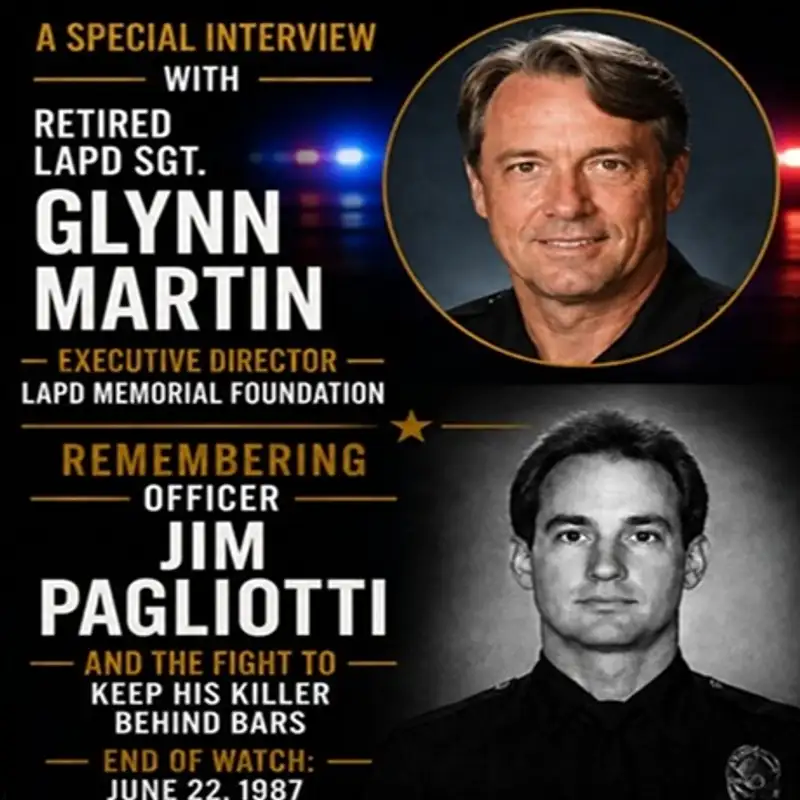
NPA Podcast with Guest, Glynn Martin, Sgt. LAPD (Ret), Exec. Dir. LA Police Memorial Foundation
Hi, this is Sergeant Betsy Brantner Smith at the National Police Association, and this is the National Police Association Podcast. You know, one of the things that the NPA is very passionate about is making sure that murdered police officers get justice. And yet here we are in 2026, we're in a situation where very often killers of police officers are up for parole and are very frustratingly not receiving the full punishment that they should for murdering a heroic police officer just trying to do his or her job. So we have become involved in a case that we're going to talk about on this episode of a 28 year old police officer who was murdered nearly forty years ago in Los Angeles. And so to that end, I'm bringing in a fellow sergeant because you know sergeants we always know what's going on.
Betsy Smith:But this is a good friend, a very good friend, we're going to talk about that, of a murdered police officer who now in retirement is the executive director of the LAPD Memorial Foundation. Glynn Martin, thanks for being with us today.
Glynn Martin:Oh, it's my pleasure. I certainly appreciate you taking the time to, to talk about this particular case.
Betsy Smith:So before we talk about your friend and partner, Jim, I have to ask you because everybody always wants to know, Glynn, why'd you become a cop?
Glynn Martin:You know, it's the answer to that is not as direct as you think it might be. You know, I started out very much wanting to be a sports writer. I was an athlete in college and worked for a local paper here in Glendale, California as a sports writer. And then one day, I took a look around the newsroom and realized that there were a whole bunch of very, very talented folks there that weren't making much money. So I took another look, this more inward.
Glynn Martin:My father, as a retired captain from the Glendale Police Department, and I realized that he had provided a pretty good living for me, my brother and our family and thought that might be an option. And not long after taking that kind of internal survey, my best friend from childhood said, hey, I'm going to apply for LAPD. So I said, All right, I'll go with you. And guess what? He became an LA City firefighter and I joined the Los Angeles Police Department.
Betsy Smith:Now this is the early '80s. You you and I are contemporaries into the seventies on into the early eighties. LAPD was the place anybody who wanted to be a cop wanted to go. LAPD was all over television and movies. And so here you are.
Betsy Smith:I mean, that had to be just an amazing moment when you decided to join the LAPD and they chose you to join up with them.
Glynn Martin:Yeah, it truly was and you know, frequently when discussing this kind of stuff, the question comes up, you know, why didn't you join Glendale with your father? And the and the answer is for me at least was was pretty obvious. I was born and raised in Glendale. I knew a lot of people in Glendale. As did my father and I just didn't want my nose in the business of people that I grew up with, people that I resided near.
Glynn Martin:And then there was the second part was exactly as you stated. LAPD was all over, like you said, all over the entertainment industry. Adam twelve, Dragdad, all kinds of great stuff. But more importantly, of equal importance, I should say, the LAPD Academy was about midway between my home and where I attended college at USC. So this, for me, was kind of a progression.
Glynn Martin:Hey, I graduated from SC. I went straight into the LAPD Academy. More importantly here being an Angelino, I cut my commute in half.
Betsy Smith:Because in LA, it's all about the traffic, right? Just like Chicago.
Glynn Martin:It was. I lived in Glendale and commuted to USC, it was the even being in pretty fairly close proximity to the campus, it was still a heck of a drive. And the Academy literally was halfway between home and USC. So that was kind of an ancillary benefit. And yeah, very, to have served for the Los Angeles Police Department and very, very glad they gave me that opportunity way back in 1982.
Betsy Smith:So how many years did you spend on the job?
Glynn Martin:I spent twenty with LAPD.
Betsy Smith:Excellent. Excellent. And during those twenty years, what was your favorite assignment?
Glynn Martin:Oh, you you gotta limit it to one. As a three year officer, I worked at detail in Hollywood known as the Special Problems Unit. It was a group of 10 of us with a supervisor, and virtually all the work we did was in plain clothes and plain cars. And basically, we were assigned to investigate street felonies. That was a great assignment.
Glynn Martin:That was an assignment where I worked with Jim Pagliotti. Several other officers that I worked in that unit with remain near and dear friends to this day. So as a youngster, that was a lot of fun. In terms of investigations, I was a major narcotics detective for three years. We did some record setting cocaine seizures.
Glynn Martin:That was fascinating work. And then my final assignment as an assistant watch commander, I had a shift of about 42 or 44 people, and that was enjoyable. And in between I worked on all different corners of the city and several different specialized assignments, including Hollywood Vice where again I worked with Jim Pagliotti.
Betsy Smith:So let's talk about Jim. Have his photo behind you in the shot. 06/27/1987, talk about that.
Glynn Martin:It was a Monday night. Hollow Advice four or five months before that. He was trying to fulfill his dream of becoming a member of SWAT. And at the time, the requirement was that he worked Metropolitan Division. So Jim and Jim and I had, Jim had left Hollow Advice where we worked together and before that we worked Hollow with Patrol together and before that we worked Hollow with Special Problems together.
Glynn Martin:Jim had left for those four or five months. He left right after I got married where he was one of my one of my groomsmen and we're talking about June 22. On June 21, he was having a wedding planning meeting with him and his bride and his parents and those of us that were supposed to be in the wedding. I had some other commitments, particularly Father's Day. So I wasn't able to make it, but I did talk to Jim on the phone.
Glynn Martin:It was early morning, June 21, at about a little after eleven on June 22, I get a call from one of the officers that we worked with in Hollywood who inquires about my relationship with Jim and said, hey, yeah, were longtime partners and we owned a house together. And then he informed me that he'd been shot and killed. Being in a new assignment, they didn't have the kind of connection with Jim that all of us in Hollywood, Jim had been there for four years, all of us in Hollywood had. So after making that notification they directed me to call Metropolitan Division. I called Metro and spoke to somebody knew who told me that the Metropolitan Division officer on the phone indicated that they needed somebody to make the death notification.
Glynn Martin:And for me, was pretty simple. His parents only knew two of us. I knew the second one was out of town. So I told Metro, I'll be there in twenty minutes. Got down there, had discussion about how we're gonna go about doing this.
Glynn Martin:And my contribution was say the first thing we need to do is try and locate his fiance. Other than the condo that Jim had just bought, I didn't have any other kind of any other means contacting her other than her place of employment, which by that time was probably midnight or so, the place of employment was closed. Nonetheless, made an effort to try and make notification to his fiance. She's a tremendous woman who I've managed to stay in contact with over all these years. I was unable to make that personal notification and and that certainly was was my goal and and that's certainly what should have happened but it just You know, the timing just didn't work out for us.
Glynn Martin:So in terms of the timing, I knew that his father, who was up in Santa Barbara, California, his father left for work real early. I'm talking about 04:30 or 05:00 in the morning. And then we had we had a second challenge kind of thrust upon us. While we were out trying to make the notification to Jim's fiance we we were advised I believe via police radio probably on attack channel. We were advised that the news media was gonna make his name public at 5AM.
Glynn Martin:So this very much sped things up for us. Had to abandon the effort to try and make the notification to his fiancee. And I headed to or I was driven to the Omani Airport where there was an LAPD helicopter waiting for me. So I was airlifted to Santa Barbara with Jim's new commanding officer at Metropolitan Division. We landed in Santa Barbara and we were picked up by a Santa Barbara sheriff's deputy and taken to his parents' home.
Glynn Martin:So it was a little after four in the morning when I knocked on the door. And my perception, my interpretation was that as soon as I knocked on the door, at least Jim's father knew. You know, So even at four in the morning and even though he's an early riser to get to work, I knocked on the door. He asked who it was. I said, hey, it's Glynn, Jim's old roommate and he opened the door and you know, we made the notification nobody ever wants to make.
Betsy Smith:Absolutely. Tell people how Jim was was murdered. What was he doing? And and who shot and killed him? Because we're gonna talk a lot more about that.
Glynn Martin:Sure. At the time, there was a a plainclothes element at Metropolitan Division and you know, metro at least as it was described at the time was a mobile field task force. And what it was was a tool that a station could use with these tenured and hand selected officers to apply to a major crime problem. You If you're having a street robbery problem, they'll send in a whole platoon. A very talented folks, they drive unmarked cars and to this day they drive unmarked cars And sometimes their works in uniform, sometimes it's in plain clothes.
Glynn Martin:Separate and apart from that at the time, Metro had a surveillance detail. And we have some very, very talented surveillance details that are assigned various functions. Like when I work major narcotics, most of our work was surveillance. In this case, these were metro work cases that might not rise to the level of the attention of these other major citywide surveillance details. And in this case, the surveillance team was involved with a serial burglar out in the San Fernando Valley.
Glynn Martin:And it so they're proceeding through the valley. The crook turns on to a cul de sac and Jim follows the crook down the cul de sac which is kind of standard practice on surveillance. The rest of the units kind of disappear. It's an send one man on point, in this case a moving point to call out what's going on with the surveillance. As Jim was headed down the side street, of the other officers on the surveillance team came on the radio and said that they had observed some pair of armed suspects.
Glynn Martin:So Glynn abandoned the surveillance of the burglars, spun his car around, and by the time we got back to the intersection where the other officers that encountered these suspects, Both suspects have been stopped and engaged by the metro officers. Jim, who was alone in the car, exited the car, identified himself, and wound up engaged with Louis Belvin Jr. They exchanged gunfire. Jim hit Belvin. Belvin hit Jim.
Glynn Martin:Jim went down. Belvin ran off and hit. Both were ultimately transported to the same hospital where Jim was pronounced dead and the medical staff there was able to successfully treat Louis Belvin Jr. So there was a second suspect, Thomas Mixon, who was shot by one of the other surveillance officers and his wounds life threatening and he too was treated at the same hospital. That's kind of simultaneous to the other two.
Glynn Martin:So that's kind of how that went as the background of these folks was revealed. Belvin was a known gang member who was selling rock cocaine out in the San Fernando Valley. Traveled 20 summer, 30 miles just to basically just to find a more wealthy audience, guess you will, if you will, to purchase his cocaine. So known gang member, he had shot at least one person previously, previous to Jim, and he was three weeks shy of his eighteenth birthday when he Jim. So ultimately, the metro officers took took Belvin into custody as well.
Glynn Martin:Took four and a half years to get the case to trial and kind of came out with a mixed verdict, verdict to trial. Having monitored the trial, been at the trial on behalf of the family every day. I think the jury I'm pretty sure the judge had something to say about it. I think the jury missed missed of the stuff and got confused about Jim's role being in plain clothes and whatnot. They did not return they returned to guilty verdict but it was for second degree murder and he was Belvin was sentenced to twenty seven years eight months in state prison, so I think they bought into some of the claim and to this day Belvin claims that.
Glynn Martin:That he fired in self defense. He thought Jim was somebody coming back. He had Belvin and Nixon had had a dispute with a cocaine customer earlier. He too was hospitalized. He was beaten very badly.
Glynn Martin:He was in serious condition at the hospital and that's what they mounted as a defense that they mistook him for this Jim who's a college fullback mistook him for this guy that was a five foot four and that remains to be his claim that he thought Jim was shooting him in retribution for the sale gone bad a few minutes or a few hours earlier. It's factually untrue. It's been proven that way. The court has found it that way. And still even at the last hearing in 2023, he proffered that.
Glynn Martin:It's his reason for shooting and killing the very talented LAPD officer.
Betsy Smith:And I mean Jim was 28 years old. You guys were all in your 20s, right? He's 28 years He's a very athletic guy. And he certainly didn't appear to be a cocaine dealer. Mean, this ridiculous defense that you can read all about when you research this case, It just doesn't hold water.
Betsy Smith:Belvin who again, is always called a juvenile. He was not a child like you said, he was a few weeks short of his eighteenth birthday. He was a known gang member, he was a known drug dealer. And so he went to prison, but he keeps coming up for parole. He came up for parole in two thousand and five, twenty ten, twenty seventeen, twenty twenty two.
Betsy Smith:And every time this case is pled for him that he didn't really mean to murder a police officer, all that. It's all nonsense, in my opinion.
Glynn Martin:Yeah, and your opinion is absolutely spot on. And certainly when you've been around like you and I have, Yeah, I understand they need to launch a defense. And and just for clarity sake, this is Belvin in the hearing launching the defense. You know, the problem is you you go back to these transcripts and over and over and over and over again, He has put forth this this absolute fable here and he continues to cling on to it and you know, besides besides all the stuff that goes into the process, for me, it just feels like we're always picking that scab. The Pagliotti family is never gonna heal because every couple of years, we're picking that scab and we're picking that scab because Belvin won't own up to it.
Glynn Martin:In 2010, I thought there was some hope for that hearing. He refused to come out. He stipulated to ten more years in prison. And then he made he applied to advance the hearing. So instead of the ten year gap we got a seven year gap.
Glynn Martin:And we were back in 2017. So you know I understand that because you know we've been in court. We've been in trials. We know people need to launch defenses. But we've got to get off of this.
Glynn Martin:And the other thing we've to get off is he's a shot caller for United Blood Nations. He claims and has claimed repeatedly that he has disavowed association with the blood gang. But this is the third in three times in five years he's been caught with cell phones in his cell. The one time that he spoke in defense of that was, well, he likes to watch movies and he wanted to watch movies on a cell phone. For me, the calculus just isn't there.
Glynn Martin:So you've got somebody that's affiliated with United Blood Nation, they have a cell phone, He's a shot caller.
Betsy Smith:Right. For clarification, a shot caller is basically an inside boss in prison in a street gang. And he's not reformed, and he's not gonna come out, in my opinion and be a productive member of society ever. And again, he shot and killed a 28 year old police And like you said, this continues to come up every few years and it puts the family through untold emotional turmoil. It puts you as his close friend and former roommate.
Betsy Smith:I mean, you guys weren't just coworkers, you were very, very good friends. And it's just, it's so unfair and so extraordinary extraordinarily inappropriate that the California border parole would continue to do this. And again, I know everybody gets a defense, everybody gets you know their day again before the board, but this continues to cause so much turmoil and upheaval in the lives of not just the LAPD but of real live human beings who lost their son, their brother, their fiance, their friend, their loved one.
Glynn Martin:Yeah, that's true. As we all know, scales of justice, This is a case, while, know, cold justice is being served, this is out of balance here.
Betsy Smith:That's a great way to say it.
Glynn Martin:Yeah. It
Betsy Smith:is out of balance.
Glynn Martin:What's going on on the inmate side is far more far more complicated, far more frequent than anything. You know, if you look at this period of time, just the the 2005 to 2026, the years that we've been involved with the parole hearings, I I'd like to see the weight of what it is for the inmate, you know, weight with a with an E. How is that weighted in these scales versus what's been done for the victims during that same period of time? Because having represented this family since the minute I knocked on the door, I'm not aware of much being done for the victims. I've seen all kinds of things being done for the inmate here and that's where I think the scales of justice are just completely out of order in this in this manner and these kinds of procedures and processes.
Glynn Martin:Because it leaves people that are doing what I'm doing, which are usually family members, it leaves them in a horrific spot.
Betsy Smith:You're absolutely right.
Glynn Martin:You've gotta go through all this because if you don't, they get released. And you know, there's a bigger service to society keeping them in. So you try not to focus on, you know, on the self here. Yeah, do I like going through this? No, I don't like, I don't like reliving this every few years.
Glynn Martin:But the fact of the matter is, if we're not doing it and we're doing it very active and I've got a lot of great partners here doing this. Our current chief of police, our past chiefs of police, chief chief more Mike Albany is the now retired chief of who is at Metropolitan Division the same time Jim was these folks step up in a big way to help us out.
Betsy Smith:Well, that's why the National Police Association decided to get involved because we're sick of seeing this. We're sick of watching what's going on. And that's why we're encouraging people to get involved. And we put out a press release and you can go to nationalpolice.org and find where you can send an email, where you can send a physical letter, and where you can keep up with what is going on with this case because in October 2026, this case, the case of Mr. Belvin being paroled is going to come up once again before the California Board of Parole.
Betsy Smith:You'll be there. And understand that for anybody listening and watching this from California, think, I wanna go to that hearing. I wanna support the LAPD. It's very limited. How many people can attend?
Betsy Smith:Who can attend? So sending that email and sending that letter and making your friends and family and neighbors aware of this are what people can do to help with this, right, Glynn?
Glynn Martin:Very, very well said yes. And we appreciate the efforts of everybody that steps up, even just listening to this is is a step in the right direction. And we appreciate and have appreciated over all these years, there's been a lot of very loyal followers and supporters of this initiative. And the fact of the matter is, and this is my opinion based my current job here, taking care of the fallen and all my years of law enforcement experience, was born into a law enforcement family. If this person is released, he will kill again.
Glynn Martin:I say that with all the knowledge I've amassed and with great conviction here, and I think that's a compelling reason for anybody, whether they're affiliated with the LAPD, they care about law enforcement, whatever it is. I think for me, that's the motivation right now. We gotta keep this guy locked up for the benefit of you and me and everybody in between. So, yeah, thank you and thank you for all that and thanks for what you guys do as an organization. I'm very proud of the work that we do, but we are LAPD specific.
Glynn Martin:And I'm glad to see there's somebody out there to help out the rest of our law enforcement colleagues.
Betsy Smith:Absolutely. And I'm so glad you said this. This isn't just an issue of fairness or justice. This is literally an issue of public safety. Glynn, where can people find you?
Betsy Smith:Where can they find the LAPD Memorial Foundation and keep their eye on this initiative?
Glynn Martin:Yeah, we're in lapmf.org is our website. We have a pretty good presence on Instagram, there's an interesting connection there. Our social media representative that takes care of that, is retired from our department. His father was shot and killed in 1983. So the foundation unfortunately, you know, both fortunately, unfortunately, you know, we're here to support those families.
Glynn Martin:Unfortunately, there's a lot of us involved here. So, LAPMF dot org. Check us on Instagram. There's a private Facebook group that uh-uh our social media rep can uh-uh can help get people admitted to. So, yeah, I appreciate that.
Glynn Martin:I certainly appreciate this and all the support. You know, this is we're twenty one years into this parole process with Belvin and each one gets more and more difficult because as he ages, there tends to be a generation of sympathy. I think he should for the remainder of his life be treated unsympathetically and never be released.
Betsy Smith:Amen. Very well said. And Glynn, we can't thank you enough for spending time with us today. And if you'd like more information about the National Police Association, you can visit us at nationalpolice.org.
NPA:Every day, the brave men and women of law enforcement put their lives on the line to keep us safe, but they need our help to continue their mission. Activist politicians, progressive prosecutors, the ACLU, and the rest of the anti police forces receive millions in donations from extremist pro criminal elements like George Soros and woke corporations. The National Police Association is fighting them in courts around the country, including the United States Supreme Court, defending officers who are being attacked for doing their jobs. Additionally, the National Police Association works year round to pass tough on crime legislation to put and keep criminals behind bars. Consider going to nationalpolice.org and donating to keep us in the fight.
NPA:Together, we can win. That is nationalpolice.org.