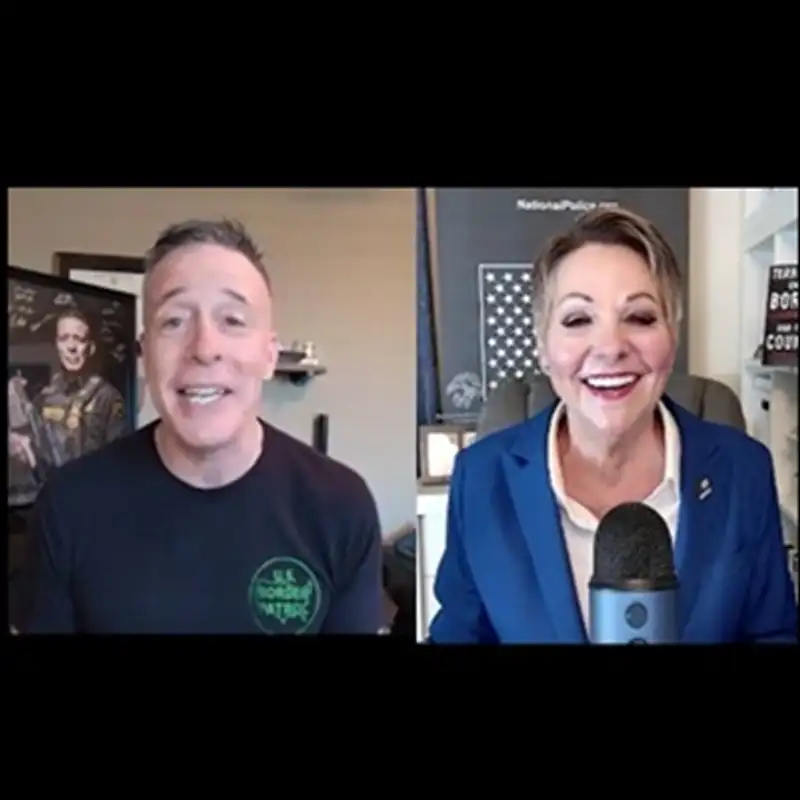
National Police Association Podcast Pt. 2 with Gregory K. Bovino, Commander-at-Large of the United States Border Patrol (Ret.)
Hi. This is Sergeant Betsy Brantner Smith with the National Police Association, and this is part two of our interview with Border Patrol chief Greg Bovino. And yet there's this narrative out there, and I hear this all the time, you know, from activists, you know, here locally in in Arizona and beyond that, well, you promised to only deport the worst of the worst. You know? And and that's just not true.
Betsy Smith:Can you explain that?
Greg Bovino:Sure. And the worst of the worst is something that's that has creeped into this conversation. Worst of the worst hey. We we do wanna take the worst of the worst. Hey.
Greg Bovino:The terrorists and the and the the child rapists, murderers definitely want them off the streets. Absolutely. No one denies that. But if that's all you go after, that's not on a mass deportation. That's a very specific and targeted approach, and that won't cut it when you're when you're looking at the numbers.
Greg Bovino:Look at the numbers that came in under Joe Biden. Tens of millions over those four years. Worst of the worst does not address those tens of millions or the other tens of millions that were here before, before the Biden administration. And, you know, when you go worst to the worst, do we have to wait for someone to harm or kill an American citizen before they then are into that worst to the worst category? I I I detest that line of thinking.
Greg Bovino:We need to go after them all now. That includes worst to the worst, but it also includes some of those other other individuals, all the other individuals that affect America in in many different ways. Like, say, take the flower vendor there on the street corner, maybe an illegal alien flower vendor. You might think, well, hey. That's not the worst of the worst.
Greg Bovino:What's wrong with him? Well, you know what? An American citizen business, a florist, is being hurt, undercut by that individual. Magnify that millions of times over and you start to see that illegal immigration is not a victimless crime. It's not a victimless crime.
Greg Bovino:It affects somebody somewhere sometime. Maybe that's why our affordability is is nonexistent right now in The United States. So, yeah, there's a, you know, a lot of different ways to look at this, but worst to the worst is really code word for amnesty. Because if you only go after worst of the worst, what happens to those other tens of millions of illegal aliens? If you're only going after the worst of the worst, what happens to them?
Greg Bovino:No one seems to want to talk about that, but we saw that back under the Reagan administration, amnesty. And when you bring amnesty to tens of millions of people, that then becomes a draw for tens of millions more wanting to come in with those family members, those friends, those acquaintances that are in The United States, and it's just a it's just a slippery a slippery slope that once once you go down, it's very difficult to recover. We've gotta do this now.
Betsy Smith:You know, the DOJ is really, they're trying to chip away legally at sanctuary cities, you know, litigation, things like that. What is the cost really of of sanctuary city policies when it comes to law enforcement, when it comes to being able to, deport people that need to go?
Greg Bovino:Well, they're they're trying to make it virtually impossible. I mean, look at Karen Bass in Los Angeles. She's giving free rent or money for illegal aliens to live in Los Angeles so that they don't have to to leave their residence because they might encounter Border Patrol agents. That's good and bad. It's good because we know we're having an effect.
Greg Bovino:But that that blue city, that blue state is actually, co opting criminals co opting criminals for more criminality. They're saying, hey. You know what? It's okay. What you're doing is okay.
Greg Bovino:And if that's okay, what else is okay? Again, it goes down that slippery that slippery slope. So they do make it very difficult. When an illegal alien goes to Chicago or Los Angeles and they say, right. This is a sanctuary city or sanctuary state.
Greg Bovino:We don't consider it that in The US border patrol, but they do. It becomes a draw. It's it's a draw. And that that makes our job infinitely harder when when there's two opposing sides to the law. One wrong, one right.
Greg Bovino:We're right. Immigration law, they're wrong by saying it's okay to come into the state illegally and be an illegal alien. So it's a it it makes the job a thousand times harder, plus it takes those state and local law enforcement officers, One of our greatest assets through history, as you said, Betsy, for the past hundred years, we worked together. And you take all of those out of the mix, it's no wonder Americans are being killed, maimed, raped, killed in drunk driving accidents or commercial driver's license truck drivers with commercial driver's license killing look how many people they've killed. It's it's it's atrocious.
Greg Bovino:So that's what you get with a blue state or a sanctuary city.
Betsy Smith:And isn't it true that that illegal aliens truly are sapping resources from American citizens? You know, you know, although we're told that illegal aliens don't they can't get welfare and they're, you know, not on Medicaid and, you know, things like that. We all know that's we all know that's not true. But they also take they take legitimate jobs. They take up spots in classrooms.
Betsy Smith:They take up beds in hospitals. You saw all of that firsthand. What's what's your messaging to get the working class to understand how their lives are being truly negatively impacted by illegal aliens?
Greg Bovino:Yeah. It it's the message is it's all sectors. It it doesn't just affect, you know, one small portion of the American population. And I think that's one of the that's one of the ways the the crazy news media and some of these crazy politicians have framed it that they're doing work that Americans don't wanna do, and it's just a few a few sectors of of the workforce that it affects, like maybe construction or picking fruit. Nothing's further from the truth.
Greg Bovino:What they do is they destroy what what I call the living wage. There are jobs out there that American citizens have done traditionally, would do now is just with this mass influx of millions of illegal aliens, most of whom are low skilled, they'll do the job for half or or less than half of what an American citizen will do it for. American citizen has to make a living to support a family, to make a house payment, a car payment, but you import cheap labor by the millions from foreign nations that'll do it for half or a quarter, an American citizen can't compete with that. So then it's a self perpetuating prophecy by the left. Hey.
Greg Bovino:You know what? Americans don't wanna do it. My gracious, we need even more illegal aliens. So it affects every single sector, whether it's that classroom that American children American citizen children are hurt in because now that the, the instructor, the teacher has to spend time with individuals that don't speak English, are not up to speed. What who does that hurt?
Greg Bovino:American citizens. So schools, hospitals, go to an emergency room and see what that's like now. An American citizen behind illegal aliens at the emergency room, that's unconscionable. And the re one of the reasons that that the emergency rooms came up was once we got to Los Angeles, Chicago, Charlotte, all those cities, folks would come up to us on the street, Sarge, and say, wow. You know what?
Greg Bovino:A family member, I had to go to the emergency room, and there was no wait. Just think about what that costs the taxpayer when illegal aliens with with with no insurance go to the emergency room. Just that alone. So it affects all sectors, all people throughout our society now. Imagine if all those individuals were removed via mass deportations, commutes into work, they improve.
Greg Bovino:Jail, schools, hospitals, everything improves not just a little bit, but dramatically. So talk about The United States flourishing without this this illegal cheap labor, unskilled labor. And, you know, I think you start to see the the the size of the problem, but the size of what happens if that solution's put into effect, how much stronger we as a society are gonna be.
Betsy Smith:One of the things that we hear from the activists and the media and the politicians is that every single one of these illegal aliens, is deserving of the full due process of the law. You hear due process all the time. Can you explain to people how due process is different for an illegal alien than it is for an American citizen?
Greg Bovino:Sure. We've got our immigration statutes and a lot of people don't realize this. There's really there's there's really two different ways that we address, folks that are in the country illegally. One is through a criminal statutes and that would be the due process part just like any American citizen, for instance, if an illegal alien murdered someone. Well, they're gonna have their due process, their day in court, that type of thing.
Greg Bovino:But then there's also the administration the administrative portion. There's administrative statutes of the INA. The INA is the Immigration and Nationality Act, the INA. And when something is in the administrative realm, what that's meant to do in a nutshell is it allows us to to apprehend or deal with these illegal aliens without having to go through a regular court process or a regular large scale legal process because those individuals are not citizens of The United States. So they they fall under those administrative those administrative rules and regulations of the INA, such as we can we can send someone right back across the border after we catch them.
Greg Bovino:Now how do we do that? Someone will say, well, that's not due process. Well, it is due process under the INA because that's what we do under the under the Immigration and Nationality Act. That's what that's the reason that the INA was enacted in the first place is so that we don't clog our court systems up, that we don't I call this lawfare now. The left loves to do this lawfare.
Greg Bovino:Let's just tie everybody up in court, and then no one gets deported. That's why we have the INA in the first place is so that we can utilize those administrative statutes to do what we need to do to remove illegal aliens. Another prime example would be someone that has a green card. A green card allows someone to come and go as they please from whatever the country they're from, allows them to work, reside, and be in The United States. Now to take a green card, we can take that green card if that if that alien, that resident alien commits a crime.
Greg Bovino:Say they commit a crime, say they they, oh, I don't know, rape someone. They might receive the due process at some point, but then those administrative statutes kick in, and we can take that, we can take that green card and deport them. Prostitution is
Betsy Smith:something the activists say, oh, you can't do. They were here, you know, illegally. I mean, they were here legally. They were here with permission. You know, we hear a lot of that that that, the border patrol and ICE are overstepping their bounds when it comes to people's, you know, quote, unquote, legal status.
Betsy Smith:That's just not true. Right?
Greg Bovino:It's not. And, yeah, Betsy hey. Betsy, are are you an illegal alien? See, I just asked you the question. You it's a simple question.
Greg Bovino:You know, I can ask anyone that. And if you give me an indication that you are, then you you fall under that administrative statute immediately. Those administrative statutes, I'm going to arrest you and deport you or return you back to back to your country, maybe a voluntary return, many different pathways to go back. So that that's a prime example. A consensual encounter in a large city in America, I can consensually encounter anyone just like a police officer can talk to anyone for any reason that they want to.
Greg Bovino:I'm not saying detain someone. I'm saying talk to someone. And, you know, that that's purely administrative. That's not violating anyone's rights. It's never been violating anyone's rights.
Greg Bovino:That's just United States law. And, you know, for someone to say that I can't talk to someone, well, I just talk to you, Betsy. Hey. How are doing, Betsy? Hey.
Greg Bovino:Where are you from? That that's not illegal for me to ask that. I will ask that. And if someone thinks that's a, you know, a violation of someone's rights, well, you know, I'd like I'd like for them to prove it to me.
Betsy Smith:You know, there has been an absolute unprecedented war on, CBP, on on border patrols, on ice ages. They have been not just demonized and vilified, but literally dehumanized to the point where attacks, physical attacks on agents have just gone through the roof. And yet you see people on the activism side and sometimes on the political side literally cheering on the the attacks on agents and the the the physical injuries, of agents. Talk about how demoralizing that is for line level personnel, not to mention leadership.
Greg Bovino:Yeah. I've never seen anything like it. And once we got into those cities and I realized the the scope and depth of of this violence. It was every day unrelenting, every minute that those border patrol agents and ICE officers were out there. It was every minute of every day.
Greg Bovino:And I'm not talking just a physical attack, like a punch being thrown or or a a brick being thrown, but I'm talking attacks with vehicles. That was, one of those tactics, and I call those cartel tactics, that we started to see, and it was actually pretty alarming that that folks were using vehicles as weapons. And it started there in Los Angeles and then spread to other cities, and it was every day. And the reason I know this is every single time I was out there with Border Patrol agents is it happened to me. It happened to them constantly.
Greg Bovino:So that level of violence was unrelenting, and it was a it was, you know, a high level of of of some very difficult situations. And, again, a lot of this was perpetrated by community leaders or politicians or, you know, some of these folks that that were able to appeal to some of their weaker minded constituents. And, unfortunately, it happened so much that, you know, our agents had to develop tactics. They had to develop an awareness of what was coming their way from the moment the moment they stepped out on patrol till till till they stopped the patrol that day. And, yeah, yeah, that was definitely, you know, you've got agents now that have returned from from those operations that are you know, their head's still on a swivel.
Greg Bovino:They're they're still in they're still in the red zone. And you do that for long enough. And I'll tell you what, it was a it it it definitely is a it's tough to deal with, but we did have some very highly trained our agents are are trained fantastically. And the other thing that a lot of the viewers might not realize is a lot of this stuff did happen on the border for for many years. We had a lot of there's been a lot of violence on the border.
Greg Bovino:A lot of that goes unreported. So our agents are a pretty rugged workforce, so they were able to deal with it. But every day like that and then having politicians and, you know, activists, spurring that on definitely was a was a concern to our agents. Absolutely.
Betsy Smith:What I gotta try and bring it back to a little optimism here before we end. What what do you think you know, we really feel all this lawlessness pressing in. Right? You're average American citizen. And what how do you feel about what it's gonna take for a return to to law and order, to sovereignty?
Betsy Smith:You know, we're we're literally the only country in the nation that just is is, that has these ridiculous border issues internally where we're literally eating our own. What do you think it's gonna take to to return to some normalcy, some law and order, some sovereignty when it comes to people who are here in our country illegally?
Greg Bovino:Sure. Well, to to be, to have an opt you know, ending this on a good note, as you say, I think that, the the the good part about that is we have the means and the capability to stop this problem immediately. We can do that. You you know, Carl Van Clausewitz, that that famous military strategist once said that the most advanced societies produce them as brilliant soldiers. Same thing with our police officers and law enforcement.
Greg Bovino:The brilliance out there, our creativity and innovation, our American exceptionalism, that hasn't gone away. So let's think about it in terms of that, Betsy, is just think about once we attain that willpower to do the job, we can do the job. Doing the job is not a you know, that that's not that big of a problem. Look look at what we did with 250 Border Patrol agents in those cities. Remember that was 250 Border Patrol agents, and we were shutting entire cities down.
Greg Bovino:When I say shutting down, I'm talking about the illegal alien and transnational criminal threat populations in those cities and then causing self deports. That operation was was, our intent was for that operation to to grow exponentially with thousands of border patrol agents, thousands of police officers, two eighty seven g, and that total spectrum immigration enforcement. So when you think about it in terms of bringing that to bear, we can win this. So, we should all be optimists in terms of can we win it because we can. American exceptionalism will we're not gonna lose.
Greg Bovino:Americans don't lose. It's just that willpower. We've got the president in there that I think if he's advised correctly, that he will pull the trigger on that. He he he would well, he already did. I mean, look.
Greg Bovino:We we were there for a year on a small scale, not not the scale that that that we wanted to be, but we were there. It's just, you know, having the correct advisers advisers advising advising the the president. And if you ask me, would there have been anything I could have done different or would wanted to have done different, that would have been for me to brief my strategy in full straight to to president Trump himself. That's something that if I had to do over again, I would have sat in front of him. You know, he got the strategy, I think, in bits and pieces the way his advisers wanted him to get that strategy, but he needed the full monte to see how we were gonna do it, when we were gonna do it, timelines, and how we're gonna deport a 100,000,000 people.
Greg Bovino:I think once Trump sees that, that it it, you know, it would click it would click with him, and and he would actually do that. So I'm I'm an optimist in terms of, is this gonna happen? I think it will because there's too much at stake for it not to.
Betsy Smith:Lastly, what would you say to somebody who's in high school or college or maybe a small town cop somewhere and is thinking about, you know, broadening their horizons and and joining the Border Patrol? What do you say to them?
Greg Bovino:Join the Border Patrol and save America. Oh, absolutely. Yeah. It was, you know, it's been thirty years since I joined. And, at least for the Border Patrol, and I'm sure it was, it's like this for police agencies nationwide, is you're not gonna be disappointed at what you find there with the folks that you work with and the fantastic supervisors that you're gonna that you're gonna meet and work with and most especially that American taxpayer.
Greg Bovino:Those taxpayers, they depend on you, they love you, and they'll tell you so. And I think once you get embroiled in that, enmeshed in that, you're gonna see that the the profession of public service is one that is very rewarding, and most of us can't think of anything else we would rather be doing. I can't. If I had it to do over again, I think I would have tried to find a some type of a potion that could double my lifespan so that I could spend double the time in The US border patrols. So if I was if I was 20 years old, oh, what I would give to to join up again and and be with that Mean Green team.
Greg Bovino:They were the best. Same thing with all police nationwide.
Betsy Smith:Absolutely. I'll tell you, Gregory Bovino, I cannot thank you enough for for taking all this time with us. Tell folks where they can find you, how they can follow you, how they can catch up with you, and and follow you as you navigate the next chapter.
Greg Bovino:Alright. Well, it's Gregory k Bovino, and that's on x. I haven't got my Instagram and Facebook handles up and running yet, but I am on x. So follow me there, Gregory k a Bovino on x, And, I'd like to hear I love I love when people message me with ideas about, hey. This is what I wanna hear.
Greg Bovino:Sort of like what you did today, Betsy. So let's talk. Let's, dial into the the tough issues, and, we're we're gonna win this.
Betsy Smith:Absolutely. I think together, we can save this country. Thanks again for being with us. And if you'd like more information about the National Police Association, you can visit us at nationalpolice.org.
Narrator:Every day, the brave men and women of law enforcement put their lives on the line to keep us safe but they need our help to continue their mission. Activist politicians, progressive prosecutors, the ACLU and the rest of the anti police forces receive millions in donations from extremist pro criminal elements like George Soros and woke corporations. The National Police Association is fighting them in courts around the country including the United States Supreme Court defending officers who are being attacked for doing their jobs. Additionally, the National Police Association works year round to pass tough on crime legislation to put and keep criminals behind bars. Consider going to nationalpolice.org and donating to keep us in the fight.
Narrator:Together, we can win. That is nationalpolice.org.