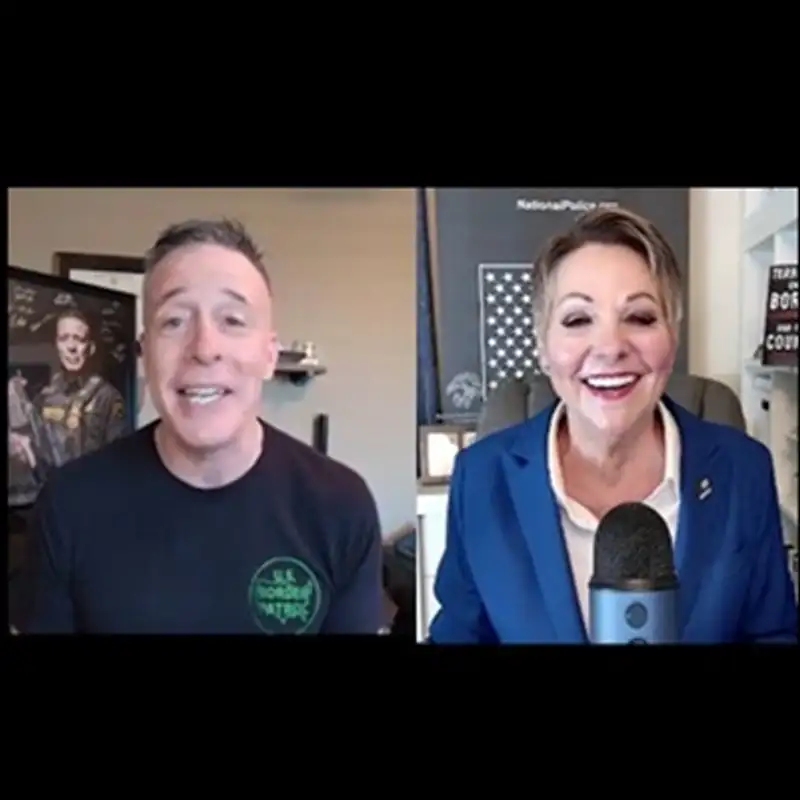
National Police Association Podcast Pt. 1 with Gregory K. Bovino, Commander-at-Large of the United States Border Patrol (Ret.)
Hi. This is sergeant Betsy Brantner Smith with the National Police Association, and this is the National Police Association Podcast. I have a guest today that, you know, it sounds so cliche, but he know he needs no introduction. We reached out to, Gregory Bovino, very recently of the United States Border Patrol. This is a guy who has been everywhere when it comes to illegal immigration and public safety inside of The United States.
Betsy Smith:And we really wanted to get him on this show. First of all, to congratulate him on his retirement and, and see what he's up to, but but also ask him to help us understand what is happening with immigration and deportations here in The United States. Sir, welcome to the show.
Greg Bovino:Well, Betsy, thanks for having me, and it's good to be here.
Betsy Smith:So I'm gonna ask you the question I ask everybody who is in law enforcement and and comes on this show. Why'd you become a cop?
Greg Bovino:Well, I had some excellent experiences as a youth with cops. It had to do with snowballs. There in Western North Carolina, I thought it would be a good idea one time to throw snowballs at cars, except I hit sergeant Taylor's patrol car with a snowball. And old sergeant Taylor was a little faster than I was. That was probably about 1978, '79, something like that.
Greg Bovino:And we had a long talk, and I'll tell you what. It it I was very impressed even at a young age with law enforcement and the way they did things and the way they actually cared about society. And then fast forward to the US Border Patrol, I like to that let's care about society kinda thing, do a little bit do a little bit for the public for the for the public morality, the public virtue, that type of thing. But let's do it maybe with the US Border Patrol. A little hint of adventure there with US Border Patrol as well, sort of the Wild West many years ago.
Greg Bovino:And I put the application in and joined, but that started way back in the seventies with the snowball.
Betsy Smith:That is a fantastic story. So so you joined the Border Patrol in 1996, and then, you know, you worked your way up. And in, 2020, you ended up in El Centro, California, which is a a sector that I'm really familiar with. And and talk to me about the leadership principles that that that drove you when it came to working right on the border, the Southern Border of The United States and Mexico?
Greg Bovino:Sure. The, well, as far as leadership in the US border patrol, you know, one of the things I think that influenced me there on the border is the fact that for many years, as you know, Sarge, excuse me, the US Border Patrol was, you could say the redheaded stepchildren. They're the federal government, often underfunded, sort of America's secret there on in the Southwest there that no one really paid attention to. So, therefore, I thought it was much more important to get through those lean times, those tough times via leadership because leadership can boy, it can really have an effect, good or bad, on on a mission and most especially on our most precious resources, and those are the Border Patrol agents. So as I joined the Border Patrol in '96 in El Centro sector and then climbed the ranks and became a first line supervisor in approximately 2002, and I thought, you know, let's provide leadership to these these men and women that are out there giving it their all with nothing.
Greg Bovino:You you know, that was before the days of, remote video surveillance cameras, drones, ground, the the really good ground detection sensors that we have now. They did it on their own. So let's support those folks, and let's lead those folks and make them successful in a very difficult mission. So, you know, I think that lack of resources back then was something that that really spoke to the need for good strong leadership that would stand up for agents that might not otherwise have a voice or have good leadership.
Betsy Smith:You know, I'm glad you said that because you have said that that it's been your great honor to serve along alongside those agents who are doing an incredibly difficult job with that lack of resources. You know, if you listen to the media now, you think that border patrol are are running around in helicopters and and everybody's got a personal drone and this and that, and yet and yet nothing could be further from the truth. Right?
Greg Bovino:Exactly. And that that speaks to those vacillations of politics. You know? There are some political regimes that come in that are actually pretty good to the border patrol. Donald Trump, for instance, hey.
Greg Bovino:He wants to fund us. He wants to give us the equipment, the manpower technology, all this good stuff. But look what happened. Trump '45, and then all of a sudden Biden came in and took it all away. Not only did he take it away, he took more away than than what we had, and it made it actually worse.
Greg Bovino:So these vacillations of politics, definitely affect the border patrol perhaps more than any other federal law enforcement agency. And that's bad, Sarge, in many ways. But but in some ways, that makes our workforce more resilient, doing more with less in difficult times like that. So it's not all bad. If we don't have all the best equipment, or the best funding, we make do sort of the marine corps or federal law enforcement, I guess you could say.
Greg Bovino:And it does make our men men and women more resilient. And when I say I like, my greatest pleasure is serving alongside those Border Patrol agents. That's one reason why is that resilience, that, that spirit there on the border, wow. That's a it motivates me as a leader, actually. I actually get motivated by them.
Greg Bovino:And, hey. You know, if we don't have brand new Tahoes to drive, well, you know what? We're still gonna get the job done, and it's that Border Patrol spirit that that does it. So it's, again, our most precious resource. That's the agents.
Betsy Smith:So here you are. You know, you're you're a cop. You're a boss. You're doing your job. And then all of a sudden, you are thrust into really the international media, and you're you're running these operations in in Minneapolis, in in Texas, in LA.
Betsy Smith:And and so you're not just dealing with that, but you're also the subject of all kinds of vitriol. And and there's there's a go everybody go online and look at all the Gregory Bovino memes that are out there, good and bad. You become this incredible larger than life figure. What what was that like?
Greg Bovino:Well, you know, honestly, I was so busy, Sarge, that a lot of times I didn't even have time to to really take a look at that nor delve too deep into that. A lot of times I don't take myself very seriously anyway. So so, yeah, I I knew there there was obviously a lot of media, as you say, a lot of vitriol, especially by those politicians. I did key in on that because when you have a governor Newsom or governor Pritzker or all those crazy mayors that are impugning or saying bad things about my border patrol and my agents, we're we're gonna have a problem. We're we're fixing to have us a problem, immediately.
Greg Bovino:So I did key in on some of those things, and one of the things I wanted to do was set the record straight as best as I could. We had a very strong social media, platform or several platforms, Instagram, Facebook, and x. And a lot of people said, wow. You've posted some really, some really strong messages or videos or things like that. Well, we meant to do that.
Greg Bovino:Betsy, we meant to do that. There's a reason for that is when you have a Pritz or a Newsome saying border patrol agents are Nazis or or whatever the whatever they were saying, and they said everything. They said everything under the sun. It was it was amazing. It was breathtaking.
Greg Bovino:But, let's put let's put the truth out there. Let's, let's key in on that, and we'll push them back on their heels. So I think that one of the things that that I wanted to do there in the face of all that was push them back on their heels. And the way to do that is, one, tell the truth because a legal, ethical, and moral law enforcement mission is a truthful mission, and it's awfully hard to argue with the truth. There's two court decisions, the supreme court there in Los Angeles on consensual encounters, and then the seventh appellate court victory on our use of force in Chicago, that really put them back on their heels, and I let them know it.
Greg Bovino:But don't don't mess with our fellow police officers, and I know you probably felt the same way when you were in the police force. Don't don't mess with those folks out there putting it on the line every day because then you idealize people like me, and I'm not the person you wanna idealize because I'm gonna come really hard. And that's one of the reasons that that I did come pretty hard there in social media.
Betsy Smith:How difficult was it to to you know, you're just trying to do, do your job, have your people do their jobs. And you've got not just the the, you know, the nutty protesters and and things like that, but you literally have the media working against against you. You have all the politicians you named and more working against you. And for a period of time there during the especially during the Biden administration, you literally had your employer working against you with things like the CBP one app and and, these parolees, as they call them, who only, what, 70% of them were even doing the reporting they were supposed to. You know, did you did you and your people seem like an island there for quite a while?
Greg Bovino:Yes. In many ways, that that's correct. You know, the two front war is never the war that you wanna fight on two fronts. We wanna fight the bad guys. All cops, all Border Patrol agents, we wanna fight the bad guys.
Greg Bovino:And that's what we should be fighting is the bad guys. And but when you have to fight the good guys that are supposed to be, well, your support, it does make it a lot more difficult. That's where you the leadership principles you were talking about come into play. I had a very strong staff in the El Centro sector, strongest border patrol staff that I've ever that I've ever had the pleasure of working with. So, we'd worked together for many years because I I actually stayed in El Centro as a chief patrol agent generally a lot longer than most chiefs are able to stay.
Greg Bovino:Probably because of Biden, he didn't want me anywhere else. Thought they would contain me there. So what that did is it allowed us to to to to train that staff up. We were all on the same sheet of music. So when you have a very strong staff and then that trickles down to those line agents, those border patrol agents working the line.
Greg Bovino:When we're in close concert working together like that, whether it's on the whether it's on the on the border or in the middle of Minneapolis, we're on the same sheet of music. And that coupled with the fact that it's always important for the leaders to take these heat rounds. We'll just let's call them heat rounds. If there's heat rounds coming from the good guys, the Biden administration, they they they relieve me of command at one point. Or that crazy media in Chicago or Minneapolis, there's someone that needs to take those heat rounds and take them gladly for that workforce.
Greg Bovino:So my staff and I, we tried to shed a lot of that heat so they could only have to worry about going out and doing that job, doing that immigration mission, whether it was on the border under that the crazy Biden times, that catastrophe, the millions coming across, or in those cities. We learned a lot there on the border under Biden. We learned a lot. And all kudos to my staff because they learned a lot, and they turned that right around, took it to the interior, and applied those lessons that we had already learned over those past four years. So, yeah, two front wars are are are never optimal.
Greg Bovino:Hey. We're still fighting a two front war, Betsy. I mean, look at look at some of the politicians now, the things they're saying. Look at what Chuckie Schumer said here, last week. I mean, he said, hey.
Greg Bovino:The American public hates the hates ICE and the border patrol. And then all of a sudden, the president is somebody's trying to shoot the president. People listen to those words. And I think more than anything, the Border Patrol agents there in the cities were like, you know, these politicians are causing this to happen. The Chuckie Schumers are causing this to happen.
Greg Bovino:And then even some of these politicians that remain silent, I call those RINOs. You know, I didn't hear, Tom Tellis or represent representative McCall from Texas or that Joe Kennedy from Louisiana saying anything while we were while we were fighting the two front war. But they came in on that backside and then had some rather distasteful things to say about border patrol and our operations. So two front wars, not a good scenario. But like any law enforcement anywhere that whether Chicago PD, US Border Patrol, we're gonna complete the mission, and we're not gonna complain about it.
Greg Bovino:We're just going to stand too and do it.
Betsy Smith:I think one of my biggest frustrations is this forced separation of local law enforcement, state law enforcement, county law enforcement, and our federal partners when when American law enforcement officers have worked so well for decades and decades with federal law enforcement in places like Chicago and and Minneapolis. What was that like to see, especially, you know, in a place like Minneapolis where where those men and women have been so wildly vilified, And and then you guys are there trying to help them, and and yet they're they're basically separated from you.
Greg Bovino:Yeah. It you know, that's a travesty. What a travesty of our times. What a travesty against The US taxpayer. Those the rank and file board of attorney agents and the rank and file police officers and sheriff's deputies and law enforcement, we've always gotten along as you as as you well know, sergeant.
Greg Bovino:We've always gotten along. We've always supported each other. We'll roll the cavalry for any law enforcement anytime. But one of the things I want the the viewers to know and and and all the police associations out there to know is that they still had our backs. And I think if something really, really bad had happened, they would have had our backs.
Greg Bovino:We had their backs. I I can't count the amount of times that the rank and file would come up and say, hey. You know? Hey. We're sorry.
Greg Bovino:We support what you're doing. You're helping the community. The crime is, like, plummeted in places like well, everywhere we went. LA, Chicago, Charlotte, New Orleans, everything. So every time we talk to to to local law enforcement, oftentimes, would have to do that in the shadows.
Greg Bovino:They would have to actually talk to us in the the shadows for fear of those politicians, those city council members or county or commissioners or or, or whoever these politicians were that would actually see them talking to us. But you know what? They made it a point to talk to us, and we made it a point to talk to them. A lot of challenge coins passed back and forth between local law enforcement and US border patrol in those cities. So, like like we said in those cities, Sarge, those are our brothers and sisters in blue, and we always have their back.
Greg Bovino:They've got a tough job, almost a tougher job than us because guess what? They're up against the same that same type of out of control activist activist politicians that, hey. It might be immigration one day, but you know what? They're on those cops the next day for something else. And they've got a inhumanly tough job in those blue cities.
Greg Bovino:But we saw eye to eye and, you know, superintendent Snelling there at Chicago PD. We talked a lot on the phone, and he was a cop's cop. Old Snelling was a cop's cop. Yeah. And he said, hey.
Greg Bovino:If you need something, we will roll the cavalry, and I'll just do it myself. I respected that a whole lot from from Snelling. He's a good guy.
Betsy Smith:Well and you made at least 3,200 arrests there for operation mid Midway Blitz. And but people people listening to this are are saying, you know, most people voted for mass deportations. What is that going to take from a logistical point of view for the American public to see these mass deportations really really take hold.
Greg Bovino:Yeah. Mass deportations are the key. First and foremost, everyone has to realize that mass deportations are the key. If we if we keep scratching the surface, we'll never get there. With tens of millions I my my number's a 100,000,000 illegal aliens here in The United States in all cities, all regions, whether it's a rural environment or the city, they're everywhere.
Greg Bovino:They fill our jails, schools, hospitals, take social services, cause rents to soar. They hurt our affordability. All sectors. So because they affect all sectors, all sectors need to affect them, and I call that total spectrum immigration enforcement. Total spectrum, that is everything everything being brought to, to the forefront of of enforcement.
Greg Bovino:But not only enforcement, but there there's there are many other areas that we can delve into that we haven't. And I've said this often, but the grassroots the grassroots being Mal and Paul America, the the grassroots being the million police officers nationwide. Could you imagine, Betsy, if we were able to bring all the two eighty seven g two eighty seven g is the, the immigration statute that allows state and locals to enforce some immigration laws. Imagine all the two eighty seven d's that we could bring into the fight nationwide in earnest with the police officers. Imagine mom pom Erica actually calling a nice tip line that worked and treating that like a call for service just like it would be a 911 call or a call for service in a in a city or or or or wherever.
Greg Bovino:Imagine that that that true whole of government approach, but it needs to be even more than that. You know, bringing in our grassroots is so very important, so vital to make making that happen. So it's gotta be everything all at one time. You know, you may hear, hey. We're gonna go after folks at the worksite, worksite enforcement.
Greg Bovino:Well, you know what? If you rely on any one tactic, then then you're not seeing the larger picture here. It's all tactics. It's one giant war. Anything that we can bring legally legally, ethically, and morally into this fight, that's how we win it.
Greg Bovino:And then those self deportations. So vitally important. We started that in Los Angeles, Chicago, and New Orleans, especially New Orleans. And those self deportations are key. So let's have them deport so we're not putting handcuffs on a 100,000,000 people.
Greg Bovino:That's that's a that's a a lot of people to arrest. Let's have them do it themselves. Total spectrum immigration enforcement does that. It causes that mass deportation to happen. And, you know, there's so many different tactics and strategies that can be brought together at one time to do that.
Greg Bovino:So we're gonna have to do that, and it's called willpower. Do we have the willpower to do that? You know what? The 90% of Americans that I've talked to on the ground in places like Minneapolis, Chicago, talking to people like you, Betsy, we do have the willpower. It's just there seems to be a vocal a very vocal small minority, whether that's, you know, extremists or activists or even some of those politicians that don't have the willpower.
Greg Bovino:But 90% want it. We need to start now because the time's getting late.
Betsy Smith:Thanks so much for tuning in to part one of our fascinating interview with border patrol chief Greg Bovino. Don't miss part two. And in the meantime, if you'd like more information about the National Police Association, you can follow us on Facebook, follow us on X, follow us on LinkedIn, and of course, you can go to our website at nationalpolice.org.
NPA:Every day, the brave men and women of law enforcement put their lives on the line to keep us safe. But they need our help to continue their mission. Activist politicians, progressive prosecutors, the ACLU and the rest of the anti police forces receive millions in donations from extremist pro criminal elements like George Soros and woke corporations. The National Police Association is fighting them in courts around the country, including the United States Supreme Court defending officers who are being attacked for doing their jobs. Additionally, the National Police Association works year round to pass tough on crime legislation to put and keep criminals behind bars.
NPA:Consider going to nationalpolice.org and donating to keep us in the fight. Together, we can win. That is nationalpolice.org.