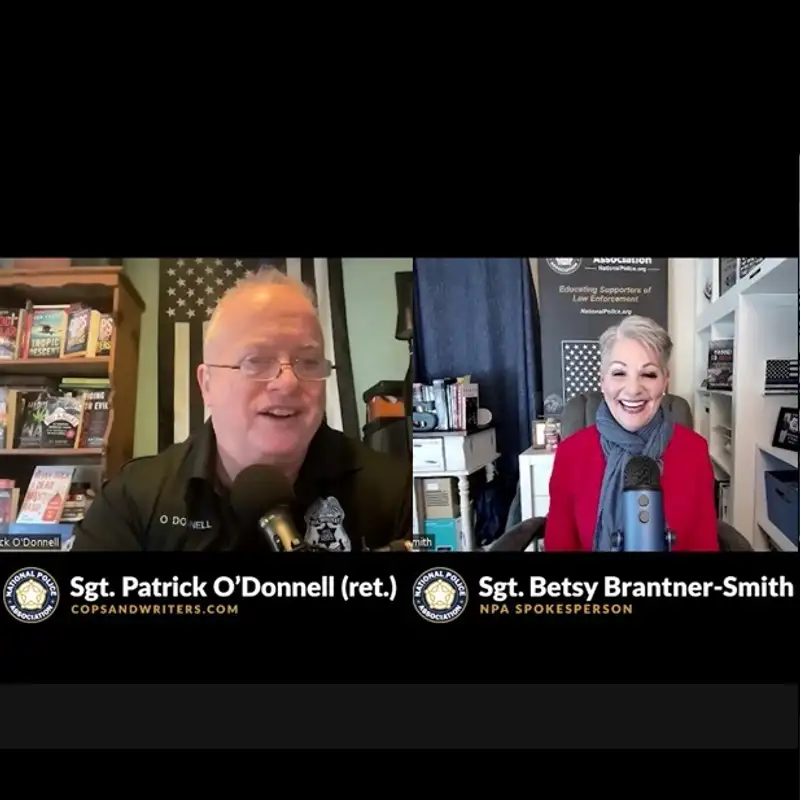
NPA Report with Guest, Milwaukee Sgt. Patrick O’Donnell (Ret.) Best Selling Author & Writing Coach
Hi. This is Sergeant Betsy Brander Smith at the National Police Association, and this is the National Police Association podcast. I have a guest with me today who is an amazing prolific writer. I too am a writer, but this guy, you know, I write articles about, law enforcement and officer safety and leadership. This guy writes incredible books.
Betsy Smith:And, not only does he author books and by the way, he's a super popular author on Amazon, but he also has a really interesting podcast. So I thought that you needed to meet him. So Sergeant Patrick O'Donnell, welcome to the show.
Patrick O'Donnell:Thank you so much for having me.
Betsy Smith:Hey, Sarg. I gotta ask you. We were just talking about this off the air, how sergeant is the best job in any agency. And and, of course, we do the most work, don't we? Absolutely.
Betsy Smith:But I gotta ask you what I ask everybody who's in law enforcement who comes on the show. Why'd you become a cop?
Patrick O'Donnell:Well, I'm first generation Irish, so I didn't have much choice. Either I become a cop, a firefighter, or a politician. I hate politics. I don't like heights. So as default, I guess I'm I'm destined to become a police officer.
Patrick O'Donnell:Right? Well, I was born in Chicago, and as a wee lad, you know, I was fascinated by the Chicago coppers going up and down the roads with the blue flashing lights. You know, I always thought it was super cool as a little kid. And I had a moment where we moved to the suburbs, and our neighbor's house was getting raided. They're, like, executing a search warrant on our neighbor's house.
Patrick O'Donnell:And I was, like, maybe, I don't know, nine or 10 years old, maybe a little bit older. And I remember it like it was yesterday because you see the stack, you know, coming of these, like, SWAT officers. There's two of them in our backyard. One's got an m 16 and the other one's got a shotgun. And I'll never forget it.
Patrick O'Donnell:I'm like, mom, mom, look at this. You know? And they're creeping up on the side door, and our kitchen window was perfectly you you had a clear view of what's going on. All these houses are super close to each other. And my mom was like, oh, Jesus, Mary and Joseph.
Patrick O'Donnell:What's going on here? You know? So the you know, they got the shield. They got the ram. They'd ram down the door.
Patrick O'Donnell:They're pulling people out by their hair, and I'm like, this is the coolest job ever. I gotta do this for a living. Oh my god. They get paid for this? You know?
Patrick O'Donnell:And I'm like, this is crazy. So, you know, obviously, you know, was born in '64, so, you know, Adam twelve, Swat, Starsky and Hutch, Beretta, you know, all these really the Rockford Files, Columbo, all these awesome movies. Favorite shows, Pat. Yes. Oh my god.
Patrick O'Donnell:We were so lucky we grew up in that era. Absolutely. You were exposed to these TV shows. I mean, yeah. Were they corny?
Patrick O'Donnell:Of course. Was the procedure right? Adam 12 was probably pretty close. You know? But there was, like, no almost no humor in that.
Patrick O'Donnell:But, hey, it was it was fun to watch, and I I just thought it was cool. Then fast forward years by, I'm in college. I started as a music major, and that did not work out. And I'm like, well, I still have the police bug. I did an internship with the sheriff's depart sheriff's department in Milwaukee, and I was hooked.
Patrick O'Donnell:You know, back then, I mean, it was funny because it was between Madison and Milwaukee. I interviewed with Madison, and they're like, well, most of our interns are Rhodes Scholars. I'm like, that's not me. I got kicked out of college twice. Are you kidding me?
Patrick O'Donnell:Well, we want you to write, you know, at least six research papers. You know? But I'm like, I'm looking at this guy, and I'm like, am I gonna get to ride around and do cool police stuff? And he's like, what are you talking about? You'll be behind a desk most of the time.
Patrick O'Donnell:I'm like, oh, no. That's not me. So then I go to Milwaukee, and it's like, yeah. You might have to write one paper at the very end, and you're just gonna I'm gonna put you in the jail right away. You're gonna be right next to the deputies.
Patrick O'Donnell:You're gonna do everything the deputies are doing except for arresting people. And I'm like, sign me up. This is cool. Well, this is back in '86, and it was literally the Wild West, and the crack wars were full throttle. It was just Crazyville, USA.
Patrick O'Donnell:And I just had a blast. I thought it was the coolest thing ever. So I'm like, yep. Gotta do it.
Betsy Smith:I love it. So so here you are. You're in Milwaukee. And, I mean, you know, that was just as busy in the eighties as it as it is now. And tell us a little bit about your career.
Betsy Smith:What what was your favorite assignment?
Patrick O'Donnell:Boy, that's hard to I started in patrol like everybody else does, but I didn't know the city of Milwaukee. I was living in Madison at the time. I went to University of Wisconsin Whitewater. I lived in a little town. My parents moved us from Chicago to Fort Atkinson, Wisconsin, a ton of 10,000 people when I was a freshman in high school.
Patrick O'Donnell:So I felt like I landed on Mars. I mean, it was just where the hell am I? You know? This is crazy. So I wound up going to college in Whitewater, moved to Madison, and, you know, I'm I'm armed with a sociology degree, so, you know, I was qualified to be a restaurant manager.
Patrick O'Donnell:I used car salesman, a bartender. You know, I did all those things because it was really hard to get a police job back then. Know, You affirmative action was full steam ahead. You know, city of Milwaukee, you you each academy class had to be 25% majority male, 25% minority male, you know, same thing with females. And when I took the test, there was, like, 4,000 people, you know, for I don't know how many positions, and I was on the waiting list for four years.
Patrick O'Donnell:So sorry to digress, but, yeah, that that was a tough time.
Betsy Smith:People yeah. I'm glad you brought that up because people have no idea. I was recently talking to a reporter about police recruitment, and and and I was I was telling them that thousands of applicants would show up to test for pretty much any major city or suburb in the nation. Yes. And and they were stunned they were young, so they were stunned to hear that.
Patrick O'Donnell:Oh, absolutely. So, you know, I'm on the waiting I was on the waiting list for four years to get into the academy. So I finally get in. I get assigned to District 5, and I didn't know Milwaukee, and, you know, there's no Google whatever or there was no GPS. So our last day at the academy, they gave us the afternoon off to go to our work assignment.
Patrick O'Donnell:And I'm driving around, and I'm like, well, I'm from Chicago. I know what a bad neighborhood looks like, and this that's where they're sending me. You know, there's this the block where the district station is, it looks like, you know, a concrete freaking, you know, like, bunker. And there's, you know, houses that are all boarded up or there's no house there. There used to be a house there, you know, vacant lots, and it just looked horrible.
Patrick O'Donnell:You know, there's garbage everywhere, and it's just it's just icky. There's no nicer way to put it. And I didn't know it at the time, but I was blessed to go there because it was nonstop action. You know, as a new cop, you're just like, every night was some kind of shooting. Every night was some kind of chase.
Patrick O'Donnell:Every night it never stopped. So I worked there for about seven years on late shift, working midnight to eight as a
Betsy Smith:That's a rookie's dream.
Patrick O'Donnell:Oh, it should be. Yeah. It should be. It's not for everyone. I I'll say that for sure.
Patrick O'Donnell:But for me, I thought it was awesome. I I couldn't have been happier. Not that people were getting hurt or killed or anything like that, but the excitement of all of it. And the only way you're gonna learn any police job is to actually do said police job. Get roll up your sleeves and do police work.
Patrick O'Donnell:It's as simple as that. You know, it's like chasing cars. Something as simple as that. You know, it's like you get better as the more cars you chase. It's it's a diminishing skill that if you don't keep that up, people are gonna get hurt, and bad stuff is gonna happen.
Patrick O'Donnell:So you need you actually have to do it. You know? There's no yes. You can have training. You can eat Evac.
Patrick O'Donnell:You can go around racetracks with cones and whatever else. Nothing replaces, you know, 03:00 in the morning in a highly congested urban area, you know, where you're going after some guy who just shot at you or shot at a cop or whatever the case may be, or a stolen car. Who knows what? So I was super happy that I was there. Then the chief of police was Arthur Jones at the time, highly controversial.
Patrick O'Donnell:And he decided to mix it all up, and he transferred half the department. There was, like, almost 2,000 cops. He transferred half of us in one order. I'll never forget. My partner calls me.
Patrick O'Donnell:I'm working third shift. He calls me, like, at noon. Dude, are you up? And I'm like, no. But what?
Patrick O'Donnell:And he's like, dude, you've been transferred. I'm like, what? He says, yeah. You wouldn't have to shift. And I'm like, ugh.
Patrick O'Donnell:Alright. Where am I going? District 3. Well, it's right next to it. It's the same ghetto.
Patrick O'Donnell:It's the same everything. Yeah. It just it just different geography. You know? It's the same same calls, same everything.
Patrick O'Donnell:I did that for a year, then I took the promotion, test, and I became a sergeant. They send me to the South Side, so I start back there again midnight to eight. So where I worked, if you became a sergeant, you got knocked down in seniority. So city of Milwaukee, there's 200 sergeants for the city. So guess what?
Patrick O'Donnell:Now I'm at the very, very bottom. You know? Like, alright. Well, I guess I'll be working nights forever, but, you know, so be it. Whatever.
Patrick O'Donnell:So I I was on the South Side. I worked there. Then I got late power, which was 7PM to 3AM, and that was awesome because a lot of my cars were nonassignment taking cars where they weren't chasing the radio all night, where it's like, okay. I have an anti armed robbery car. I've got a tavern car.
Patrick O'Donnell:I've got and I'm in charge of all these. You know, we had an AGU as an anti gang unit. So I got to do some of the high speed fun stuff where, again, where you're not, like, chained to the radio and you're just answering 911 calls all night long. So I was able to do that, then got a bad divorce, had to go day shift after seventeen years of work at nights, and they sent me to the slowest district in the city. I thought I was gonna lose my mind.
Patrick O'Donnell:Oh my gosh. That was not fun. But I learned to appreciate it because the victims there were, I hate to say it, real victims. You know, the people committing the crimes didn't live in those neighborhoods. And, you know, you're talking about the pregnant housewife that gets carjacked, and then the asshole has to kick her in the stomach a couple of times just for good measure.
Patrick O'Donnell:So you're dealing with that. And it's like, oof. So you actually felt like you were, like, accomplishing something, you know, when you were getting bad guys. So I had a I did that, and I thought I'd ride out my career there, but I did not. I got sent back to District 2 for my last year and a half where I started as a sergeant.
Patrick O'Donnell:And the neighborhood quickly devolved. It was it was just as bad as the North Side, and that's where I pulled the pin, and that was the end.
Betsy Smith:So when did you decide, and what made you decide to sit down and write a book?
Patrick O'Donnell:You know, it's funny you mentioned that. I had zero intention. And if you knew me in high school or college, I'm the last guy in the world. You think I'm not some scholar. I'm not some I wasn't born with a typewriter in my hand.
Patrick O'Donnell:You know, mom was very happy about that. But, you know, it just what happened was, like I said, you know, I'm on the waiting list for the Milwaukee Police Department, and I gotta do something to pay the rent. So I'm selling cars. I'm bartending, you know, yada yada. And I get on the job, and I was helping people buy cars, You know, family, friends.
Patrick O'Donnell:You know, I was on the other side of the desk. I know how this goes. And then I actually started a small business of helping people buy cars. It was like phone a friend, or if you want me to go with you, you know, I'll charge you. If you're a friend or something like that, yeah, it might cost you a beer or a cigar or something like that, but, you know, nothing crazy.
Patrick O'Donnell:And somebody's I I forget where it came from. They're like, you should write a book on how to buy a car. I'm like, you can do that? And I'm like, yeah. So long story, I had a line on an agent, everything was looking hunky dory, that ended in one night, but that's another story.
Patrick O'Donnell:And then I found out you could self publish, and I had no idea. So I self published my first book, and it was a glorified PDF. It was nothing super special, but it was a light bulb moment where I'm like, okay, people are buying this. They're complete strangers. They're not my mom, You know, buying my book, you know, that guy.
Patrick O'Donnell:And I'm actually making beer money off of this. So I'm like, that's interesting. Then another sergeant that I'm working with, he's working on his doctorate, and he was so sick of writing his thesis, He wrote a post apocalyptic book. He made, like, $10 on it the first year. And it wasn't I'm not gonna say it was a bad book.
Patrick O'Donnell:It was a great story, but, like, the editing was bad. The cover wasn't great. And I'm like, I can do that. So I wrote one, but the timing was off, and maybe it wasn't that great. I didn't do that didn't do so well, and I wrote a couple of other books.
Patrick O'Donnell:I'm doing all this under the radar, under pen names, because in in our agency, any kind of off duty employment, you gotta write a memo. It goes to the chief. And most of the time, the chief, if he doesn't understand it, and I know the chief didn't understand this, he'd just say no. So I just I just flew under the radar towards the end of my career with that.
Betsy Smith:What was your first big hit, if you will, as far as your books go?
Patrick O'Donnell:Cops and writers over my shoulder there. What happened was I started going to writers conferences. There was one in Vegas that I used to go to every year, and it was called twenty Books to fifty k. That was the name of the conference. And the premise was if you could have 20 books if you could pump out 20 books a year, you should be able to make 50,000 a year.
Patrick O'Donnell:And the guy who started all this, his wife was he met did he meet his wife? Yeah. I think he met his wife in Cancun. And, you know, she's from Mexico. She was, like, an international pharmaceutical salesperson.
Patrick O'Donnell:And she's like, you know, we could live very comfortably on $50,000 a year down here. So that was the thought process. Now later on, I wound up writing four books with him. He has his own publishing company, and he's like a millionaire, know, over and over and over again. But his work ethic is crazy insane good, and he's super, super smart.
Patrick O'Donnell:But, yeah, what happened was I'm at this I'm at this conference, and all the magic happens not in the classroom, but at the happy hour or, you know, the dinners afterwards or whatever.
Betsy Smith:Like most conferences.
Patrick O'Donnell:Yes. And one of those of the people that knows a lot more about this stuff than I do, they're like, you're writing the wrong books. You should write books for for authors about police procedure. And I'm like, I never thought of that. I didn't wanna write police y stuff.
Patrick O'Donnell:He said, no. You got it wrong. He said, lean into what you know. And I'm like, alright. Because, again, at these conferences or whatever, or I get phone calls or emails and it's like, hey, would my character need a search warrant to do this?
Patrick O'Donnell:Can they break the door down for that? Can you get, you know, fingerprints off of a rock like I see on television? You know, just stuff like that. And I was always eager to help them and he said, make some money. And I'm like, okay.
Patrick O'Donnell:So I wrote the two Cops and Riders books. The first one was From the Academy to the Street, the second one is Crime Scenes and Investigations. And it was very rudimentary, taking somebody like, okay, you got a homicide. Who does what and when? And it just turned out to be a hit.
Patrick O'Donnell:And at the same time, I'm like, oh, boy. I need to promote these books. Because writing a book is hard, promoting it and marketing it is double hard. That is where the secret sauce is. That's tough.
Patrick O'Donnell:So I started a Facebook group for the same reason to help authors, you know, answering their questions. It was me, my editor, and, like, a couple buddies. And that today, it's right around 8,500 people worldwide. I wound up in the front page of the Wall Street Journal. They did a story about that and me.
Patrick O'Donnell:And, I mean, down at the very bottom, but I'm okay with that. There's a little there's a little paragraph, but then there was, like, a full page, almost a full page article about me, like, three or four pages in. And I'm like, if you would have told me I would be in the Wall Street Journal, I would have you you're high. I'm like, really? I thought the guy was joking when he called me, and I'm like, I'm getting punked right now.
Patrick O'Donnell:You know? Nope. So that has exploded, and then I started my Cops and Riders podcast to promote the books. And that grew likes. And all of a sudden, it's like, now that's super popular.
Patrick O'Donnell:And I'm like, alright. I guess, you know, you just work hard, put your head down, and just keep on keeping on.
Betsy Smith:So are you one of those people that nobody wants to watch a cop show or a cop movie with?
Patrick O'Donnell:My wife says that all the time. She's like, you're ruining it. You're ruining it. It's like, I can't help it. This is so bad.
Patrick O'Donnell:Oh my god.
Betsy Smith:So authors, writers who wanna write fiction primarily about a law enforcement
Patrick O'Donnell:Yep.
Betsy Smith:Topic, that's who comes to you, right, to explain. Because I I gotta say this. It does make me crazy when I read some sort of fiction or I see a movie or a TV show, and it's clear. And this is all of TV right now. I'm gonna say that.
Betsy Smith:It's very clear that whoever wrote this has no clue and did no research and has no consultant when it comes to law enforcement. Right?
Patrick O'Donnell:Well, they might have consultants, but they just don't listen to them. I mean, obviously, it has to be, you know, Hollywooded up. You know, you gotta have the action, whatever. You know, wife loved Bosh. Did you watch any of the Bosh?
Betsy Smith:Yeah. We have so many friends who are just in love with with Bosh and shows like Bosh, books like the Bosh series.
Patrick O'Donnell:Right. But, you know, so I'm thinking to myself, okay, my wife wants to watch it. I'll watch it too. And the first episode was so cringeworthy. I am just like, really?
Patrick O'Donnell:He's you you got the girl who just shot herself and he's sniffing the barrel. You know, he's doing and and I'm just like, no. None of this. And a suit and tie suit and tie detective running after some bad guy at 03:00 in the morning in a dark alley. Our guys would never ever do are you kidding me?
Patrick O'Donnell:That's no. Unless you're in some gang squad, you know, where you're doing undercover high speed undercover stuff, yes. Absolutely. But like your normal suit and tie detective, no. That's not happening, and the court courtroom scene was ridiculous.
Patrick O'Donnell:But what they did get right was you kinda like the character. You kinda liked Harry Bosch. So people if you're gonna be writing a book about police or anything else, the character comes before anything else. Know, you kinda fall in love with the character. Then they had Bosch legacy with his daughter.
Patrick O'Donnell:That was forced and it was kinda cheesy. Then they had the third one, the gal that does cold case stuff that's LAPD, and they put Harry Bosch in there. They inject him into it, you know, once in a blue moon to, you know, keep things going. But she is just the most unlikable character ever. She never smiles.
Patrick O'Donnell:You know, Ballard, that's what it was called. I don't think it's been picked up for another season. Maybe it has, but I don't know. I'm not gonna watch it. Because there was zero humor.
Patrick O'Donnell:Everything was forced. Everything was DEI. You know, you had you had, like, a civilian that looked like a bowling ball running after some dude, and it's like, no. Absolutely not. And the main character was always broody.
Patrick O'Donnell:And I'm like, why is she so sad and broody all the time? Does She's got a really shitty life. It's like, yeah. Lighten up, Francis. Jeez.
Betsy Smith:So how have you seen things evolve? We'll talk about reality in a moment. But just from a fiction standpoint, how have you seen, as a writer and somebody involved in, information when it comes to writers about law enforcement, how have you seen things evolve over the last, say, fifteen, twenty years?
Patrick O'Donnell:You know, again, you know, if it's a good book, you can overlook a lot of stuff. If it's a good story, you can overlook a lot of stuff. You know, it used to be one of the biggest traps that authors get trapped in is they pigeonhole the cop as either, you know, everyone's a detective or everybody's a boss. And either they're the stoic, no sense of humor at all, or they're crazy and off the rails. You know?
Patrick O'Donnell:They're on the verge of getting fired all the time and getting criminally charged. And the stuff that they're doing, yes, they would be fired, and they would be criminally charged for the stuff that they're doing. You know? It it just in the last, like, twenty years, maybe they've injected some of the tech, a little more of the tech, you know, a little more of this science as far as DNA goes. You know, that's that's exploded.
Patrick O'Donnell:But they're still unrealistic. You know, it's like, okay. If you're at a crime scene and your DNA is at their Betsy, but you've never been arrested and there's no your DNA isn't out there, I can't just pick it up off out of the blue. Right.
Betsy Smith:There's really not an international database
Patrick O'Donnell:on all
Betsy Smith:of our d all of
Patrick O'Donnell:our Yeah. I don't get swabbed. You know, babies don't get swabbed, you know, when they come out of the womb. You know, it's just silliness. And, you know, and it takes more than, you know, one hour to get the DNA results.
Patrick O'Donnell:You know, that kind of thing. You know, the the CSI effect, those types of things. And what I see too, and I think it's a disservice to females and minorities, is they pigeonhole these characters, and they're not even they're going first with the, well, I have to have x amount of females. I have to have x amount of minorities. I I have to have this gay guy in here, you know, because that's what's popular right now.
Patrick O'Donnell:Instead of, hey, that's a really good character. I'm getting emotionally invested in that character. You know what? Party on. I love him.
Patrick O'Donnell:You know, this is great. Instead of forcing things. You know? Let it happen. You know?
Patrick O'Donnell:So that's the biggest, you know, what I've seen through the years.
Betsy Smith:Yeah. I I believe the DEI has ruined everything. And and that that's one of the things I'll I'll always have people that know me and they're like, oh, you gotta read this book or this series because it's the the main character is a female cop, and I'll start reading it or I'll look into it. And she's always either some single woman who can't keep a man, and it's her and her cat that live together. And or it's some other ridiculous.
Betsy Smith:It's just it's usually very ridiculous, and it's unrealistic. And and so I have kinda given up on that genre because they really I'm like, can't if you never talk to a female cop I did have one author who is a friend of mine who this is years ago, who spent hours and hours and hours writing along with me, and he he wanted to write a series about a woman cop. And he went through, you know, kind of her life. It was a great series. And and but he actually talked to you, and I set him up with other women cops to talk to, and it was the most realistic series.
Betsy Smith:And and you know? But but like you said, you know, DEI really has no place in fiction because of just because you've inserted x amount of characters doesn't mean people are gonna like them. And that's kind of how it is in reality. Right? DEI is negatively impacting our profession, isn't it?
Betsy Smith:You and I start both started in the eighties. It was a great time to be a cop. And then in the nineties, we kicked ass as well. And and now all of a sudden in 2026, you've got ridiculous initiatives like 30 by 30. You know?
Betsy Smith:We gotta have 30% female cops by 2030 and other ridiculous especially in large blue cities like yours. Right?
Patrick O'Donnell:Yeah. Well, look at Cheadle, the secret service. How did that work out? Yeah. I mean, how did that work out for you there, ma'am?
Patrick O'Donnell:But, you know, my first partner on the job was female, and I would follow her to you know, through any kind of war or fire or whatever. I absolutely she was my favorite partner, and she was my first one. This is actually when you worked with a partner every night. You know, there's somebody sitting next to you in a squad car. You know, they especially in the neighborhoods where I worked.
Patrick O'Donnell:Know, the it was almost mandatory. There were some nights where, yeah, you were one man because, you know, stuff happens. People get sick. They're on vacation. You know, whatever.
Patrick O'Donnell:But it just it's a disservice, I think. You know, it's they I could go on and on. You know? It's like we had one instructor in the academy that I was already out of the academy, but a buddy of mine was an instructor at the academy, you know, later, and he got kicked out because he was a captain at the academy. And he says, you know, for you females in the classroom, you have a special gift that us men don't have.
Patrick O'Donnell:You know, you can talk to people that in a way that us men cannot, you know, blah blah blah. So he's still in the room, so my body goes to the podium and says, if you think you could disregard your verbal judo and the tech the skills that we're training you just because you have a vagina, you're sadly mistaken. You have to go through the training. You have to do this right. You know, just because you're a woman does not give you carte blanche that now you're gonna be the super communicator that's gonna I can't tell you how many female cops that wrote checks when I was on the street that we, big guys, would have to cash.
Patrick O'Donnell:You know, I worked with female cops that could make Gandhi an you know, a fighter. Yeah. I could that make mother Teresa a no person. Yeah. And I was like, would you please shut up?
Patrick O'Donnell:I don't feel like fighting with anybody tonight. But guess what's gonna happen? Because you, at five foot nothing, a hundred pounds, you know, you might get one, like, little zapping, but guess who's gonna be rolling on the ground with mister asshole?
Betsy Smith:It would
Patrick O'Donnell:be
Betsy Smith:Sex is not a sole indicator of your ability to do anything. It's gotta be a a complete package. I've been teaching that for for absolutely for decades. So I gotta tell you, you know, I well, first of all, I wish I had another hour to talk to you because Yes. We could go in so many different directions.
Patrick O'Donnell:Well, I'm gonna be interviewing you later, so that's good. Yeah.
Betsy Smith:So do me a favor. Tell people where they can find you, where they can find the books. You know, how can people hear more about you and more from you, Pat?
Patrick O'Donnell:Cops and writers. My website is copsandwriters, you know, .com. That's it's got all my socials on there. It's got links to my books, and my podcast is cops and writers. I'm on, you know, Apple, Spotify, I think, like, 20 other platforms.
Betsy Smith:Yeah. You're everywhere.
Patrick O'Donnell:Yeah. So and I have a YouTube channel as well. So, yeah, we're if you'd put in Cops and Riders, Patrick O'Donnell, you'll find me.
Betsy Smith:Perfect. Perfect. Well, I gotta tell you, Sarge, it was it's been so great to spend time with you, and I I can't thank you enough for coming on the show. And if you'd like more information about the National Police Association, you can visit us at nationalpolice.org.
Narrator:Every day, the brave men and women of law enforcement put their lives on the line to keep us safe, but they need our help to continue their mission. Activist politicians, progressive prosecutors, the ACLU and the rest of the anti police forces receive millions in donations from extremist pro criminal elements like George Soros and woke corporations. The National Police Association is fighting them in courts around the country including the United States Supreme Court defending officers who are being attacked for doing their jobs. Additionally, the National Police Association works year round to pass tough on crime legislation to put and keep criminals behind bars. Consider going to nationalpolice.org and donating to keep us in the fight.
Narrator:Together, we can win. That is nationalpolice.org.