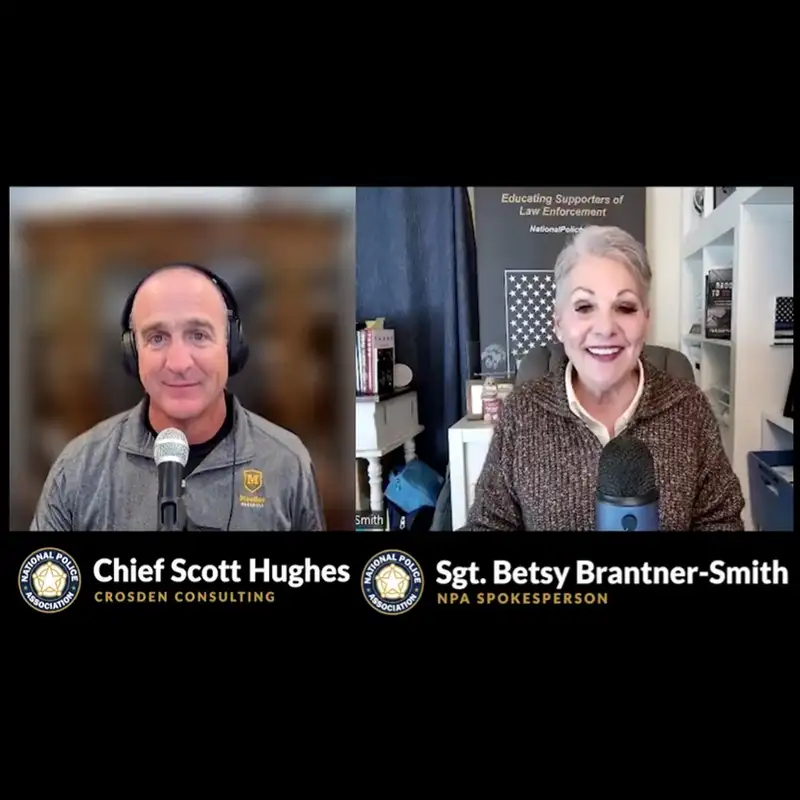
NPA Report with Guest, Scott Hughes, Chief of Police, Instructor, Expert, Consultant
Hi. This is sergeant Betsy Brantner Smith with the National Police Association, and this is the National Police Association podcast. I thought I'd start this year off with somebody that you've met before. I've had him on the show before. But as as we approach the year's end and I looked at the officers killed in the line of duty statistics, the officers shot, the officers assaulted, I thought there is no better guy in this country to talk about all of this than my next guest.
Betsy Smith:So welcome back, chief Scott Hughes.
Chief Scott Hughes:Hey. Thanks for having me, Betsy. It's an honor to be here.
Betsy Smith:Hey. So I just wanna remind everybody. Tell me again why you became a cop.
Chief Scott Hughes:Well, you get the same answer I told you last time. I don't know. It's just something I've always wanted to do. I have a picture of me when I was about nine years old at a Kmart back when they existed at a photo lab, and I had a little badge clipped on my collar. And it was at that point that I guess it was decided what I was gonna be I grew up.
Chief Scott Hughes:But, honestly, my father was in the Marine Corps, and I always had a sense of wanting to give back to the community and and serve the community. So I think it comes from comes from him.
Betsy Smith:So you're not only a chief of police, but you're you're a a national level police trainer. You're an author, and you're a consultant. One of the things that you're doing now is you're a an expert witness where you testify about things like a police officer's use of force. So you're a pretty busy guy. Right?
Chief Scott Hughes:Yeah. Unfortunately, you know, a lot of incidents out there happened across the country, and there's a lot of litigation. And it certainly keeps me busy, but I'll tell you, there's nothing there's nothing, better than than than still being a cop and getting to go out there and and wear the uniform and work with the men and women who do what my friend calls the hardest job in America. I absolutely love it. Still do.
Betsy Smith:Oh, absolutely. So so this year, one of the reasons that we wanted to talk was, for the first time since 1897, in The United States, we have had less than one hundred line of duty police officer deaths in this country. And and, you know, you and I as, trainers, this is something that has been on our radar, for years and years and years. And, this is something that, some mutual friends of ours started to talk about, gosh, a decade or so ago, why can't we get to below one hundred? And that became a movement, didn't it, in in law enforcement training?
Chief Scott Hughes:Yeah. It did, you know, kind of build on this philosophy that, you know, complacency kills, you know, slow slow slow down your drive and wear your seat belt. You know, remember the fundamentals of this job. And, you know, I always as I travel the country speaking, teaching, and writing, I I I like to harp on the fundamentals, and I think it it it applies in all aspects of your life, not just tactically, but as a leader, just, you know, whatever it is that you're doing. If if you remember the fundamentals, good chance that things are gonna work out okay.
Chief Scott Hughes:And I think I think, you know, I don't wanna speak for below 100, but I I believe the, you know, the the thought process behind it was, what can we do? What message can we get out there that officers officers will remember and they'll take with them? So things like slow down, wear your seat belt, wear your vest, etcetera, are easy for officers to remember. And, you know, there's not one of us who's wearing a badge today that hasn't made a mistake. And, unfortunately, you know, 98 of our brothers and sisters this year are no longer with us, and your thoughts and prayers to their agencies and their families.
Chief Scott Hughes:For those of us that have made mistakes, we're still here to talk about it. I feel like it's our obligation that we have to make a profession better and no better way than remember those fundamentals and and and and, you know, teach into the next generation, if you will. So I think there's lot of reasons why we got below 100, which I think we're gonna dive into here soon. But, yeah, back to your original point, you know, this this this blow 100 movement's been around for a long time, and I know the folks who who were who were the founding fathers, if you will, of that have certainly got to be proud that they got to see this this actually happen.
Betsy Smith:I'll be honest. I never thought I'd see it in my lifetime. You know, when I when I I'm I'm old enough to be your older sister. And when I started, we had lost about 250 police officers in the line of duty. You know, we saw huge losses in the seventies and on into the early eighties.
Betsy Smith:And and, you know, a lot of that was because we didn't have we didn't have the training we have now. We didn't, you know, we didn't have we didn't even have we barely had body armor when when I started, and it was a very different material than we use now. Cops were very resistant in wearing it. We didn't wear seatbelts when I started as a police officer. And that that was one of the things that below 100, that whole movement really hammered that we have got to wear our seatbelts, you know, not just when we're going to a hot cobbler when we're on patrol.
Betsy Smith:And and even if you're a detective, even if you're a chief of police, right, where whenever you get in a car, you wear your seat belt. Slowing down, watching your speed was another thing that I didn't learn that in the police academy. My field training officer never really talked to me about that because, again, back then, I started 1980, full disclosure. You know, one of the reasons we all became cops is we wanted to drive really fast. And Yeah.
Betsy Smith:And it, you know, it took about a decade for us to learn exactly how dangerous that was. You know? And and, of course, we were we were cognizant of getting shot. We were cognizant of getting stabbed. We also did, and we'll dive into this too, we also didn't do much in the way of first aid or self aid or buddy aid when it became to to being a street cop.
Betsy Smith:We tended to wait for the paramedics. I'm of a generation where we were we were told that tourniquets were bad. They were bad for you. Never use a tourniquet. You're you're not a trained medical professional, you darn cop, so don't be putting a tourniquet on somebody.
Betsy Smith:You'll they'll lose their leg. Things like that. So much has changed in the last forty plus years, hasn't it?
Chief Scott Hughes:Yeah. I mean, you know, just look at, you know, look at look at the technology inside the car. Right? I mean, you've got the cars now. I mean, if the car in front of you is slowing down and you're not paying attention, you know, you get a you get an audible noise, your seat vibrates, you get some other indication that, hey.
Chief Scott Hughes:The car in front of you is slowing down. You know, if the vehicle starts to drift out of the lane, you get an indication your vehicle's starting to drift. So you've got some changes inside the vehicles in of themselves that are certainly making the car safer. You know, you mentioned you mentioned motor vehicle crashes, and, you know, I've always taught and been told that, you know, typically typically, the top couple killers of police officers are are gunfire and car crashes. And I had a friend of mine one time say say this, that for every one cop that's killed in a car crash, three more are injured to the point where they sometimes can't come back on duty, that they're permanently disabled in some in some or or disabled enough where they can't come back to full duty.
Chief Scott Hughes:So, you know, whether or not that's a that's a concrete statistic or not, you know, we know what happens. Right? We're when you drive a car for eight, ten, twelve hours a day, the likelihood of you being involved in the crash are obviously way higher. So so seat belts, obviously, I think now we're of a generation where, you know, the kids are I can't get my car today and drive without my kid in the backseat saying, hey, dad. Your seat belt.
Chief Scott Hughes:Right? So I think generationally, we've come a long way in that respect. You've got airbags, of course, both front, side, rear, all that protection. So I think as far as car crashes and survivability, one reason why that number be coming down is because of that. Now having said that, we still have unfortunately, this is my opinion.
Chief Scott Hughes:We still have officers who are driving too fast to calls that probably don't warrant that kind of response. And, you know, the old now I sound like the old guy. Right? But the old saying, if you don't make it, they're alive. We're no good to anybody.
Chief Scott Hughes:And, you know, it's like everything else in life. If you drive lights and sirens to a call and you drive at breakneck speeds and nothing happens to you, you're starting to condition your brain at, hey. That's good. And then you do it again and again and again, and, unfortunately, sometimes those things catch up to you. So so I think that that covers automobile.
Chief Scott Hughes:I think as far as other kind of training goes, you talked about first aid. I don't know many police officers today in America that don't have a tourniquet on their belt. We've come so far with tourniquets and and so many success stories out there about the benefits of tourniquets that that certainly is another factor. You have officers now that are wearing that are wearing kits on their uniforms with gauze and and and and, you know, other other things that provide first aid until until medics arrive. You've got you've got this this philosophy now that, hey.
Chief Scott Hughes:It's okay if your partner gets injured. Throw him in a cruiser, hold something on him into that wound, and just drive and get him to the aim get him to the hospital. Don't wait for an ambulance or a life squad because it might that might make a difference. So philosophical change, I think, has helped. And then and then certainly training.
Chief Scott Hughes:You know? This is my big thing, Betsy. You know? And and think the last time I was on here, I was kinda hammering. We're still not doing it the right way, and and I still think we have a long way to go to get to where we actually need to be as a profession.
Chief Scott Hughes:But I digress on that point to say this, that we are at least exposing our officers to the realities of the job, I think, more today than we have before. And if it's not physical hand to hand training, you're actually firing a gun or something like that, we're at least exposed to videos now and and things online that we could see and we can watch. And I think we can learn a lot of lessons from from from watching others who sometimes unfortunately may have maybe made a mistake or or paid the ultimate sacrifice. And and, again, I'm I'm a perfect example that, you know, probably I should not be here. I've had situations happen to me that had they gone a different direction.
Chief Scott Hughes:I could have been a statistic. Right? So by no means am I saying I'm I'm perfect because that's certainly not the case. And if if I did something that was caught on video that could be could be a lesson for someone else. I want people to see that.
Chief Scott Hughes:So I think we're seeing we're certainly seeing some changes there as well.
Betsy Smith:Well, you know, YouTube is one big training film library for your average cop, and and that is that's something that, again, generationally has changed so much. We didn't have, you know, the the body camera footage and the dashcam footage and the camera on every pole and building and and everything else. Now with every single officer involved shooting, you know, we can we can very quickly see those films. And those films, of course, you know, mostly make it onto YouTube and Rumble. And and, you know, of course, there's always a salacious nature to that.
Betsy Smith:But then as police officers, and we've all encouraged our students to do, every day go online and watch a couple of those, talk about them at roll call, think about what would I do, what would I have done better, how would I have reacted to that. You know? So there's the tactical aspect of those videos. There's also that mindset aspect, and that's one of the great changes that I've seen in in training is, again, you know, going back to the eighties when I started, in scenario based training, when when you got shot in a scenario based training, this the scenario stopped. So what my generation was taught was if you get shot, you you're dead.
Chief Scott Hughes:Right.
Betsy Smith:Now, you know, people like you have come along. What do you teach an officer when they get shot, Scott?
Chief Scott Hughes:You know, it's an old military saying. Right? Pain is weakness leaving the body. If if if you're feeling pain, you're still alive, so let's go. Right?
Chief Scott Hughes:Let's let's we got we got stuff to do. We got lives to save. You'll be fine. You talked about videos real quick on YouTube. You know, the other thing that that I know at my agency, I'm proud that we do, is we're all wearing body cams.
Chief Scott Hughes:Right? Everybody's got body cameras clipped on them. We, at our agency, we my supervisors are required to review body cam footage with every one of their officers every month. They have to review, I believe it's three to five cases, and it's not we don't I always get some some eye rolls when I say this because I think everybody goes to worst case scenario, but for us, it's not used to say I got you. We use them to reinforce officer safety principles.
Chief Scott Hughes:Right? So for example, one of my sergeants will see an officer make a traffic stop at night, and he doesn't slam his car door. He keeps his weapon hand free. He does a good, you know, passenger driver side approach to the car. He does it in the right tactical manner.
Chief Scott Hughes:You know, they'll write that up. Hey, officer a exhibited good behavior, blah blah blah blah blah. And again, that is reinforcing to the officer. Hey. This is the right way the right way to be doing things.
Chief Scott Hughes:It goes back that whole complacency kills mindset. I when I teach, I always I always say this. I don't like to use the word complacency because I think it's complacent to say complacency. We've heard it so much, but go across the country and just start watching videos of police officers work, watch me work when I was a street cop. You're gonna see complacency because it's just what happens to us over time.
Chief Scott Hughes:Right? So I don't like to use that word complacency, but by reinforcing again those concepts through body camera views or dashcam reviews, you are reminding officers. Hey. This is what is important. These are the things I need to be doing.
Chief Scott Hughes:I would love to see more agencies adopt that kind of a philosophy. You've got a great tool clipped on your chest with these body cameras. Use them to show your officers what they're doing good or where they can make changes. Not just I got you moments because if that's all you're doing with them, then they're then they're gonna they're gonna hate going in the office to do the review because they're just gonna be waiting for you to yell at them or, you know, whatever the case might be or write them up or something. But I think I think all of that is how we get this number to stay below 100, but but but the it has to be reinforced like anything else in life.
Betsy Smith:Well and we're we're at a time period now. So we're in we're in 2026 where, really, the last five and a half years almost, you know, police officers in this country have been demonized and and vilified, and we we saw a big, huge dip in, proactive policing. You know?
Chief Scott Hughes:100%.
Betsy Smith:You know, where cops were. They were more like firefighters. They were responding to things rather than going out and and hunting. Are you seeing as you're traveling around the country, as you're talking to cops, as you're talking to other chiefs, are you seeing a resurgence when it comes to proactive policing?
Chief Scott Hughes:I think it so short answer is almost like a lawyer. Sort of maybe kind of sometimes a little, not really. And I think I think it depends upon where you are. Right? I mean, have I have friends who work in some areas that are not so friendly to the police.
Chief Scott Hughes:When I say not so friendly, I mean politically, where they don't really have the support that they wish they had from others. So I think you see a little more reluctance in those areas. And what frustrates me about that is the police officers who are working in those jurisdictions where they just don't they don't feel that support or have that support, whether it's politically or maybe it's even the admin, which is really bad. But those those officers who are working there, every one of them wants to go out and really do a good job. They took a note.
Chief Scott Hughes:They wanna go out. They wanna put bad people in jail. That's what they really wanna do. And they're frustrated because they can't do their jobs. Right?
Chief Scott Hughes:So I think in those jurisdictions, you certainly are going to see a reduction in proactive work. I was just on a radio show a couple days ago, and a large metropolitan city here in Ohio, One day last week, they had three officers in roll call. Three for a large city in in Ohio. Like, that's just unheard of. And and, you know, it's you you have seen this probably more than I have around the country in these big cities.
Chief Scott Hughes:They're struggling to to put to put bodies in patrol cars. They just don't have people to work. Nobody wants to do the job. Or what's
Betsy Smith:happening? Nine out of 10 police of ours in this country are still short staffed, and and they're mostly those big blue cities like you're talking about.
Chief Scott Hughes:Yeah. And and what happens is, you know, I'm a I'm I'm in I'm in a county just north of a of a one of those cities and counties, and I not necessarily my department, but departments around me, they're they're recruiting those officers because those are good officers down there who wanna go do their job. And if, you know, they're saying, hey. If I can drive 50 miles away and be somewhere where I'm I'm gonna get support both politically, internally, and in the community, why wouldn't you? And sometimes those departments are paying better as well.
Chief Scott Hughes:But back to back to your original question, I you know, when you look at when you look at the deaths being below 100, you look at gunfire, I think gunfire deaths, math was never my thing. So fact check me on this, but I think, like, 46% of the total officers killed were gunfire. If that 45 to 46%, if that number is accurate, and I think it's pretty close.
Betsy Smith:Yeah. It is.
Chief Scott Hughes:One of the reasons that that's that that might be lower is because officers aren't being as proactive. Right? They're not jumping out on the on the on the suspicious people in the corner. They're not making the traffic stops that maybe they might be making trying to look for that criminal element because, unfortunately, for them, it just might not be worth it for fear of political prosecution or something like that. So, again, that's unfortunate because none of us signed up for that, and I feel bad for those folks.
Chief Scott Hughes:I really feel bad for the community, you know, because they're the ones ultimately that are suffering from that lack of proactive policing. But I think that's probably for another episode. But I do think
Betsy Smith:We have some crazy experiments going on like the NYPD right now that we're gonna see how they function under a Democrat socialist mayor and, you know, how proactive do we think they'll be. And, again, departments like New York and Chicago and LA and Portland and Seattle, and we could go on and on and on, are wildly short staffed. Yeah. From hundreds to literally thousands of police officers short. And and yet and with all that, again, it's crazy that we were able to keep those line of duty deaths below 100.
Betsy Smith:Another piece of that, I think and we were talking about this. There were nearly 350 cops shot this year, and 90 of those were shot in 67 different ambushes. So officer ambushes continue to rise. They've been on a a ten year trajectory going up. And so we have almost a cop a day shot in this country, which is which is insane.
Betsy Smith:So there's a couple of takeaways there. One is and you were already talking about this, but just tactical medicine. You know? We we do a better job ourselves, the law enforcement officers. I think our medics, our paramedics are better trained, and I think we have better medicine.
Betsy Smith:We you know, we're able to save cops, but a lot of those cops never come back to the job. Do they? They're never able to.
Chief Scott Hughes:Right. You know, it's kinda like it's kinda like I mentioned earlier with the driving. You know? We've got officers that, you know, you you don't hear about those statistics because no one tracks them. You know?
Chief Scott Hughes:It's they don't track. Well, hey. This also they may they may track officer shop, but they don't track. Did they come back to work full duty? Or are are they on permanent disability?
Chief Scott Hughes:Are they in a temporary assignment for the rest of their career? You know, they don't track those numbers, so that's that's where it kinda gets interesting. But, certainly, the ambush situation is real. I'm in Ohio. And in May '25, we had three officers killed in Ohio, three in our state, and all three were ambush style.
Chief Scott Hughes:One officer was was working a traffic detail when he was targeted by by an individual. Another one was on a domestic walking up to the house. And the third one, they he and his partner were were what we called dored up. You remember that term. Right?
Chief Scott Hughes:Dored up, side by side. And they were having lunch when they were ambushed, shot and killed one, injured two more. So, you know, kinda going back to that complacency word, you know, directing traffic or excuse me. A deputy Henderson wasn't directing traffic. He was standing.
Chief Scott Hughes:He was working the traffic control box when when this when this criminal murdered him just plowed him over and
Betsy Smith:yeah, he wouldn't even shot.
Chief Scott Hughes:He was no.
Betsy Smith:No. I was using a vehicle. Yeah.
Chief Scott Hughes:He was struck by vehicle, you know, but but I mean, I mean, how quote unquote routine is directing traffic? How quote unquote routine is sit in the parking lot having lunch? And, you know, I look at I like to look at lessons learned and then I also have to say this. There are some things that just happened, and those are two great examples right there, and they're not great by your stretch of imagination that there's nothing those officers could have done to prevent that. Right?
Chief Scott Hughes:I mean, you can't prevent sitting in your car, having lunch, getting ambushed with a rifle from how many 100 or, you know, feet away or whatever the case is, directing traffic. You can't possibly know that this is gonna you know, those are the ones that really scare the, know, what out of me because there's nothing I can teach an officer. There's there's hardly anything I can reinforce to a police officer that says, hey. Don't do this. Right?
Chief Scott Hughes:We can talk about slowing down. We can talk about parking away from scenes. We can talk about not pulling up the front door of alarm drops and things like that. But having lunch, I mean, short of saying, hey. Come back to the police department and don't eat in public.
Chief Scott Hughes:How do I teach that? Right? How do you train that? Hardest my my friend says this is the hardest job in America, and he is spot on. Spot on.
Betsy Smith:Yeah. Absolutely. We also have officers die in, by other types of assaults. Right? We've had we had several stabbed, correctional officers.
Betsy Smith:We've had we had a number of correctional officers killed as well either with, you know, knife, you know, sharp objects, or with just going hand hands on with somebody, choked to death, beaten to death, things things like that. So it's not just always gunfire we're looking out for. Right?
Chief Scott Hughes:Right. 100%. You know, I'm I'm I'm proud of my agency. We we are actively practicing hand to hand combat multiple times a year, BJJ, ground fighting. We we are we're testing out the the new BolaWrap right now as an intervention tool.
Chief Scott Hughes:We've we we always looking for the latest and greatest, and I think, you know, as a leader, I believe I owe to my people to make sure that they have the tools and the equipment to do their job to the best of their ability. So there's that side of the house. The other side of the house is like, hey. If this product is gonna keep my people safe, then why would I not try to apply, you know, apply it? And but, yeah, you're right.
Chief Scott Hughes:You know, and we don't there's not enough hours in the day to give our officers all the training they need, but in this this may rub some of your listeners the wrong way, and I apologize. But if if your if your people haven't practiced handcuffing or self defense since the Police Academy, and that's been five, ten, fifteen, twenty years ago, I'm telling you right now when they need that tool and they need that technique, they're not gonna be successful. Right? They're just it that that muscle memory has long that ship has long sailed. And that also kind of frustrates me when I see some of these cases because, you know, our good friend Gordon Graham says predictable is preventable.
Chief Scott Hughes:Right? And it's like, man, if if if you haven't practiced x y and z and then it happens, well, it's predictable. Right? What what's going to occur? So therefore, does it become preventable if on the front end you would have done something?
Chief Scott Hughes:So I think a lot of states are making some changes. They're trying to they're trying to to go in the right direction. We just have got such a long way to go. And, Betsy, it comes down to money. It comes down to funding.
Chief Scott Hughes:Right? I mean, for me to take an officer off the street and put him in a specialized training for eight hours, two days, three days, four days, There's a there's I gotta backfill that. I have to pay overtime, or I gotta pull somebody in for a different assignment. Now you're robbing Peter to pay Paul. So, again, we have a long way to go, I think, to get there.
Chief Scott Hughes:I am excited, though, when I see what some states are doing with continuous training and and making sure we're getting something. I I don't think you get that sitting in front of a webinar, but we are making we we are making some progress in some states, and some I think still have a long way to go, and it it all comes down to dollars, in my opinion.
Betsy Smith:Well and we're we're always gonna have thousands of police officers in this country who whose agencies aren't going to be able to send them to training. You know? And, again, you know, we talked about this. All these police departments that are short staffed, especially these large agencies, they can't send a police officer training or take them off the street because they you know, they're already working them, you know, twelve, sixteen hours a day, six days a week or more. And, and, you know, so so we've got that issue.
Betsy Smith:But one of the things that I know you've always emphasized, I've always emphasized is if you're a cop, you're gonna have to get it get your own training yourself sometimes. You know? If you wanna stay alive, if you wanna stay healthy, if you wanna stay in one piece, if you wanna get to retirement, you know, you're gonna have to invest in yourself. Right?
Chief Scott Hughes:Yeah. A 100%. I was gonna say the exact thing. You gotta invest in yourself. You know, it's no different than going to the gym and working out.
Chief Scott Hughes:I mean, you do that on your own. I know I got some guys that do the the the BJJ, the ground fighting stuff on their own. I got guys go to the range on their own. I got I got guys that, you know, are are are doing whatever it is and, you know, in this line of work to make themselves better to perfect their craft. And I wish I could sit here and say, don't worry about it.
Chief Scott Hughes:The department will take care of you. But, again, it comes down to bodies working the street, and it comes down to money. And, you know, until and and that is probably more of a a systemic issue, right, that has to change. And what that looks like, you know, I I don't know what that looks like. Doesn't, you know, different hours, different schedule of police officers work.
Chief Scott Hughes:You know, I I don't know. But but, yeah, you have to invest in yourself and take pride because, you know, every one of you has someone at home who wants you to come home and someone who loves you more than anybody else, and they wanna see you at the end of your shift. And, you know, we can't take that for granted. So, you know, kinda back to the to the below 100, you know, it's those fundamentals. Remember those fundamentals, and you'll significantly increase your chances of survival or and just not get hurt in general.
Chief Scott Hughes:Right? You know, it's and that and that's part of it. We've we've talked a couple of times now about this, and it's we always hear about the deaths, but let's not forget the ones that are out there that are permanently disabled and who will never never walk again, they'll never drive again, they'll never breathe on their own again, or whatever the case might be. Those those situations are just as tragic as an officer killed on lot of duty. So remember the fundamentals.
Chief Scott Hughes:Absolutely.
Betsy Smith:As of this taping, we have lost one police officer in the line of duty, a Texas constable, shot and killed, outside of a bar in Texas. So, you know, but we're going to be looking this year to maintain that below 100 while we, hope to continue to see more support for the American law enforcement officer. You know? Crime is down. We're seeing you know, homicide went down in every major city in 2025.
Betsy Smith:In a lot of those same big cities, we're seeing property crime go down. We're seeing carjackings go down. So, hopefully, crime will continue to go down. Right? And officers killed in the line of duty will keep it below 100 for another year.
Chief Scott Hughes:That would be fantastic if we never have to if we never have to talk about higher than a 100. Right? I mean, one's too many. But to your point, keeping it below 100 when you're averaging a 150 to a 180 a year, that's a huge that is a huge number. That's a great decrease.
Chief Scott Hughes:So, you know, kudos to everyone out there who's doing it right and doing it the right way. Kudos to the leaders who have embraced training and have embraced their officer safety as their number one priority. Again, I always say when I teach leadership classes, you know, your people are the most important thing you got. Without them, you got nothing. They're your most important resource.
Chief Scott Hughes:We can't you can't ever forget that. So sergeants, you know, out there backing up your officers, making sure they got what they need. They're doing it the right way. Not being afraid to have those hard conversations when you see someone do something incorrectly. You know, again, this is probably another podcast, but that's another issue is, you know, you Sergeant, you gotta get out of the office.
Chief Scott Hughes:You know? You can't you can't see what your people are doing if you don't see them work. And, you know, watching a body cam footage or reviewing a dashcam isn't the same as standing there next to them working and, you know, making those corrections as needed. That's that's why you exist as a leader, and and that is what what will help keep this number below 100 for sure.
Betsy Smith:Absolutely. And for the citizens watching, make sure that you're supporting your local cops. You're thanking them for what they do. You're going to those city council meetings, and you're taking a look at that police budget. And you're making sure that as a citizen, that your cops, the people protecting you and your community, are able to get that training.
Betsy Smith:They're able to get those mental health resources, those physical that they need to be able to do a good job for their community. Chief, where can people find you on social media? Where can they find your consulting company? You're you're all over the place, and you're always one of my favorite followers on or follows on X.
Chief Scott Hughes:Yes. So on X, it's simple. It's chief s Hughes. So chief s h u g h e s. LinkedIn is just my name, Scott Hughes.
Chief Scott Hughes:But the easiest thing to do would be go to crosdenconsulting.com, and you can find all the social media links there.
Betsy Smith:I tell you what. I can't thank you enough for being my first guest of the year and talking about something that, that I know is near and dear to both our hearts. I'm hoping we're talking at the beginning of next year where we've got those officers, killed and, injured stats even lower. So thanks so much for being with me. And if you'd like more information about the National Police Association, you can visit us at nationalpolice.org.
Narrator:Every day, the brave men and women of law enforcement put their lives on the line to keep us safe. But they need our help to continue their mission. Activist politicians, progressive prosecutors, the ACLU and the rest of the anti police forces receive millions in donations from extremist pro criminal elements like George Soros and woke corporations. The National Police Association is fighting them in courts around the country, including The United States Supreme Court, defending officers who are being attacked for doing their jobs. Additionally, the National Police Association works year round to pass tough on crime legislation to put and keep criminals behind bars.
Narrator:Consider going to nationalpolice.org and donating to keep us in the fight. Together, we can win. That is nationalpolice.org.