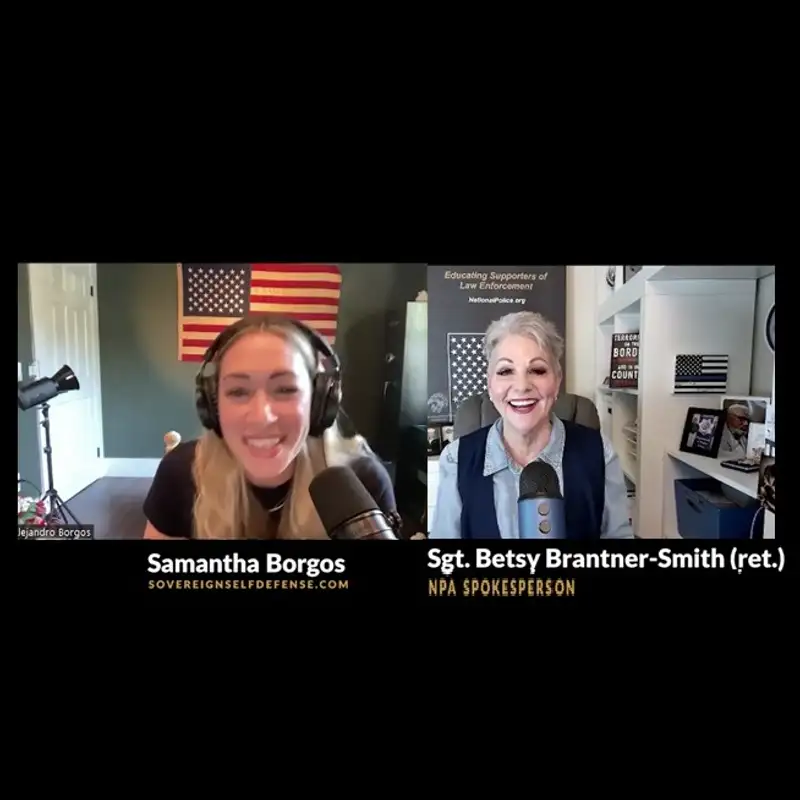
The National Police Association Podcast with Samantha Borgos, Co-Founder of Sovereign Self Defense
Hi. This is sergeant Betsy Brantner Smith with the National Police Association, and this is the National Police Association podcast. I have a guest with me today who has this amazing social media presence. And I started watching one of her videos, and then I watched another one, and then I watched another one. And I think it was, like, an hour later when I said I have to find out more about what this woman and her company are doing.
Betsy Brantner Smith:So I reached out to her. She immediately reached back. And, so she's here to to, share with all of us, what she's doing online and in person when it comes to helping citizens, cops, veterans understand the use of deadly force. Samantha Borgos, welcome to the show.
Samantha Borgos:Hi. Thanks for having me.
Betsy Brantner Smith:So I I gotta tell you first first and foremost. So my daughter's an Instagram influencer, so I'm pretty bougie about it.
Samantha Borgos:Wow.
Betsy Brantner Smith:People's social media presence. And and yours is fantastic. And as especially as a woman, when I watch some of the things that you're doing, it's just incredibly engaging, and it and you you make carrying a firearm for a civilian, especially for a woman, seem so effortless. How do you do that?
Samantha Borgos:I really appreciate that. I like to call my content edutainment. So it's educating you along the ride of some deliberate entertainment. Right? And, yeah, I would say for me, I didn't start off knowing a thing about firearms.
Samantha Borgos:I think to understand how I got to my social media presence, which I like to say it was completely by accident. The the but I can kinda get into my background, if you will, because that kinda gives the full picture as to how I even got to where I'm at now.
Betsy Brantner Smith:I think that's perfect because because, again, you're not some, you know, woo woo girl who came out of third grade with an AR 15 in your hand and and all that. Tell us tell us about your background and and how you got involved in what you're doing now.
Samantha Borgos:Yeah. So for any of the listeners that don't know, what I'm mostly known for these days online is open carrying a firearm into different stores, different popular stores, whether, you know, they have different beliefs or not. Of course, I abide by the law. But, you know, there I get very known and lots of views for open carrying in different publicly known stores, whether it's Saks Fifth Avenue to Whole Foods to etcetera. Right?
Samantha Borgos:And I film some of the reactions. I film whether or not if I'm gonna get kicked out, if I'm gonna get asked to leave. And then sometimes people randomly high five me. It could be a random employee. It could be somebody walking in the store.
Samantha Borgos:And I started filming these reactions. But the funny part so that's you know, if you if you don't know my social media, that is what I'm pretty much known for. And then I like to mix in some educational content of how to even get to the point where you are confident, whether that's a concealed carrier, you know, a home defender, or an open carrier. I like to post a lot of content in between those funny reaction videos just so people can start to gain their confidence with carrying a firearm. But the funny part about that is so floor I'm in Florida.
Samantha Borgos:And Florida, as of September 25, our governor DeSantis just changed or, you know, it went through a process, and he he ok'd it that we can now open carry in Florida. So I you know, being a founder, cofounder with my husband of a very known self defense training company, I, of course, have guns. I carry guns all the time. And I said, well, let me just experiment open carrying because it's so new to I mean, you guys are in Arizona. You've had open carry for a long time.
Samantha Borgos:It's but it's so new in Florida. Right? And I'm I'm not in the main city area. I am in more of a a residential area of Florida and whatnot. And I said, you know what?
Samantha Borgos:Let me just experiment. And and I just threw up my camera. And I said, let me just film it and see because maybe my client my students, my clients will wanna see. And I posted it on Instagram, and I completely forgot that I even posted that. Because, again, I didn't at the time, I didn't really I think I had a thousand followers or something, and nobody cares.
Samantha Borgos:You know? And I signed online a few hours later, and I had, like, a 100,000 views on this post. And I said, Maybe I'm onto something. You know? And and I I don't to be an Instagram influencer.
Samantha Borgos:That was not my my objective. I have a business. I'm I'm running a business. But I said, you know, maybe this could be kind of inspiring to other people, especially women, because I always felt what I represent is you know, when I started getting into shooting, and, again, I can tell you about me in a second, but just for anybody listening, when I started getting into shooting, I was completely new. And I would look at the women shooting, and they either looked like like they belonged in the CrossFit gym, which I'm not I don't do.
Samantha Borgos:And, you know, just very tactical, very muscular, very more more masculine or something. Mhmm. And then the other extreme was they just looked, like, flimsy and, like, they didn't know what they were doing or something with a gun, like which was me at the time. I didn't know anything. And and I was like, I don't relate to either one of this.
Samantha Borgos:So I feel what I represent and for my students too is that that you can be feminine. You know? You can be I like the girly things. I like fashion. I like makeup.
Samantha Borgos:I like all the things. Right? And you can still be extremely confident and safe and capable with a firearm. You know what I mean? Like, you don't have to be this super tactical person or something.
Samantha Borgos:And, know, so it's like, felt, hey. Let me just start recording some videos showing in use how to, you know, be a carrier. And and then lo and behold, I now I have a whole series of open carry videos, and they I'm shocked, honestly. So that's what I what I have more recently gotten known for. And people the funny thing is people will come up to me locally and say, are you the girl that that open if I'm not open are you the girl that open caries at my local coffee shop?
Samantha Borgos:I said, yeah. That's me. And they were like, well, why aren't you open carrying now? Can you do one here? And I okay.
Samantha Borgos:So it's kinda it's been kind of a journey.
Betsy Brantner Smith:I love it. So what what was your real, real job before all this?
Samantha Borgos:Well, I would say so about ten years ago, I had a marketing and branding agency. So I know a thing or two about videos, to say the least. I was a creative director for personal brands and all that. I I had a marketing agency and a business partner at the time, and we had lots of clients. And we we this was, you know, Instagram, and the the Internet was totally different than the way it is now.
Samantha Borgos:It's so fast paced and always evolving. And about ten so I would say about seven years ago, my husband, who also at the time had a whole another business. He he was a United States or he is a United States marine, but he sent out he got he did some civilian work for a while. He had a whole another business out of the, quote, unquote, war fighting world for a while. And, you know, a series of events happened, and he unfortunately, you know, the the Stoneham Douglas Parkland shooting happened locally, and he has four daughters.
Samantha Borgos:And long story short, he said to me, I have this idea. And I said, what's the idea? He says, it's called the warrior workshop. And I was like, the warrior workshop? That sounds kinda cool.
Samantha Borgos:What is it? And, again, I was very new to shooting. Like, our first date twelve years ago was on he took me to the shooting range. That was how we met. I heard he I heard that he is a marine.
Samantha Borgos:I heard that he teaches people how to shoot guns, and I heard he's single. So that checked all the boxes for me. We went on a first date to a shooting range, and I moved in with him within ten days. That's a true story. That you know, a few years into our relationship, he said, hey.
Samantha Borgos:I got this idea. You know, it's called the warrior workshop. I was like, oh, what is it? And he's I wanna teach civilians. You know, all this stuff was going around in Florida, and it was just a a weird time.
Samantha Borgos:And and he said, I wanna teach civilians how to be capable, but not the way everybody's doing it. Right? And, again, in your in in the tactical world, and I'm sure you know this in in the tactical industry, it's one of two things. It's, again, it's the super tactical, you know, play Navy SEAL for the day, which is cool. I'm not knocking that.
Samantha Borgos:That's fun. You know, it's like plate carriers and night vision and, you know, you get to be a dad and run and gun or something. You know? And then the other extreme, at least in Florida, I can speak for is it's just go get your concealed carry license real quick. You take this couple hour class if that you might shoot maybe a magazine, you know, worth of ammo, and that's it.
Samantha Borgos:You're a concealed carrier. And so we found
Betsy Brantner Smith:And let me just say this. I can't tell you how many women I know who especially, you know, here in Arizona, but other places as well, who some guy talks him into some giant framed handgun, and they do exactly what you just said. They go get their concealed carry, or, you know, here in Arizona, you can open carry, but they bring it home. They're scared to death of it. They put it in their underwear drawer, and they never look at it again.
Betsy Brantner Smith:And, you know, I think that's what you're talking about. Right?
Samantha Borgos:Yeah. You go out. You you buy a gun. You're like, okay. I'm a good American.
Samantha Borgos:I own my firearm, And that's as far as you take it. But the reality of actually having to use that firearm is a completely different reality and a completely different purpose to train. Mhmm. And so my husband's genius is practical application. He was a weapons and tactics instructor in the in the military, in the Marine Corps.
Samantha Borgos:He was a, you know, gunner instructor, but it was beyond that. His his true genius and his true is the heart is getting people to the reality of, hey. If you do need to use this, this is the reality of the sit and it's not fear based. Look. There's great people that defend themselves every day.
Samantha Borgos:There's nothing to fear. It's but this is the reality of the intensity that you have to train for. So he came up with this warrior workshop, which was just called the warrior workshop at at the time. And then it was I was the first student. So I, again, I knew very little about guns.
Samantha Borgos:I looked at the gun on the on the kitchen table. I'd think it would jump out and shoot me if I looked at it wrong. That's how much I knew about guns at the time. So like I said, this was about ten years ago or so. So then I I took the warrior workshop.
Samantha Borgos:It was like me and, like, maybe some friends and family, you know, in the workshop. And at the end of the day, it was an eight hour day, I said, Alex, this is this is not about guns. I was like, what the hell did you just create? Like, you're on to something here. And everybody in the class, all of our friends and family said, well, when's the when's the level two?
Samantha Borgos:Because this was just one workshop. We thought, alright. We'll do this on a random once a month or something. You know? Yeah.
Samantha Borgos:And and everyone said, when's level two? And and he said, I don't know. Next weekend? And everybody signed up for the level two. Well, lo and behold, now we have five levels, and it's very successful and whatnot.
Samantha Borgos:But the biggest thing that that we say that's important for people to know is it's where personal protection meets personal development. Because and you know this. Right? It's about training who you need to be in that moment. And you might not even have a gun as a civilian.
Samantha Borgos:Let's say you don't have a gun on you. Well, you still need to defend yourself. You still need to protect your family. You know what I mean? So if you've got you and you've got the fortitude and the character and the courage to actually get that job down.
Samantha Borgos:My husband always says, if you know your why, you'll figure out how. So
Betsy Brantner Smith:Yeah. That's exactly what we teach cops, you know, that winning mindset, that that warrior mindset, which in in American law enforcement, there there are since about 2014, that word warrior has gotten such a bad connotation in law enforcement to the point that the state of Minnesota has a law on the books that you cannot do what they call warrior training. And and My god. Guys like guys like my husband, lieutenant colonel Dave Grossman, they are what is known as warrior trainers, and they're not supposed to set foot in states like Minnesota or California. It's it's ridiculous.
Betsy Brantner Smith:That word warrior, I'm so glad to hear you utilize that.
Samantha Borgos:Wow.
Betsy Brantner Smith:Because in law enforcement, it's gotten such a bad, a bad reputation among, dare I say, the the ignorant left.
Samantha Borgos:Sure. Yeah. Absolutely. I mean, we are the name of our company is Sovereign Self Defense, and we're called the Warrior Workshop. So I don't know.
Samantha Borgos:We've got we've gotten a few comments about that here and there, but it is, yeah, a transformational experience to say the least. And and, you know, that's the reality. Right? It's it's preparing for the reality and the brutal facts of what and, again, it's not fear based. It's just without courage, what does the world look like?
Samantha Borgos:And without good men and women defending that integrity of of the country, of yourself. You know? And it's interesting because, you know, we during 2020 in that time, we always ask people right when they come into the training. We say, why are you here? Why are you taking the workshop?
Samantha Borgos:What made you sign up? Da da da. A lot of times people say, oh, the country. The country. Oh my god.
Samantha Borgos:The country. And and we get it. You know? But the reality is it doesn't really matter who's in office when you're talking about a home invasion. It happens whether or not you like the president or not.
Samantha Borgos:Right? Or whether you're not whether or not you like your it doesn't matter. Home invasions, armed robberies, gas station robberies, these crimes of opportunity happen every single day in nice neighborhoods and bad neighborhoods, and politics is really not as much involved in the in the man to man of it. You know what I'm saying? So it's like develop yourself, learn to protect yourself.
Samantha Borgos:And the more that you are capable to defend your own personal security and body, then you can start worrying about these high minded things like politics. But if you don't actually know how to defend yourself, then it's just it's like a yappy dog in your mind.
Betsy Brantner Smith:Well, and to that end, and that's one of the reasons I wanted to talk to you, you know, the the National Police Association, we are the most pro citizen carry, pro second amendment police organization in this country because we're realistic enough to understand that because especially big city police departments, but most police departments are short staffed. Cops are not sitting in front of your house waiting to stop that home invasion. They're not sitting next to you on the train waiting to save you from somebody. They're they're not sitting next to you in the coffee shop or the gas station when an armed robber comes in. And Right.
Betsy Brantner Smith:And so we that's one of the reasons I wanted to talk to you was because a lot of times, I think citizens, and especially women and senior citizens, are told, well, you know, you just gotta wait for the police. Call the police. The police will help you. Yeah. The police said we're there to help you, but we're probably not right there when you need us.
Samantha Borgos:Yeah. Exactly. And that's a big, you know, reality check for a lot of people, myself included, when I first started in this industry because, you know, I was just talking to you about how we started the business. What what ended up happening for me is I I my husband and I sold everything ten years ago, I mean, to do this full time. We were like, we just have to do this.
Samantha Borgos:And I I had I left my marketing agency. I sold everything, so did my husband, and we've been doing this full time ever since. And it's worked extremely well for us. We're very fortunate. But to your point, you know, a lot of a lot of what I went through as a student and what we have to educate people when they come in is, you know, you always think, and I think we're conditioned from school.
Samantha Borgos:Like, call 911 as a little five year old. If something ever happens to mommy, you gotta call 911. And that might work in certain aspects. Right? And, yes, we obviously train people to call 911.
Samantha Borgos:But here's the reality. If somebody comes into your house at 02:00 in the morning and they're armed and usually home invasions, we find multiple people. It's not usually a single person. That's a whole that's a different level of crime. But let's talk about, like, the breaking and entering, the the fast paced, aggressive, and, you know, forced entry home invasion is multiple people.
Samantha Borgos:Multiple people are armed, and you're in your underwear at 02:00 in the morning and you wake up flustered and you you go for your gun. You gotta handle the situation in front of you before you can even get on the phone. And a lot of the surveillance photos or excuse me. A lot of the surveillance footage that we see is people having their phone in their hand and their gun in the other hand, and they're trying to call 911, and they're trying to neutralize the threat at the same exact time. And that doesn't work.
Samantha Borgos:You gotta get your your full attention in the fight. You gotta get your hands on the weapon. You might need to get loved ones out of the way. I mean, it's a dynamic scenario, and I could show tons and tons of video of people just in that fight or flight trying to get on the phone and trying to call 911. It's like, no, you gotta get in the fight.
Samantha Borgos:At that point, you don't have an option. If you have an option and you can go barricade and you can secure yourself and you can get on the phone and call the cops, then absolutely do it. But there's so many scenarios where you can't you can't call the cops until unfortunately it's done. The fight's over. And then you gotta call the cops.
Samantha Borgos:And so this there's such a we call them training scars. There's such a training scar in society that we think that, oh, we'll just call the cops and they'll come and they'll handle it. It's like, no. As a as a citizen as as a civilian, we have the right to be our own first responder in America, and that's what we want to push is the reality of how important that is.
Betsy Brantner Smith:Oh, absolutely. And I I you know, and you and I were talking about this be before we started the show. You know, there are there are certain things. There's kind of a procedure that you teach citizens who have had to use deadly force what to do legally, you know, to protect themselves legally, to protect themselves physically. Because after you've used deadly force as a citizen, the police are ultimately gonna come at some point, you know, whether you're in your own home or you're out in the public.
Betsy Brantner Smith:You've got to interact appropriately with law enforcement. And and, frankly, law enforcement is there to make sure everything's safe and and all that stuff. But then they're there also to look at this shooting scenario where you're the shooter, and they've got to act, you know, from a law perspective, if you will. And there's certain things that citizens need to do to protect themselves legally. Let's talk about that a little bit.
Samantha Borgos:Yeah. I mean, one of the things that we always train our students is put yourself into the other perspective of law enforcement. Right? So law enforcement gets this call. Hey.
Samantha Borgos:You gotta respond over here, gets the address, and sends a team. They that might be all they know. Right? It's not like they have a full briefing on the entire situation of what just happened. Nobody knows.
Samantha Borgos:Everybody's in the unknown. So law enforcement, they're in fight or flight too. They're like, oh, crap. I might be going to a gunfight. What do I know?
Samantha Borgos:You know what I mean? So they come in. They're hot, and and they don't know who's the good guy, who's the bad guy. They haven't assessed the situation yet. So now you're a good guy, and you're assuming everybody just sees you as the good guy.
Samantha Borgos:But they don't nobody knows. They don't know yet. So what we train is, you know, completely comply. You might end up you I mean, just be quiet. You know, that adrenaline dump, you know, is is real.
Samantha Borgos:And there's only so much that you can train for. Right? That level of adrenaline, that fight or flight of what the body goes into when you do have to use that level of force, you don't you might be black. You might not even remember, you know, completely. So what we always say is just train yourself to shut the heck up for that moment.
Samantha Borgos:And, ideally, you have some level of an attorney that you can reach out to and let them handle it cool down for twenty four hours. Now law enforcement, they might need to arrest you for the moment or whatever the procedure is that they need to do. That's okay. That's okay. Ultimately, you know what you you know what I'm saying?
Samantha Borgos:You know that you are a good guy, and you know that you complied within the law, and you were in self defense, and you were scared for your life. I was scared for my life. I was scared for my life. And that's you know, at the end of the day, if you're scared for your life and there's you're in within the law, then you have to do what you have to do. But what we always train our students is just completely comply because you have to put yourself in the law enforcement's perspective of what they're showing up to, and they're in the completed unknown as well.
Samantha Borgos:That's exactly the lawyers handle it.
Betsy Brantner Smith:Exactly. And that's how we teach off duty police officers. You know? We we have there there's over 200 police officers on the law enforcement officers memorial Wall in Washington DC who were killed taking action off duty. And, sadly, a few of them took what we call blue fire where, you know, they had to take action off duty, then the uniform showed up, and, and mistakes were made.
Betsy Brantner Smith:And, you know, we don't want that to happen to anyone, and we certainly don't want it to happen to, our civilians who, again, are exercising their Second Amendment rights because we are, and it's not just in big cities. You know, there's, you know, there's crime virtually everywhere. And, and, you know, we do all have to be prepared to take, action to to save ourselves, to protect our families, to to know and the law is very different depending on again Yeah. You know, Florida, Arizona, Mississippi, you know, different states like that have, pretty citizen friendly laws, I I guess, I would say when it comes to Yeah. You know, the second amendment.
Betsy Brantner Smith:The state of Illinois, for example, where I hail from, we didn't even have citizen carry until about 2013. And, so it's it's, and and that's why that was one of the reasons I was so fascinated by your open carry videos was because for the entire twenty nine years, I was a police officer. If you saw someone openly carrying a gun, we arrested you unless you were a police officer or there was there were a few tiny exceptions. Mhmm. You know?
Betsy Brantner Smith:And other than that, boy, you you were going to jail because you didn't you couldn't open carry a firearm. What I've gotta ask you because I've seen, like, didn't you go to Sephora and and, you know, that's one of my favorites. What kind of reactions do like, what's the craziest reaction you've gotten to open carrying in a place that might be a little wigged out?
Samantha Borgos:Well, the craziest reaction that I got was probably at in the physical store was probably Whole Foods. I it was and, again, this was early when I started making the videos, so the law just changed. People were not used to open care. They're still not used to it. Yeah.
Samantha Borgos:But it's funny because I use this as, like, a case study. Right? So one of them one one just a couple instances. One instance is people just absolutely have no clue I'm even carrying. Now I carry you know, I I I dress appropriately.
Samantha Borgos:I you know, there's a whole protocol when I am open carrying and I'm recording a video, and I I wanna make that clear for the listeners in a second. But on the reaction side, some people just have very, very little situational awareness whatsoever and don't even notice. So the I can think of one reaction. I haven't posted the video yet, but I I will this coming week, and it was at Starbucks. Okay?
Samantha Borgos:So to be clear, some Starbucks have a no gun sign, I've seen, and some do not. So the one that did not have a no gun sign, I gladly walked in. I got my chai latte, and I asked the guy at the store. I said at the at the counter, I said, hey. Have you ever you know, the open carry laws just changed.
Samantha Borgos:Have you ever seen anybody open carrying in in Starbucks before? And I'm open carrying, mind you. And he said, no. I've never seen anybody walk in here with a gun. And I said, really?
Samantha Borgos:Never? Like, not even today. You haven't seen any he's like, no. I've never seen anybody walk in here with a gun. And I was like, oh, okay.
Samantha Borgos:And I and I said to him, how about me? And I pointed, you know, to it. And he goes, oh, I didn't even realize. So, I mean, this goes back to people's heads up there, but,
Betsy Brantner Smith:you know,
Samantha Borgos:as part of my theory. I've gotten asked, hey. Are you undercover? And I'm like, if I was undercover, I would not be open carrying, number one. So that was a funny one I posted.
Samantha Borgos:And then the Walmart or no. Not Walmart. It was Whole Foods was funny because I actually got a call from I posted the video, and then I got a call a few days later from a representative of Whole Foods letting me know that they did not like the video. And they they were you know, they they didn't like it. They didn't appreciate it, and they wanted me to take it down.
Samantha Borgos:But I said, that's too bad. I'm not gonna take it down. Right. So it wasn't it wasn't so high up in in corporate per se, but it was definitely they were letting me know that they did not appreciate the video and the open carry, but but that's okay. I that's why I film it is let's just see where these where everybody's at.
Samantha Borgos:Right?
Betsy Brantner Smith:I love it. I wish I so wish we had more time, but I I wanna tell people you train, you train civilians, obviously. You train law enforcement. You train veterans. You you guys are are, you know, really out there in your own community.
Betsy Brantner Smith:And, so so tell people how they can find you, how they can find your amazing social media because everybody needs to follow you, not just for fun tips, but just for fun. Yeah. Tell everybody where they can find you.
Samantha Borgos:Yeah. So my personal Instagram that we're talking about here is on Instagram is Samantha Jacqueline underscore is my Instagram. And then our company is at the warrior workshop, and that is where you can find more on the training and whatnot. So those are the two different places.
Betsy Brantner Smith:And give us the website again.
Samantha Borgos:The website is sovereignselfdefense.com.
Betsy Brantner Smith:Oh my gosh. I Savannah, I cannot tell you how excited I was to get you on the show to I hope everybody watching and listening will will follow you and interact with your social media. And and we just thank you for what you do because you're so supportive of our second amendment. You're supportive of law enforcement. You're supportive of the military, and and you guys are just about as American as it gets.
Betsy Brantner Smith:So thanks so much for being with us today. And if you'd like more information about the National Police Association, you can visit us at nationalpolice.org.
Narrator:Every day, the brave men and women of law enforcement put their lives on the line to keep us safe but they need our help to continue their mission. Activist politicians, progressive prosecutors, the ACLU and the rest of the anti police forces receive millions in donations from extremist pro criminal elements like George Soros and woke corporations. The National Police Association is fighting them in courts around the country including the United States Supreme Court defending officers who are being attacked for doing their jobs. Additionally, the National Police Association works year round to pass tough on crime legislation to put and keep criminals behind bars. Consider going to nationalpolice.org and donating to keep us in the fight.
Narrator:Together, we can win. That is national police dot org.