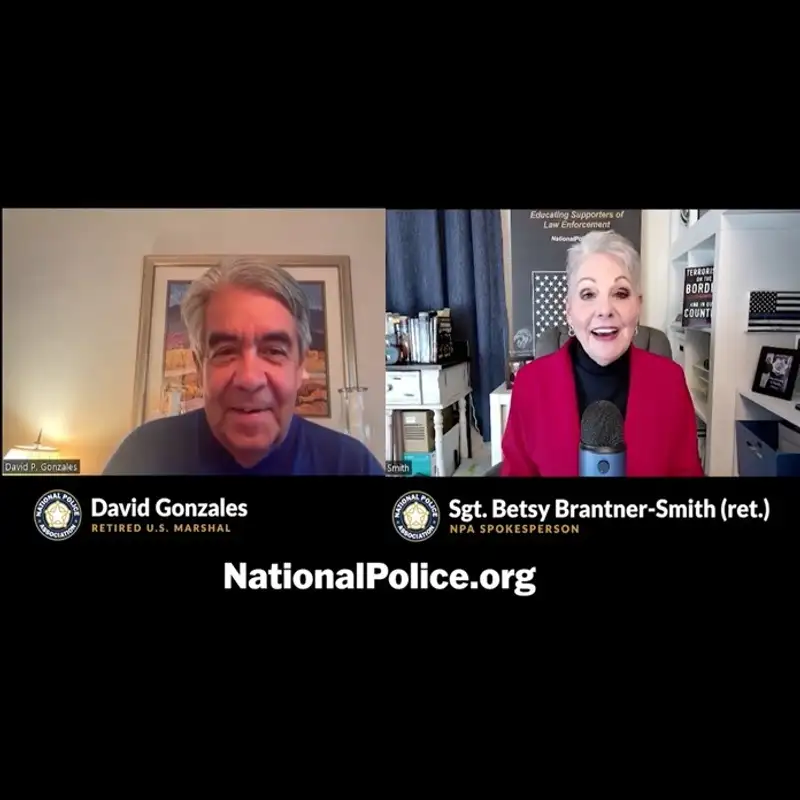
National Police Association Podcast w/David Gonzales, U.S. Marshal for the District of Arizona (Ret.)
Hi. This is sergeant Betsy Brantner Smith with the National Police Association, and this is the National Police Association podcast. I have a guest today that I have known for decades, and he he is responsible for my husband going into the state police
David Gonzales:That's right.
Sgt. Betsy Smith Ret.:Coming, JD Buck Savage.
David Gonzales:That's right.
Sgt. Betsy Smith Ret.:Yeah. And he's he's also kind of responsible for me leaving the state of Illinois and coming to the beautiful state of Arizona. And he has had just an amazing career. And so I thought you needed to meet him and and learn more about not just his career, but what federal law enforcement officers are experiencing now in in this current state of where we are in the country. And I thought there's nobody really better to explain it than Dave Gonzalez.
Sgt. Betsy Smith Ret.:David Gonzalez, welcome to the show.
David Gonzales:Well, thank you. Glad to be here, Betsy.
Sgt. Betsy Smith Ret.:So before we talk about your career, I'm gonna ask you the question I ask every cop that comes on this show. Why'd you become a cop?
David Gonzales:Well, it was interesting. You know, I was born and raised in Flagstaff, like Buck Savage, and I was raised by my grandparents. And when when I graduated from Flag High And I was on my own. I was going to NAU, Northern Arizona University, and and needed a job. And and and I always respected police officers.
David Gonzales:The the police officers in Flagstaff were tough and fair, and they looked great and all that stuff. And I thought, I'd like to do that. And there was a sheriff up there named Joe Richards. He was a sheriff for, like, thirty years. You know, there's always someone in your career, in your life that gave you a little hand up that that set you for the rest of your life, and that was Joe Richards.
David Gonzales:He hired me when I was 19 years old to be a deputy sheriff for Coconino County. You could be a sworn officer at that time at 19. And so, I went through a little academy up there, and the next thing I know, I'm patrolling in Coconino County. It's the second largest county in The United States.
Sgt. Betsy Smith Ret.:Yeah. I just wanna say Coconino County is bigger than many states.
David Gonzales:Exactly. And you get called to a bar fight. Sometime it take an hour to get there. You know? And, but it was really interesting because, I was 19 years old.
David Gonzales:I couldn't buy a gun or bullets, and I'd go to bar fights where I was even I wasn't old enough to buy a beer in there. You know? And and if I wanted bullets, I'd have to go ask my sergeant to to to buy me, you know, to buy me a box of bullets for my gun and we wanted to shoot it. So it was really interesting times. They they changed a lot later to '21 probably because of me.
David Gonzales:You know? And
Sgt. Betsy Smith Ret.:and then seen little Dave Gonzalez at 19. I've seen pictures of you. Yeah. And yeah. Wow.
Sgt. Betsy Smith Ret.:I bet people were surprised when you showed up.
David Gonzales:Oh, they were. And when I turned 21, you know, I always I always wanted I was I was a big fan of the Arizona DPS, you know, the highway patrols now state troopers. And I love their uniforms. And, Betsy, I'm gonna be honest with you. I I love that Smokey the Bear hat.
David Gonzales:There was something about that Smokey the Bear hat.
Sgt. Betsy Smith Ret.:All you state trooper guys love your hats.
David Gonzales:I loved it. And and but I have a big head, so they had a special order. There weren't very many, like, size eight long oval, smoking the bear hats, but they they finally got one for me. And I was sent to Tucson. Went to college, and then, if you sign a piece of paper when you went to DPS, they can send you anywhere.
David Gonzales:So I'm thinking, oh god. I don't hopefully, I end up on the Indian reservation like Dave. You're Dave. I just wanted to go to Phoenix, Tucson, or Flag for the that's where the three universities were. And they said, I'm gonna be going to Tucson, which was great for me.
David Gonzales:I was 21, single, and started working the graveyard shift for, two years, going in going to the U of A and to be a mighty wildcat. And then after two years, there was a big push for narcotics agents at the time. The the drugs come pouring across into Arizona from from Mexico was heroin, A little bit of cocaine. That that came about five years later. Marijuana coming by the tons, and they were looking for people that were younger, could speak some Spanish, that could infiltrate those groups.
David Gonzales:And I said, yeah. Sounds good to me. So I I went off on the criminal investigation side of DPS where I spent the majority of my career and my ranks, except for two years as head of the highway patrol in the Phoenix area. Other than that, was in the criminal investigation section. And then had a great career with DPS.
David Gonzales:Great great organization. And when president George w Bush was elected, I always I always knew there was this marshal position out there, which is a presidential appointment position. And, there are you know, just for some background, there are 94 federal districts in the country, and the president appoints the US marshal and the US attorney, for those districts. And I knew McCain and senator Kyle would be making making the nomination to Bush. And I and I knew senator McCain and Kyle.
David Gonzales:Senator McCain, I knew him a a lot better. And I knew his son very well, Andy. And I and I worked a lot in the community with DPS and working when I was head of the gang unit here as a captain and commander. And, I'd worked all over the state, you know, on the on the, on the ress, with the sheriffs, with the chiefs of police, with the county attorneys. So when I put in, I had a lot of support.
David Gonzales:And to make a long story short, senator McCain and and Kyle nominated me to Bush to to be the the US marshal for the District Of Arizona. And I was fortunate enough to stay through all of eight years with Bush, eight years with Obama, which he appointed me, which I was surprised because we were different parties. And then Trump came in, he reappointed me, and and then so did Biden. And and the twenty two years as a presidential appoint appointee for, as a US Marshal for Arizona. That in a nutshell was is is kind of my career.
David Gonzales:It was I had a storied career, and I'm blessed, you know, to to do that. And and when I left after, was that almost forty eight years carrying a badge and gun, you know, I was like, I you know, I think that's that that's good. You know, let let's let's let's have new blood come in. And and so that that that's kinda kinda it, Betsy, you know, and and I still run-in. But, you know, I I know that a lot of a lot of police officers, they'll leave when they retire.
David Gonzales:They they miss it, and they have issues with that. I knew when I left, I'm done. You know? I joked that retired police officers, especially command chiefs and stuff, you you become plankton. You You know?
David Gonzales:Nobody cares. You know? But I I was absolutely blessed to have great and travel all over the country. A lot a lot of countries outside, especially with the marshal service, the the the things that they do that a lot of people don't know about. You know, obviously, we hunt down fugitives worldwide and the witness protection program and, you know, housing and caring for all the federal prisoners, which was a big learning curve for me.
David Gonzales:Because when you're a police officer, you you don't think about the people you arrest, what happens to them, and what you gotta do. And I tell you, it it is in Arizona at the time, we, on the immigration issue, which is a big deal now, we would have, seven, eight thousand daily prisoners, in in the district that we were responsible for. And they're they're housed at a federal facility between Phoenix and Tucson, a a town called Florence, I'm sure you're very familiar with. And if it wasn't for that facility, we we'd have no place, to put federal prisoners. And just to care for them, all the issues that go on with them, medical, getting them to court, and then you'd be attacked all the time by by groups that didn't like private prisons.
David Gonzales:And I think they had ulterior motives to try to shut down, you know, the the prison that we use private prisoner use so they can so nobody else would be arrested. And I was told, during the Biden administration that they were gonna as soon as all contracts were over, that you couldn't use private prisons. But in Arizona, there was no other choice. There are 15 sheriffs in Arizona, 15 counties, and they said find find, you know, an option to put these prisoners. So I went to all the sheriffs, and I could probably get four or 500 beds from at twice the money.
David Gonzales:So there was just no way, so they gave us an exception. And this is going out this is going this is also going on right now throughout the country. And but No.
Sgt. Betsy Smith Ret.:And I wanna I wanna ask you about that because you hear a lot, especially from the left, how terrible private prisons are.
David Gonzales:Yes.
Sgt. Betsy Smith Ret.:And and I actually have several friends who have run private prisons, and they they seem to to this patrol sergeant to be a much more successful situation than they are publicly run prisons. Can you talk about that?
David Gonzales:Yeah. Because I was surprised too. And I said, you know and I'm getting briefings, and I get all our know, they're telling me about where all the prisoners go, and I'm thinking, well, okay. And I like to help out the sheriffs, pay them instead. So for example, let's just take in Arizona, and this is true throughout the country.
David Gonzales:The private prison this this one's CoreCivic. It's charging, say, $90 a head per prisoner. I'm like, well, okay. The sheriffs, let's say Pima County and, Maricopa County in Phoenix were would be the best ops best options because they still have to go to court and all this stuff. It was double, triple the amount.
David Gonzales:And health care was terrible, and all the issues that went you know, go on with prisoners. It was better in the private prisons. You had less complaints. Plus, if there are any issues, they the marshal service and marshal me, if there was an issue, I could call the warden of that private prison, and they would take care of situations immediately.
Sgt. Betsy Smith Ret.:So because otherwise, they don't get paid. Right?
David Gonzales:Exactly. Yeah. People think, well, you know, companies shouldn't prosper for people that made mistakes or get it. But I tell you what, if I was in jail or my family member's in jail, I'd want them in a private prison, you know, because they they are they are treated better and, great health issues that they have. They have hospitals in them.
David Gonzales:They have doctors that have psychiatrists. You can speak to your family members and your lawyers at ease. If you go to a you go to one of these county jails and you want a a attorney or you wanna talk to somebody, you're gonna be waiting for hours. And they don't care about complaints. You know?
David Gonzales:So it's that was a that was a huge learning curve for me, and it it seems to work out, pretty well. But it's very controversial with with a lot of groups. But, I think if they looked at the facts, they'd realize that it's it's the taxpayers less, you know, pay less, and these prisoners are are treated better.
Sgt. Betsy Smith Ret.:Well and I think that's anecdotal of a of a lot of things now that if people knew the facts Right. They'd have a very different feeling about them. Right?
David Gonzales:Exactly. You know, also, the prisoners, if we had a prisoner and you you get some really bad ones. You get you let's say you had a gang member, Mexican mafia, you know, all the ones that you hear about. And if they were doing things they shouldn't, I would transfer that prisoner to a county jail. And they would scream and holler, But sent a message to that person, and it sent a message to all the other prisoners.
David Gonzales:You stay you you get out of line. You're gonna go to one of these county jails, and, you're not gonna like it very much. And it would it would settle everything down for a little bit. So even even prisoners would love going to these private prisons because they know they're gonna be treated better, you know, and as opposed to a county jail. And there's some good county jails.
David Gonzales:Don't get me wrong. But you've been to county jail booking. It's it's it's it's not good. It's I remember booking prisoners. I couldn't wait to get out of there.
David Gonzales:You know? And and I think those corrections officers that that work in private prisons or the government, I don't they should be making quarter million dollars a year because that is a tough, tough job. You know? And and it's like, you know you know, one of the big issues as you know going on right now in law enforcement is recruiting and and retention of of of of personnel. And in corrections, it's it's really, really difficult because it's a tough job.
David Gonzales:And and it's you know, we we think in law enforcement and police departments, state police, whatever, you have trouble getting people trying to get people to work in corrections, which is a very important job, is real difficult.
Sgt. Betsy Smith Ret.:Oh, absolutely. And and and we're, you know, we're seeing this everywhere, local law enforcement corrections, federal. And that that's one of the things when you look at the United States marshals, they are we we always you know, I as a trainer, I always said that the marshals were kind of the cops, cops of the federal agency.
David Gonzales:I think so too.
Sgt. Betsy Smith Ret.:Yeah. And and the the marshals people know the United States marshals from TV and movies and and things like that. But when you look at what the US marshals do, it is very extraordinary. I mean, you literally do hunt down wanted people, not just throughout the country, but worldwide. Talk about that and talk about the training involved, the ongoing training involved when you're a United States Marshal.
David Gonzales:Yeah. It's interesting because you're you're really multifaceted. We have the most open avenue for what we can do in in in in the federal government. And we we we deputized state and local officers and also federal officers to to to to investigate, you know, federal crimes. And, you know, the US marshals, there's we're a small agency in in the Department of Justice.
David Gonzales:There's only, like, 4,000 deputy marshals in the country. We're we're, you know, we're we're very small. But then I think I think the citizens get the bang for their buck for the from the US marshal service. And we're we're a quiet organization. I have a lot of people.
David Gonzales:I remember when I was first marshaled, they said, well, what do the marshals do? You know, they had a lot a lot of people had no idea. But, Betsy, I don't know if you knew, but the US Marshal Service gets involved in more critical incidents, shootings, and those than all federal agencies combined. Mhmm. I know it's changing a lot now with ICE, what's going on with border patrol and ICE, but we're involved in more shootings and more more critical incidents than all the all all the federal agencies combined.
David Gonzales:And and so the training for that and well, I was real big, and the marshal service nationally is real big on on on tactical training and and hunting down fugitives. And, you know, it used to be the old you know, look up the old address now, but everything is now so technical also. And you can imagine, you know, you know, the financial surveillance, you know, you know
Sgt. Betsy Smith Ret.:Facial recognition.
David Gonzales:Facial recognition tech and you know? Mhmm. And, you know, when we can we can track people. I we had one famous case here in Arizona where Hell's Angel killed killed a a woman that they met at a bar, and they took her to their clubhouse. She said something probably she shouldn't have.
David Gonzales:They ended up killing her and behaving her and putting her out and leaving her out in the desert. And the hell's angel was that that killed her was named Paul Eysheid, and he was a stockbroker during the day and a hell's angel at night. And a judge two years later, ATF was doing a wiretap and and got information that Eyeshide was was was one of the murders. He got arraigned. The federal judge released him, if you can believe that, and put it said, well, put an ankle monitor on him.
David Gonzales:And, well, you know what happened a week later? He, he one of his one of his Hell's Angel friends who looked real similar to him got a passport, and he used his friend's passport. And we tracked Paul all over the world. And Canada, Europe. And then one day under financial surveillance, we started noticing that he was getting some money sent to a Casa de Cambio, you know, exchange house in Buenos Aires.
David Gonzales:On a certain day, we noticed he would get a thousand or 2 doll 1 or $2,000 being sent to this exchange this money exchange house. We thought, oh, that's that's where he is. So we went down to Buenos Aires working with the with the Argentine police and set up surveillance in front of this, Casa De Cambio. And sure enough, one day, he came walking up to get his money, and he was arrested. It took seven years to get him back, but at least he was in jail.
David Gonzales:But then, you know, then then there's all these requirements and, you know, on on the different with different countries on on getting individuals back. Like, first of all, they can't be given the death penalty, and then they have all kinds you know, in these different countries, they have all kinds of requirements, but we just hold them out and and, you know, and then they'll they'll eventually get back. And then we also know of thousands of fugitives that are in Mexico, and we work very closely with with the Mexican police. And they and they get a bad rap a lot. But there is corruption.
David Gonzales:There's no question about that. But they work very closely with us on on getting these fugitives wanted in The US for heinous crimes. And we also do the same thing for the Mexican police, getting fugitives that they're looking for in The US and and track those those individuals down also.
Sgt. Betsy Smith Ret.:One of the things the marshals is has been involved well, they've been involved in it for a long time, but that has recently been in the news is the recovery of all these unaccounted for children. Yes. And, you know, talk about that for a minute because it's really been you know, we we, for people who don't know, over the last four years with all this, you know, our open borders and things like that, all these, children, mostly unaccompanied, have just sort of been lost in The United States, lost in the system, and and a lot of them are being trafficked. And the marshals has been doing an extraordinary job recovering these victimized kids.
David Gonzales:Absolutely. And, you know, and it goes hand in hand and also some issues with DES in a lot of the different states where these kids go to. And, they'll they're recruited. These organized crime groups know that. So they'll they'll recruit these young young women and boys, okay, also.
David Gonzales:And they know that they've had a terrible background. So and these, you know, these organized crime groups will will get them and and and traffic with them. So that is one of the big areas that we we concentrate on. And, also, just if you go to any major city, there's areas where prostitution is is occurring. And if you see the the younger ones, they're usually being trafficking also.
David Gonzales:And to get them to talk and find out how it goes. They're scared at first, as you can imagine. But once you get them to talk and find out how things are going but but you're right. The Marshall Service has taken this project up for years and years and and have home thousands and thousands of of young people that have been trafficking in in in in the sex trade.
Sgt. Betsy Smith Ret.:Absolutely. And it it it's just it's so heartening to see because especially now, we were talking about this off the air. You know, federal law enforcement is so under attack, especially, you know, ICBP. And and I you know? But I wanna talk about, you know, not just what's happening now, but back in 2020 Yes.
Sgt. Betsy Smith Ret.:When all of law enforcement again was under attack, you know, after the George Floyd situation.
David Gonzales:Right.
Sgt. Betsy Smith Ret.:And and you actually had to go to Portland.
David Gonzales:Yes.
Sgt. Betsy Smith Ret.:And the our federal facility there, our ICE facility in Portland, was just as much under attack then
David Gonzales:Yes.
Sgt. Betsy Smith Ret.:As it is now. Talk about what that was like dealing with Antifa and just being literally being in a federal building that Antifa's trying to set fire to.
David Gonzales:Oh, it was. This this was this was in, you know, in 2020 during the summer of love. You know? And and the the the federal courthouse in Portland was was under attack. So and, you know, one one of the jobs of the US marshals is to protect federal judges and federal courthouses.
David Gonzales:So nationally, the marshal service sent dozens and dozens of deputy marshals to Portland to protect that courthouse and the judges also. And I had sent from Arizona every district had to send personnel up there to support. I think I sent
Sgt. Betsy Smith Ret.:you do that? Did you ask for volunteers?
David Gonzales:Yeah. A lot of them a lot of them wanted to go.
Sgt. Betsy Smith Ret.:I was gonna say, I would have been I would have been, that sounds like fun.
David Gonzales:Usually, they're like, yeah. You know, they're not not a problem. You know? They'll go because they're like they're just like that. You know?
David Gonzales:And so I thought, if I'm gonna send a group of deputy marshals up there, I wanna see what they're going through to see what they need. Also, if Antifa comes to Phoenix, I wanna know what what worked, what didn't work. And initially, they they did. And a lot of the things that I learned in Portland came in handy when they came to Phoenix. But every night, Betsy, the day the daytimes were pretty calm.
David Gonzales:There's a park right outside the courthouse, and starting about four, 05:00, hundreds of these Antifa, NBLM people would start showing up. And they had their masks on, and they had their bags of of tools, whatever they were gonna do. And then once it got dark, they they they were just firebombing the courthouse. We had to run a big fire hose from inside the courthouse outside to to they were throwing feces and and urine bottles at us. They were they were using green lights to try to blind the deputy marshals.
David Gonzales:All I mean, it was just like you're in a riot all night long. You know? And then tactically and all this is being filmed. Tactically, when we saw an opening for a group that were really really into trying to destroy, we'd go out, send the team out, rest four or five, charge them. And you you know what happened now.
David Gonzales:We booked them, charged them. Next day, they're out, and they're back again writing, trying to and this went this went on every single night. You know? And the the the graffiti, the burning, and it it caused millions of dollars of damage to to that courthouse. And and I was and the deputy marshals and the police were frustrated because the local police were told not to they wanted to assist, but they were told not to assist the feds, You know, their government, the mayors, and and the go and the and the the local police and the state police in Oregon were very frustrated because they wanted to to assist because cops are cops when it comes down to it.
David Gonzales:And they were told they they they they couldn't help us. And, and to see the you know, to see that and a lot of them I know I've talked to mainly, many Portland cops that resigned over that. They're just like, they can't they can't do this. And a lot of cops get trapped, you know, when you're in your you got ten, fifteen years on. It's it's it's difficult to leave because of your retirement system.
David Gonzales:Yeah. And and I get that. You know? You know how that goes. But, it was it was a rough time and, you know, and and and to be up all night when you just hear this the the banging and then the flames going up and putting them out.
David Gonzales:And and, and if you do go out, then you're you're you're in some real danger. And then we did go out when we we could tactically. You don't wanna be, silly about this either. You know? Plus we knew that once we arrested them, we can get them in jail for the night, but they're gonna they were gonna be back the same day.
David Gonzales:So it was very frustrating. And we were also very frustrated, law enforcement, is that no leaders, not in locally or even nationally, said anything negative about what was going on up there. Nothing. You know, I there were there were some leaders on the other side would would would, you know, would harp on, you know, this this violence has to stop. But the leaders that that had this the say so and people would listen to, they they would not get involved and just let things go.
David Gonzales:You know?
Sgt. Betsy Smith Ret.:And fast forward now to 2025, and it's it's that situation times a thousand in so many places in the country.
David Gonzales:It's it's it's back again.
Sgt. Betsy Smith Ret.:Attacks on ICE up 8000%.
David Gonzales:And Crazy.
Sgt. Betsy Smith Ret.:And it's not just ICE, you know, that we have. US marshals, FBI, everybody's out there, ATF, you know, trying to help. Where do you see this heading now?
David Gonzales:Where I see it heading is you know, you know, as you know, this country is so split. And it was funny because once there was a change in administration from 2020 into the it stopped it stopped the same day. You know? And then once Trump got back in, it cranked back up again. So the the you know, it's political, and I think I think the the hate for our current president is is really fanning this.
David Gonzales:You know? And they'll they'll do anything to to to make president Trump look bad, whether you like him or not. You know, we should we still need to be Americans. You know? And those those young men and women that are trying to protect America and and the immigration issue.
David Gonzales:Immigration issue in this country has been has been a mess for a long time. You know? And and I don't think anybody would argue about getting the worst of the worst off. Sometimes the word some some people worry about that. But I always thought that and when I hear a politician say, well, we need, you know, comprehensive immigration, you know they're talking bullshit.
David Gonzales:You know? They don't want any comp but they've been talking about that. But personally What
Sgt. Betsy Smith Ret.:does that even mean? Comprehensive immigration report. Everybody says it. Nobody can explain it.
David Gonzales:Yeah. And they don't want to. They don't want to. Betsy, I always thought we should do, like, a especially on the South border South the Southwest Border, like an Ellis Island kind of situation. You know, if you wanna come to America, great.
David Gonzales:But you're gonna you're gonna be processed. You're gonna be interviewed. And if, you know, if if you're a positive attribute to this country, come on in. Yep. You know?
Sgt. Betsy Smith Ret.:Because a lot of them are.
David Gonzales:A lot oh, absolutely.
Sgt. Betsy Smith Ret.:A lot of immigrants are.
David Gonzales:Absolutely. You know, on a on a side note, I was getting a a have some work done on my house, some tile on my driveway. I have a long driveway. And this guy comes, and I said, well, okay. We negotiated.
David Gonzales:He goes, what I said, when can you do it? He goes, well, you know, my best guys were just arrested. You know? And so it's got it's causing a lot of problems, in in the trade industries and these other which I get. But that's when you talk about comprehensive immigration control, how about if you wanna come work in The US, go check-in.
David Gonzales:You know? We know we know where you are, where you're going, what you're working, and and, I think it'd be fine. And because it's it's a tough situation. You know? We all we all all we all came our family members came from somewhere or kicked out of some country or leaving something.
David Gonzales:You know? But you you would think that that our government could come up with a situation for getting people here that that'll that'll be a positive and and give back to this country, you know, and assimilate.
Sgt. Betsy Smith Ret.:That is so well said. I'm I'm gonna right now, I'm gonna start the Dave Gonzalez for president, faith club. And
David Gonzales:Dave That's what I would do if I was president on immigration.
Sgt. Betsy Smith Ret.:Where can people reach out if they wanna find you, talk to you, get more information? I mean, you have this nearly fifty years of, of law enforcement experience. Where can people find you?
David Gonzales:Send me an email. David dot gonzalez, ends with an s, not a z, three, david.gonzales3@cox.net. I joke on the Gonzalez's because they say, what's the difference between the z and the s? And my joke is the criminal side of the Gonzales family are z's. The good guys are s's.
David Gonzales:So that's a good way to to remember.
Sgt. Betsy Smith Ret.:That's so perfect. I'll tell you what. I can't thank you enough for being with us today.
David Gonzales:Oh, anytime.
Sgt. Betsy Smith Ret.:And if you want more information about the National Police Association, you can visit us at nationalpolice.org.
Narrator:Every day, the brave men and women of law enforcement put their lives on the line to keep us safe but they need our help to continue their mission. Activist politicians, progressive prosecutors, the ACLU and the rest of the anti police forces receive millions in donations from extremist pro criminal elements like George Soros and woke corporations. The National Police Association is fighting them in courts around the country including the United States Supreme Court defending officers who are being attacked for doing their jobs. Additionally, the National Police Association works year round to pass tough on crime legislation to put and keep criminals behind bars. Consider going to nationalpolice.org and donating to keep us in the fight.
Narrator:Together, we can win. That is nationalpolice.org.