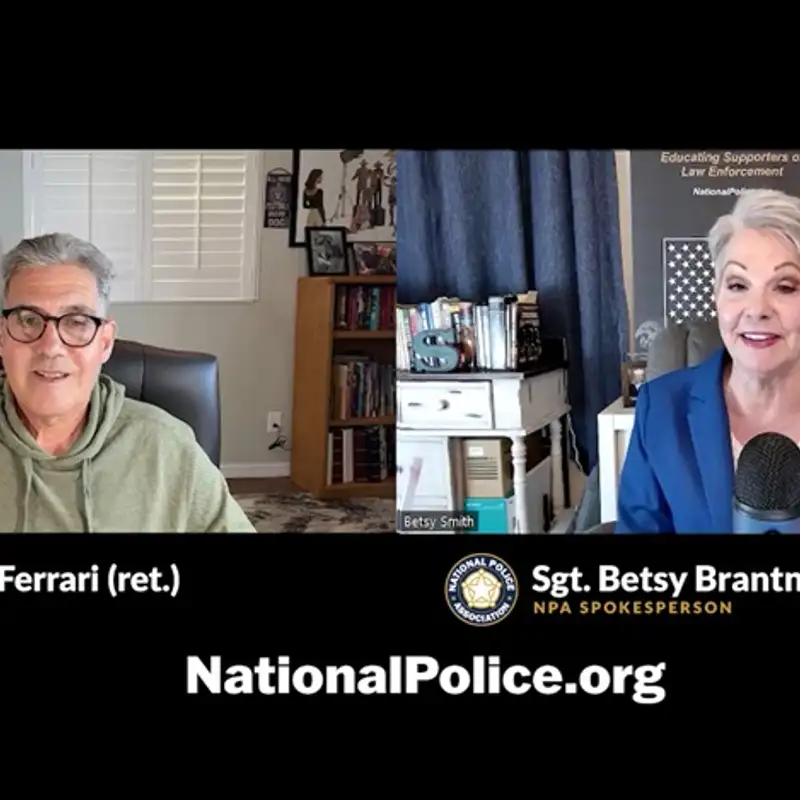
National Police Association Podcast with Guest, Det. Vic Ferrari, NYPD (Ret.) Author & Podcast Host
Hi. This is Sergeant Betsy Brantner Smith with the National Police Association, and this is the National Police Association podcast. I have a fascinating guest with me today, and not only is he fascinating, but, boy, is this timely. So we we have so much to talk to this guest about. He is a retired NYPD, but he's also an author, and he's also a student of what is happening in this country, especially as it relates to law enforcement.
Sgt. Betsy Smith:So I thought this would be the perfect guy to bring in. Detective Vic Ferrari, welcome to the show.
Det. Vic Ferrari:Betsy, thank you so much for having me. I appreciate it.
Sgt. Betsy Smith:So, before we start talking about current events, I the first thing I have to ask is what I ask everybody who's a cop who comes on this show, why'd you become a cop?
Det. Vic Ferrari:Born and raised in the Bronx, New York City kid. Always I wanted to be a police officer from the age of five growing up watching the seven ups, the French Connection, the Rockford files. I always tell the story. My mom would take me to the movie theater on Saturdays. It was around the corner from an NYPD police station.
Det. Vic Ferrari:So instead, I I was more interested in the cops and the police cars than Herbie the Lovebug part two. By age 11, 12 years old, my friends and I would sneak into the local post office and steal FBI wanted posters off the wall and conduct manhunts around the neighborhood. I knew what I wanted to do. By 20, I took the exam. By 21, I went into the New York City Police Academy, and I had a wonderful twenty year career with the NYPD.
Sgt. Betsy Smith:So you ended up as a detective. You know, the NYPD is such a huge organization. Of course, it's such a huge city. What did you focus on as a detective?
Det. Vic Ferrari:Well, you know, that you're right. The with 40 at my time, I think it was about 45,000 NYPD members, so there's there's a ton of specialized units. I grew up in a neighborhood where stealing a car was a rite of passage. No. I wasn't a car thief, but I worked in a gas station.
Det. Vic Ferrari:And there was always guys trying to sell stolen cars, get us to repair the stolen cars. So I always had a leg up. I was always the guy in the precinct that was getting into car chases and finding stolen cars. So my last ten years, I was a detective in the NYPD's auto crime division, so chop shops, exporting stolen vehicles out of the country, changing vehicle identification numbers on stolen cars for resale, a lot of organized crime cases.
Sgt. Betsy Smith:So you, like me, were very influenced by television. That's that's kind of our generation. Right? That's exactly why I'm a cop. And and I always tell people that.
Sgt. Betsy Smith:I you know, you gotta go back to when we only had a few television channels, and most of the cops, I mean, most of the television shows were cop shows or doctor shows. And and I I love that. Looking now at as how the NYPD is portrayed on network television. Give me your thoughts on that.
Det. Vic Ferrari:Oh, it's it it's total nonsense. I can't watch I mean, I have watched police shows before, but especially as a you know, when you've done it for twenty years and then you see the nonsense on television, nothing can be further than truth. And you know this, Betsy. God forbid you get into a shooting. You're not at the bar fifteen minutes later, yucking it up with your friends.
Det. Vic Ferrari:You you know you're gonna get run past the grand jury, and hopefully, you don't get indicted. So there's a lot of they they speed things up. I get it. The only police show that really kinda gets it somewhat right about the NYPD is Law and Order. Because in the beginning of the show, a crime is committed.
Det. Vic Ferrari:Right? The the cops come, the detectives come, they start an investigation. There's going back and forth with the DA's office. Do we have enough to lock this guy up? And then it gets wrapped up in a butt with a bow on it within an hour.
Det. Vic Ferrari:But law and order is probably the closest thing.
Sgt. Betsy Smith:My daughter will be happy to hear that because she is a Law and Order freak. She watches them all. So I I have to look at your twenty year career. I mean, twenty years in the NYPD is, like, forty years, you know, in in other agencies. You retired.
Sgt. Betsy Smith:You went on to other things, and then you decided to sit down and write a book. How do you come to that?
Det. Vic Ferrari:I was bored out of my mind. I retired from the NYPD. I became a cop in Florida. I absolutely hated it. I went from, you know, working in America's largest police department, working on organized crime cases to Reno nine one one.
Det. Vic Ferrari:And I said, oh, no. I can't do this. So I reretired. And my friends and family are like, you know, you got a good sense of humor. You've got all these stories.
Det. Vic Ferrari:Why don't you write a book? And I says, I don't know. You know, who cares what I think? But the reality is, I I wrote one NYPD book and another one and another one, and I'm up to my ninth book. And it it's it's it's good therapy for me that I get out the stories and and the and the fun times and and the characters that I worked with that I I really enjoy writing.
Sgt. Betsy Smith:Your book well, first and foremost, your covers are hilarious, and and they're so spot on. Who does your book covers? I I want the whole series just because of those covers.
Det. Vic Ferrari:I work with a company in Canada. It's for new writers out there. It's ebooklaunch.com. And what I do is I'll think of a title for my book, and then I'll explain to them what I want. And they first write me out a sketch, and I'll approve that.
Det. Vic Ferrari:And then they'll color it in with the fonts, and I'll say, no. I wanna come more like this, more like that. We go back and forth. But it it's it's about $600 for an ebook cover and a paper book cover.
Sgt. Betsy Smith:Well, they do an amazing job. And, you know, you think about, you know, cops see so much trauma and tragedy and and and all of that, and yet you manage to make things kinda humorous. How do you do that?
Det. Vic Ferrari:Yeah. So what I try to do is I try to focus on the characters and the funny things that happened during my time on the job. Are there dark moments? Yeah. And I I cover that in some of my stories.
Det. Vic Ferrari:But for the most part, I try to keep it light and humorous.
Sgt. Betsy Smith:Are they autobiographical?
Det. Vic Ferrari:What I do is I'm not disciplined enough to write a novel, beginning, middle, end. So my books, you can just pick it up. There's a chapter with a bunch of subtopics in it. So for argument's sake, in one of my books, I wrote a chapter crossing over to the dark side. So there's stories in there about cops that I work with that went bad or funny stories, the the things that happened down at Times Square during New Year's Eve, things that people see about the NYPD, but they don't know the nuts and bolts and what goes on behind the scenes.
Sgt. Betsy Smith:So we the NYPD now, as it really, as it always is, is is in the media. I mean, you're the largest police fire in the country. It's the largest city. You're about to have a new mayor. But you've been through this before.
Sgt. Betsy Smith:Who what mayor did you start under?
Det. Vic Ferrari:I started with Ed Koch. So I started in 1987, the tail end of Ed Koch. Koch wasn't a bad guy. Koch, he loved cops. He he supported the police, but he really didn't understand crime.
Det. Vic Ferrari:And that's when New York City was basically a dump in the in in the in the nineteen seventies going into the eighties. Then we had the late great David Dinkins, who he was even softer on crime, and that's kinda when New York City went into hell. And New Yorkers tend to vote democratic, but desperate times calls for desperate measures back then. And we got Rudy Giuliani who was a former federal prosecutor for the Southern District, a former US attorney. And Rudy understood crime and basically took the handcuffs off of us and said, you know what?
Det. Vic Ferrari:Go after the quality of life stuff. Pre Giuliani, if you brought a guy into an NYPD precinct for smoking a joint, a suspended driver's license, a couple of bags of crack in their pocket, the desk officer tell you, what are you doing? Why are taking a car off the street? You get admonished for that. Sometimes you would get dumped out of a car for that.
Det. Vic Ferrari:But what they realized under the Giuliani administration was pulling these guys off the street for what they deter back then is nonsense. This guy's got a warrant. This guy's wanted for a robbery. This guy's wanted for a rape. So we started pulling people off the playing field and slowly but surely, the crime rate dropped.
Det. Vic Ferrari:Then came Mike Bloomberg. He I think I don't think he agreed with everything that Rudy did, but he was a businessman and he understood that crime down is good for New York. So he basically kept with the same format and then I retired. But then as you can see, Bill de Blasio came in. He really he basically neutered the police.
Det. Vic Ferrari:We got him for eight years and then everybody thought it would be a great idea to hire, I mean, or vote in an ex cop, which Eric Adams was no cop. Very divisive, was always in the newspaper about race and how things weren't fair. And you know, I I talked to my friends and I was told that he he had under 20 arrests in his career. So how do you go go how do you how are you a policeman, a cop in New York City, and have under 20 arrests? So now we're at you know, now we have Mundamy coming in, which it's apparently gonna get worse.
Sgt. Betsy Smith:So I wanna go back to the Giuliani days, the the nineties crime bill, the the broken you know, you're talking about broken windows policing and Comstad and all that. What we heard first of all, you guys were the model for the rest of us all around the country, and and we embraced you know, that was one some of the safest times. And in fact, I went to New York City when Giuliani was the mayor, and I never felt so safe. I felt way safer there than I did in Chicago. And and, you know, when you when you look at that, you know, and then you fast forward, we we heard kinda mid Bloomberg that stop and frisk was racist, and you guys were just you know, you had these jump out cars that you were going into the bad neighborhoods and and, you know, beating up people of color and the same.
Sgt. Betsy Smith:Can can you explain to people what was really happening and how, stop question and frisk isn't racist and how it stops crime?
Det. Vic Ferrari:Yeah. Well, you brought up Comstat. Comstat was really good for New York in that It identified the dead wood in the NYPD, precinct commanders that really weren't addressing crime and they forced out a lot of the dead wood. The problem with Comstat is one police plaza got addicted to the crime statistics. So think of com stat as a form of chemotherapy.
Det. Vic Ferrari:Once the patient starts doing better, you don't keep bombing them with radiation. And, basically, they got addicted to the crime stats while crime is down. You gotta know when to take your foot off the gas and leave the community alone. And they wanted summonses, and now now basically, you're going around really now you're annoying the citizens with this nonsense. And stop question and frisk was was a great tool because you could stop, question, or possibly frisk somebody.
Det. Vic Ferrari:And there was a whole criteria for it, time of day, if you see somebody at 02:00 in the morning hanging around outside a place that's been robbed 15 times, and then someone calls a gun run on the person, you can stop them. You can question them. If they have they make a furtive movement or if they have a bulge or someone's walking and their arm is just kinda glued to their side. They're constantly checking their waist. There's a lot of ways to spot somebody with a gun.
Det. Vic Ferrari:So after you stop, question, or possibly frisk this person, you would fill out a form which was called a u f two fifty. And the u f two fifty, in theory, was supposed to protect the cop that, yes, I stopped this person because of this, this, this, and this. They had a gun. I placed them under arrest. That would go with your arrest paperwork.
Det. Vic Ferrari:No gun. You would fill it out and you would file it. And if the person went to make a civilian complaint, it would still go to the civilian complaint review board. But there would be a form documenting in that day and time why you felt the need to stop this person, stop question, and possibly frisk them. The NYPD got addicted to the crime stats.
Det. Vic Ferrari:And if there was a lot of shootings in a neighborhood, they would flood that neighborhood. And I'm talking with a lot of the NYPD can stop crime like that because there's just there was just so many of us. And I remember they would fly us out to Brooklyn, like, say, with Comstead. Oh, boy. We've got a lot of shootings in these two precincts and homicides and robberies are up and there's a lot of guns coming off the street.
Det. Vic Ferrari:Okay. Let's pull auto crime. Let's pull narcotics. Let's pull vice. And that we we'd be bumping into each other.
Det. Vic Ferrari:And at the end of the night, the supervisors, and it wasn't our sergeants or lieutenants, it's coming from one police plaza. Well, how many two fifties did you fill out? How many people did you stop? Well, the perps or the bad guys aren't stupid. They see police cars that they haven't seen crisscrossing each other, bumping into each other.
Det. Vic Ferrari:Tonight's not the night to do a robbery. Tonight's not the night to do a homicide. So they go inside and they're watching TV. One police plaza says, why aren't no two fifties being filled out? Now what happens?
Det. Vic Ferrari:Now you got guys stopping people that maybe shouldn't be stopped. And and you're annoying the community and there was a pushback over it. And then they did away with it. But that's that's on city hall of one police plaza for abusing it.
Sgt. Betsy Smith:Well, yeah, there's always gonna be bureaucracy's always gonna get in the way. And and quite frankly, police leadership, you know, once you make that you know, you know, you get to that certain spot, you you unfortunately, all around the country, a lot of police leaders forget what is really happening on the street with their cops and with, you know, thirty, forty thousand police officers. You know? It's, yeah, it's wildly difficult to remember where you came from, I guess. Did you ever work under Ray Kelly?
Det. Vic Ferrari:Twice.
Sgt. Betsy Smith:He you know, I see him do interviews and things like that. I he always struck me as kind of a cop's cop.
Det. Vic Ferrari:Not a fan a little, Ray, and I'll tell you why. So people forget, you know, then you now he he missed the law and order, and now he's like, you know, New York's gonna go to hell. And if I was police commissioner okay. Well, you were police commissioner under the Dinkins administration. We were averaging twenty five twenty five hundred homicides a year and over a 150,000 stolen vehicles a year.
Det. Vic Ferrari:Where were you, Ray? You were kinda part of the problem. Then all of a sudden, Giuliani kinda got into a pissing match with Bratton and basically forced Bratton out. And then they brought I don't know if it was Giuliani or Bloomberg that brought Kelly back, but he did he did make a comeback. And then all of a sudden with the the press loved Ray Kelly because there was never a microphone he didn't like to speak into.
Det. Vic Ferrari:So it was kinda self serving with him with the press. And he's a former marine, and he, know, he really looks and acts the part, but he wasn't my favorite police committee. I like Bratton, but that's just Coke, Pepsi. That's
Sgt. Betsy Smith:We yeah. Bratton, we love we love Bratton as well. Where do you think NYPD leadership is heading? Because there's again, we've had some crazy stuff happen, in in the last years, not just not just at the commissioner level, but who's been running training, who's running patrol, all of that. Without getting too far into the weeds, what's your gut feeling?
Det. Vic Ferrari:It's awful. It's like one scandal after another. You had one chief who had a female lieutenant under him and allegedly a sex for overtime scandal. You've got a the aviation guy that was hooked up to Eric Adams in the administration, the guy running the aviation unit, crashed a helicopter or almost crashed a helicopter and then didn't wanna share the records with the FAA. So it's kinda like the Mickey Mouse hour going on over there.
Det. Vic Ferrari:And they this kinda started just before I retired, they started lowering the standards to become a member of the New York City Police Department. And I remember getting phone calls my last year or two from the applicant investigation unit, and it would say, detective Ferrari, did you arrest Mike Smith in, you know, July 1992? Said, let me get back to you. I'd find my folders. I go in there and I go, yes.
Det. Vic Ferrari:Stolen car. And they go, well, he said he was the passenger. And I said, nope. Driver ignition was punched. So they were already trying to get people in just to kinda fill the numbers.
Sgt. Betsy Smith:Yeah. In my opinion, as a trainer, and I have trained a lot in New York and New York City, DEI policies have done the NYPD absolutely no good. And, and it's it's very frustrating because, again, when when I started, when you started, you the NYPD was one of those agencies we look to to see the best train, the most squared away cops. And, and once those DEI policies, of, I don't know, fifteen, twenty years ago, really started to take over, that was a real problem. Right?
Det. Vic Ferrari:Yeah. You got three foot cops, and I I'm not a big fan of facial hair for cops. You know? It's it it just looks unprofessional. And the NYPD now has more variations to the uniform than, like, an NFL team with the throwback jerseys.
Det. Vic Ferrari:You know? Back then, it was a, you know, pair of blue slacks, the blue shirt, and the eight point hat. Now it's baggy cargo pants and pullovers, and it's just it it's it's too much.
Sgt. Betsy Smith:What did no cash bail do to New York City?
Det. Vic Ferrari:Ruined it. It ruined you know, and I love well, you know, there was people sitting on Rikers Island for nonsense. That's so untrue. You've gotta be a real pain in the ass and have a million arrests even if it's nonsense where the judge finally goes, you know what? Yeah.
Det. Vic Ferrari:I get it's a misdemeanor, but this is your eightieth shoplifting collar. You're going to Rikers Island. Cashless bail, especially with the borough of Manhattan so people forget. So New York City's got five boroughs. Right?
Det. Vic Ferrari:And each district attorney's office is run a little different. Manhattan was the crown jewel. Queens was a close second where if you committed a crime, you were going to jail. Now the Bronx and Brooklyn was like spin the wheel. It it was like going to the circus in Staten Island.
Det. Vic Ferrari:That that's its own entity. But with cashless bail, it basically ruined the borough of Manhattan because all these guys, Rikers, they lowered the population of Rikers Island, and you've got all these street people committing all these crimes.
Sgt. Betsy Smith:So we look at what's happening now. We've got a a mayor elect who is a admitted Democrat socialist. He's talked about defunding the police. He has called the NYPD some of the most horrific things that you can think of. Is there going to be, in your opinion, this mass exodus of the NYPD that everybody's talking about?
Det. Vic Ferrari:Yes and no. I think that the old timers and people with time in are gonna buy their time. They want their pension. If you vest out, leave early, you're not gonna get the same. I'm sure there's gonna be a large percentage looking for jobs in other states.
Det. Vic Ferrari:I I think they'll probably under Mundhabi depending on how much he runs his mouth or what he does. You could see it at five to 10% exodus, you know, in the first six months, but it it'll you know, people still need to work. So it it'll level off, but it just depends on how radical I mean, he got elected. Let's just see if he pulls back on the throttle or he goes full in with this nonsense.
Sgt. Betsy Smith:The NYPD works a lot with other agencies. I mean, you know, you guys have, you know, so many task forces. We couldn't even begin to name them. You work with the feds. You work with the state.
Sgt. Betsy Smith:You work with, you know, everybody and their brother. Plus, there's that international element. You know, you've got the United Nations there. You've got, I mean, it's there's just so much happening. How is you look at the last ten years, let's say, how has that affected, you know, just everything that's happening in New York City?
Sgt. Betsy Smith:How does that affect those task force relationships?
Det. Vic Ferrari:I'm sure there's been a lot of head scratching and a lot of because so with a federal case, it probably wouldn't affect it so much with a federal prosecutor. But now, like, the borough of Manhattan, like we just said, we're under brag with cashless bail and so different like, again, different boroughs give you different things. Like, it would be next to impossible to get a wiretap in the Bronx. The DA's office say, yeah. Yeah.
Det. Vic Ferrari:That's great case. Just give us a little bit more. Give us a little bit more, and they would never give you a wiretap. Manhattan, you could go up on a wire like that if you had probable cause. I'm sure that a lot of this nonsense has has stymied a lot of cases on on the state level, probably not the federal.
Sgt. Betsy Smith:Let me switch gears, and then I'll you'll see the method to my madness. Where were you on 09:11 o one?
Det. Vic Ferrari:I was sitting in my office, but I was actually supposed to be in the courthouse a couple of blocks away, but my sergeant was running late. So I was in The Bronx, but I was down there walking around by about 01:30 in the afternoon.
Sgt. Betsy Smith:And you you know, so you not only experienced that, but then you experienced the aftermath of nine eleven o one where every cop in the country, but especially you guys, were revered. Right? Everybody wanted to wear an NYPD hat and and, you know, everybody's, you know, buying your lunch and your coffee and thanking you and all that stuff. Have New Yorkers forgotten?
Det. Vic Ferrari:They forgot fifteen minutes after. You know, it's funny. I always tell the story, like, the first week we were down there, we're in you know, we're going back up to The Bronx, so we're taking the West Side Highway, and the air conditioner broke. We were in a minivan, and the air conditioner wasn't working. And it was like an Indian summer, so it was still warm out.
Det. Vic Ferrari:So we had the cargo door open on the minivan and we're going up the West Side Highway and people are cheering us. Right? So we're like, look at that. I we've never been cheered before. We got up to The Bronx.
Det. Vic Ferrari:We got cut off by a gypsy cab, and the guy started cursing at us before he realized we're the police. I go, well, we're scumbags again, like, fifteen minutes later.
Sgt. Betsy Smith:And it and it, yeah, it it didn't it didn't stop. So when when you look at that, you look at the risk, the constant risk of terrorism and and and radical jihadism in New York City, What happens when a guy like Zoran Mandami who does have some friends, let's say, who does talk about jihad, who who is not doesn't seem to be a big fan of The United States Of America? What's gonna happen when he the mayor gets their hands on every single database and everything. Right? Am I right about that?
Det. Vic Ferrari:Yeah. He's talking about doing away with the the NYPD's gang database. Says we don't need it. They're gonna wipe it clean. So, you know, it's his ball, his game, but let's not let's not forget.
Det. Vic Ferrari:Eric Adams was was doing a lot of things and the feds gave him a touch. Right? He was gonna he was on a plane going to Washington DC to complain to Biden about the illegals, which he thought was okay, and then it wasn't okay. And then all of a sudden, people start getting indicted in in his administration and search warrants are being served. And then Trump came in and basically gave him a pass.
Det. Vic Ferrari:I think, yeah, I think this guy is gonna do the same thing. I think he's gonna run it. It just depends. If he goes in there running his mouth, he needs the federal he needs Trump for money. New York City needs federal money to survive because they just it's just not it's mismanaged.
Det. Vic Ferrari:So I think he could get himself in trouble. Depending on his background, maybe he gets pulled off the playing field. You never know how this is gonna turn out, but he talks a tough game. And you're right. I mean, he is wired in with the Muslim community, and one of his supporters was an unindicted co conspirator of the 93 World Trade Center truck bomb.
Det. Vic Ferrari:So to me, it looks a little dangerous with him at the controls.
Sgt. Betsy Smith:The you spent twenty years at the NYPD. Am I correct in assuming that the vast majority of New York City police officers are going to continue to do their job, love their city, protect their community no matter who's the mayor?
Det. Vic Ferrari:It's already changed from from the time I I left. I left in 2007. Basically, cops nowadays most cops are not afraid of getting killed. They're afraid of getting in trouble. And what you're creating or what they've created is you've got cops that are not doing their jobs.
Det. Vic Ferrari:They're not thinking outside the box. They're report takers. They're not looking to stop a crime before it happens. They're gonna show up fifteen minutes later and take a report and go, oh, we'll see what we can do. And that's happened in a lot of major US cities right now.
Det. Vic Ferrari:You know, part of it is generational. Different, you know, young people, people think differently. They weren't under the same conditions that we were brought up in. I really worry about major US cities with with policing.
Sgt. Betsy Smith:Yeah. I think you're spot on about that. I Vic, I have about 40 more questions, but we're out of time. Where can people find you, your books, and find out more about you? You do a lot of podcasts, and and people need to hear from you.
Sgt. Betsy Smith:Where can they find you?
Det. Vic Ferrari:Well, my podcast is called the NYPD Through the Looking Glass NYPD Through the Looking Glass podcast. It's on YouTube and wherever else you can find podcasts. I I bring on retired cops and NYPD members, and we talk about different cases. My books, just go to Amazon, type in my name Vic, Ferrari like the car, where you can preview all my NYPD books for free. If And you wanna reach out to me for an interview or got a question, you can find me on Twitter, Instagram at vic Ferrari five zero.
Sgt. Betsy Smith:Vic, I cannot thank you enough for spending time with us today. This has been such an enlightening conversation. And if you'd like more information about the National Police Association, you can visit us at nationalpolice.org.
Narrator:Every day, the brave men and women of law enforcement put their lives on the line to keep us safe but they need our help to continue their mission. Activist politicians, progressive prosecutors, the ACLU and the rest of the anti police forces receive millions in donations from extremist pro criminal elements like George Soros and woke corporations. The National Police Association is fighting them in courts around the country, including the United States Supreme Court, defending officers who are being attacked for doing their jobs. Additionally, the National Police Association works year round to pass tough on crime legislation to put and keep criminals behind bars. Consider going to nationalpolice.org and donating to keep us in the fight.
Narrator:Together, we can win. That is nationalpolice.org.