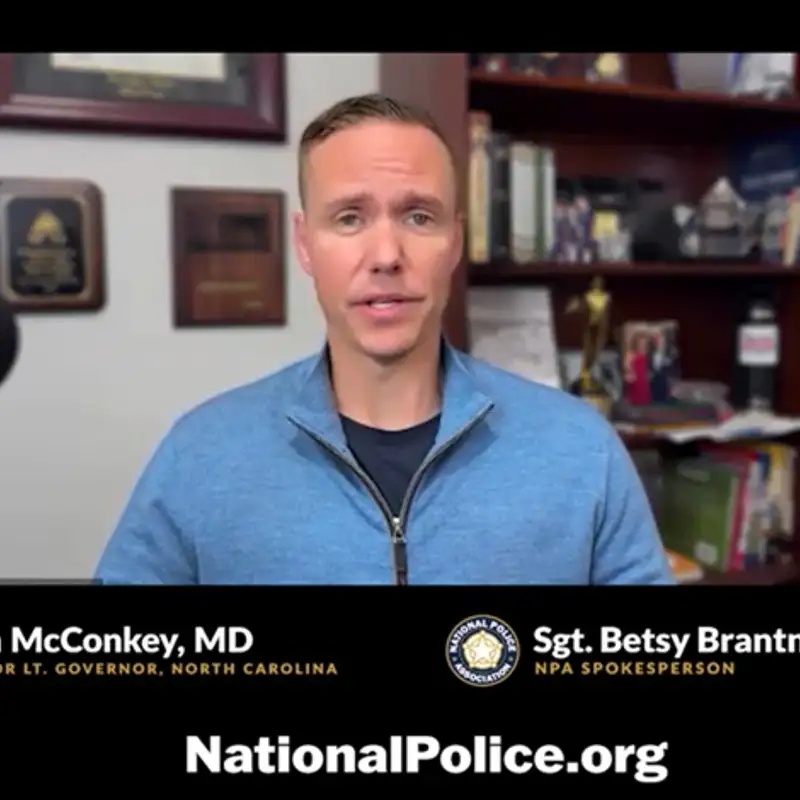
National Police Association Podcast with Guest, Dr. Josh McConkey, Physician, USAF Col. & Candidate
Hi. This is sergeant Betsy Brantner Smith with the National Police Association, and this is the National Police Association podcast. I have a guest with us today that, I've been, on Newsmax with, and he does more media than I do. And, but he's also boy, he's out there just doing some amazing things. He's a physician.
Sgt. Betsy Smith (Ret):We're gonna talk about that. He is a colonel in the air force. We're gonna talk about that. And he's also decided as though he didn't have enough to do to jump into the political arena, and he's running for lieutenant governor of North Carolina. And he's got he's got some terrific opinions.
Sgt. Betsy Smith (Ret):And I wanna start, doc, by talking about your incredible book because he's also an award winning author. So, Doctor McConkey, welcome to the show.
Dr. Josh McConkey:Thank you very much.
Sgt. Betsy Smith (Ret):So I wanna talk first about your book because I'm I'm such a student of leadership. And the the I've read, you know, like most of us, you know, a million leadership books. Right? And and your book is the one of the most least narcissistic leadership books I've I've ever read. I'm not sure I'm putting that properly.
Sgt. Betsy Smith (Ret):Oh, thank you. In your book, you don't talk about you. You talk about what others can do to improve their own leadership skills. First and foremost, what led you to writing your book?
Dr. Josh McConkey:So that be the weight behind the spirit, that's my personal leadership ethos with, you know, twenty three years of military service and trenches of the emergency department. You know, it's when you see try to describe that that title. You know, working with the tip of the spear individuals as a medical director for special operations combat search and rescue, you see what those individuals do, but you realize that it's the weight behind their spear that really gives them the power to do what they do. Their confidence is everybody has somebody in their life that give them the amazing confidence to do what they do. The best resource of any country is its people.
Dr. Josh McConkey:So teachers, coaches, volunteers, families, and mentors, that's what sets America apart. That's what makes us so special, and that's that's the way behind our spear.
Sgt. Betsy Smith (Ret):You know, I'm glad you brought up teachers because teachers are kinda getting a bad rap right now. You were raised by a teacher. I was raised by a teacher. And they are so incredibly important. And yet now kind of what we see in the media is really just a radical tiny percentage of educators in this country.
Sgt. Betsy Smith (Ret):Talk about the importance of our educators when it comes to raising kids.
Dr. Josh McConkey:So, you know, my wife is a teacher as well. And when you look at, like, the two most difficult jobs on planet Earth, teacher and law enforcement, right, just just brutal jobs. And the problem with teaching right now is that they've removed the ability for them to hold kids accountable. So they want these results, but you don't empower them to do anything to hold the kids accountable to get the results. So, you know, on top of the kind of the the woke, the DEI craziness that's been going on in public schools, you know, you don't empower them anymore.
Dr. Josh McConkey:My mom told me plenty of stories, and she's finally retired, so thankful to be retired. But the last ten years of her career, she couldn't even fail a kid. These kids would not show up, do nothing for work, literally have, like, 0%, and she can't fail them. I mean, what type of message are you trying to send kids when you don't empower your teachers to do those basic things and hold those kids accountable? So it's a very, very difficult job.
Sgt. Betsy Smith (Ret):I you know, I'm glad you said that because my husband and I were talking about this yesterday. I I said to him, boy, my mom would be rolling over in her grave if she saw the state of education now, the state of teachers' unions, and and things like that. And and when you you talk about the difficulty of that job and you relate it to law enforcement, which, by the way, is one of the reasons why cops and teachers tend to marry each other. And and but we also when you come from that kind of family like you did, like I did, that that service type family, it leads you in those directions because education is really very much a service driven profession as is the profession of of law enforcement. And, you know, one of the things that we saw in the last five years is law enforcement officers, school resource officers, generally speaking, were taken out of the education system.
Sgt. Betsy Smith (Ret):They were demonized. They were vilified. And that resource that a lot of educators had, that police officer in the school, was taken away. What are your thoughts on that as a, as a political candidate about cops in schools?
Dr. Josh McConkey:You know, they had talked about doing that here. So I live in North Carolina. I'm outside of Raleigh. And one of the public school systems had talked about talked about removing those school resource officers. We raised absolute hell, and and then I think I I can't believe which of the the school shootings happened about a week or two after that that really kinda put that to rest.
Dr. Josh McConkey:But the importance of having that school resource, cannot be overstated. You know, as someone as an emergency physician, you know, I I've worked with police officers my entire career. I've been an EMS medical director as well, fire paramedics, law enforcement, special operations SWAT teams, that types of thing. And you just they're they're just such difficult jobs. And, you know, I I've personally saved several officers' lives.
Dr. Josh McConkey:I remember some real specific cases in the emergency department. And that that's always the challenge in the ER when you get, like like, multi traumas where there'll be multiple gunshots and you've got the officer on one table and then you've got the perpetrator, you know, on the on the other table. It's always some unique situations. But, yeah, those are the most difficult jobs, and they they need our support.
Sgt. Betsy Smith (Ret):You know, when you talk about, police officers being injured, you know, and and thank you for what you've done for our profession because, again, police officer ambushes, attacks on law enforcement are up over a 150% now. And even though our officer deaths are down, officer injuries, assaults, and ambushes are up. And a a big part of that, the deaths being down, are thanks to ER docs like you. And it it and also thanks to the fact that we, the profession, started listening to your profession and learning how to do tactical medicine. We started really borrowing
Dr. Josh McConkey:Tactical medicine. I teach triple c tactical combat casualty care. So I I was just speaking at Salt and Light, a big conference, North Carolina Faith And Freedom Coalition, and ran into two, there was, two firefighters and and a police officer from Minneapolis. And the stories that they told were just just blood curdling. I just those so when they had, you know, the George Floyd protests and they were burning Minneapolis to the ground, so they were they were at one point, this is direct from them, 47 fires going on in Minneapolis at one time.
Dr. Josh McConkey:And anybody that responded, they were having rocks thrown at the vehicles, shot at. They couldn't even get to the fires because it was so dangerous. Law enforcement as well. And it just these are individuals that have dedicated their life to saving your life. You know?
Dr. Josh McConkey:Back the blue. You know? Back the, you know, thin blue line, thin red line. Like, to attack those individuals, I I didn't even understand the concept of of these ambushes, but they they literally will do that. They'll ambush the people responding to these emergency situations.
Dr. Josh McConkey:It is the most insane thing I've ever heard of.
Sgt. Betsy Smith (Ret):You know, and we're seeing not just police officers ambush, but now firefighters as well. Paramedics. As we saw in Idaho, and it it's just it's extraordinary. You you know, because cops always love to tease the firefighters. You know, everybody loves everybody loves them.
Sgt. Betsy Smith (Ret):Everybody hates us. We're used to it. But now to see our brothers and sisters in the fire service getting shot at
Dr. Josh McConkey:sometimes That was in that was in Coeur D'Alene, wasn't it?
Sgt. Betsy Smith (Ret):Yes. It is.
Dr. Josh McConkey:I've got family there. Extraordinary. Terrible story.
Sgt. Betsy Smith (Ret):Yeah. And and so we're learning now that one of the things that we have to do is we can't wait for the paramedics. We can't wait for the ambulance. We can't wait to get to the hospital that we've gotta learn to take care of ourselves. And that's a relatively new development, you know, like you said, tactical medicine that we really borrowed from the military.
Sgt. Betsy Smith (Ret):In the late seventies, we had police officers getting shot with survivable wounds, but they would just lay down and die because we'd all kind of stand around and wait wait for the calorie to come. And and we stopped doing that and go and I I'm taking this back to your book because one of the things you talk about in your book is resiliency. That's a that's a real theme that runs throughout the book. And that's something that law enforcement, again, is we're always a little behind, and, we really haven't talked a lot about resiliency until about the last twenty years. Talk about resiliency in a service profession.
Dr. Josh McConkey:Yeah. Just that ability to adapt and overcome, and that's certainly something we teach a lot in the military. You know, I talk to all the individuals under my command as a military commander. But just being able to think outside the box, and that's what Americans do best. So when you look at some military training, like the TTPs, the the the tactics and procedures, like, you know, that we have in the military, that's one of the things that always throws the Chinese and the Russians off is because, you know, we have these policies and procedures, but we don't follow them.
Dr. Josh McConkey:So, you know, because because our ability to critically think, to get outside the box, that's what sets us apart. And when you look, it is it's it's very similar in law enforcement as well. This, like, for us, our noncommissioned officers, for the, you know, law enforcement, like the the sergeants, you know, the leadership out on the street, on the beat with those officers. Thinking outside the box and being able to make decisions, you know, without, you know, the Chinese and the Russians do not have an NCO core. There's no noncommissioned officers.
Dr. Josh McConkey:That's one of the reasons that they fail. And we saw that with Ukraine invasion, just just completely botched invasion of Ukraine. But, yeah, those those things are just critically important, that basic leadership. And then when you have that that confidence in your leadership and those skills, that that resiliency to be able to think outside the box and take care of things that otherwise would overwhelm you, that's a really important skill.
Sgt. Betsy Smith (Ret):How important is patriotism? That that love of country. I I don't think in other countries you know, you mentioned Russia, China.
Dr. Josh McConkey:Yeah. They
Sgt. Betsy Smith (Ret):I don't see that love of country that we have. Right?
Dr. Josh McConkey:I have lived overseas. I've lived in Australia. I've lived in New Zealand. Spent a lot of time in Europe with the military as well. Got a lot of friends from all over the world, and that is the one thing they always comment on is just America is so different.
Dr. Josh McConkey:When I was in New Zealand the very first time, you see, we were down there in 02/2008, 02/2009. They had they they held the the Women's World Cup. I think it was, like, the Youth World Cup, like, the u u twenty or something World Cup. And a lot of my friends from Rotorua I was working at the hospital in Rotorua. We went to a game in Hamilton.
Dr. Josh McConkey:And they when when they we watched the US team play, and when they say the Star Spangled Banner, it was just know, you they just kinda looked at me in awe because, you know, I I stood to attention. You know? I'm I'm saluting the flag as a military member. And, just they they asked me questions about it, and and they just like, man, your guys' patriotism. I just we don't you know, the rest of the world just doesn't have that.
Dr. Josh McConkey:I mean, I still get teary eyed when I when I when I listen to Star Spangled Banner a lot of times because I just have so many memories from combat and those people that have sacrificed so much. And, you just overseas, they don't quite understand that. So, you know, I get lots of questions when I'm traveling around the world. Those are the things they wanna talk about.
Sgt. Betsy Smith (Ret):Yeah. Absolutely. And I I know we see that in law enforcement as well where, you know, people who hate this country, people who hate the government, you know, they're they're not particularly going into law enforcement. But we have seen over the last four or five years how difficult it has been, especially in certain areas, to stand up for your country as well as stand up for your very often big blue city. It's a it's a tough, it's a tough road for
Dr. Josh McConkey:especially early cast. Difficult to recruit in law enforcement in a lot of these cities. I mean, you look at LA and some of these other really blue cities, man, that's it really has to be a calling. You have to be a very dedicated individual because a lot of times you feel like you're those that city leadership doesn't have your back.
Sgt. Betsy Smith (Ret):I have to ask you because, you know, here you are. Great military career, colonel, ER doctor, award winning author, you know, family. Right? You're a pretty busy guy. What made you get up one morning and say, I think I'll run for, not, you know, the school board, not city council.
Sgt. Betsy Smith (Ret):I think I'll run for lieutenant governor of my state. What tell walk me through that thought process.
Dr. Josh McConkey:Well, you see failed leadership and failed policies. So, you know, COVID being kind of very, very recent in in everyone's mind. But you saw so, there's a governor Cooper who's now Josh Stein as our governor, and Rachel Hunt is the current lieutenant governor. That was a little three amigos there. They were involved in shutting down schools, shutting down churches, building just burning businesses to the ground.
Dr. Josh McConkey:And I just really disagree with those policies, and then I see the repercussions of that in my emergency department now. So that whole generation that they just basically sacrificed, you know, these these young North Carolinian and Americans, we have a huge mental health crisis. So in the ER, they're coming to me. So I see the anxiety, the depression, the suicides. Three weeks ago, at at a 14 year old individual, they got ahold of a handgun and and and killed himself.
Dr. Josh McConkey:My son is 14. You know, this this really strikes close to home. And then when you see those same that same I call them the COVID generation. You know, we take these 18 to 25 year old kids that are now coming in the military. And as a military commander, the the lack of resiliency skills and the inability to communicate, they can't look you in the eye.
Dr. Josh McConkey:I mean, I have no idea how some of these kids are gonna get through basic training. That there's clearly a problem. And we need purpose driven leadership, and we're not getting it at that level here in North Carolina. And after you've served in combat and you've watched people pay that ultimate sacrifice, that's what I think about every morning when I wake up. I feel super blessed.
Dr. Josh McConkey:I've got a wife and a family, and I will do whatever it takes to make sure that they're successful, that North Carolina is successful, and we need better leadership in North Carolina. So that's why I'm running.
Sgt. Betsy Smith (Ret):You know, you talk about the mental health crisis, and that's something that really impacts American law enforcement. And we have, lots of, political leaders who say, let's replace cops with social workers. Tell me your thoughts on that.
Dr. Josh McConkey:So let's talk about Portland. Alright. I worked there. I was with the three zero four rescue squadron. And if you look at a perfect example of, like, a local government that just has no under no understanding whatsoever.
Dr. Josh McConkey:So what they did is they decriminalized drugs, and then they started handing out the free needles to everybody. So their answer was, you know, these are all just victims of the society, and, you know, we don't need more police officers, you know, with the crime and the homelessness and just the craziness going on in Portland that we're now seeing, you know, them attacking the ICE facility. So let's let's just get a bunch of social workers, and we'll just address mental health. Well, what was so funny is as they decriminalized everything, no no jail, like, cashless bail, all these types of soft on crime policies. The very funny thing is is cracked out homeless people don't make their appointments.
Dr. Josh McConkey:Like, it it should be common sense. Like, you talk to an emergency doctor that deals with mental health all day every day. I could have told you that. So their answer was to get social workers and get them all mental health appointments, and we're just gonna address the mental health issue, which it's a problem, clearly, but they don't show up for their appointments. And so it was just a complete and total disaster.
Dr. Josh McConkey:You know? So I still have colleagues that are there, some in the police force in the Portland area, And you just hear the stories now, and it's just it was completely, foreseeable. It just it was an epic failure, and that that city is struggling.
Sgt. Betsy Smith (Ret):Yeah. That city, like so many others. And it's so ironic because, Portland, I used to go there as a trainer, and we would film training videos with Portland PD and Beaverton PD with the sheriff's department because those men and women, they were experts when it came to crowd control and and and dealing with subversive groups and Antifa and things like that. And it's it's so unfortunate, to see what has happened now in this this decade long attack on the federal facilities there in Portland.
Dr. Josh McConkey:Oh, so they're they're inaction, and that failure of leadership at that state at the state and the city level there in Portland, it's just descended to Lord of the Flies now. It's crazy. Yeah. It is. It's gonna
Sgt. Betsy Smith (Ret):be the purge eventually.
Dr. Josh McConkey:Oh my gosh. Wow. Yeah. It's it's scary.
Sgt. Betsy Smith (Ret):You know, when I was a young a very young cop in the in the early eighties, when we had, you know, mentally ill, homeless, very drug addicted people, things like that. We were able to take them to state hospital, if you will. We had facilities where we could check them in for evaluation. And very often, they would stay put for, weeks, if not months. And and, you know, that ended in the eighties.
Sgt. Betsy Smith (Ret):What are your thoughts now on dealing with this public mental health crisis that we have that includes drug addiction, alcoholism, other mental health issues combined with homelessness? What is the answer? Because I know this is something that you deal with as an ER doc, but you will also deal with as lieutenant governor.
Dr. Josh McConkey:Well, I can tell you, I know all the law enforcement extremely well because on a daily basis, they're coming and hanging out with me just dumping all kinds of homeless and social health issues and mental health issues. And, you know, and then every once in a while, have to beg and plead from one of them if we actually can find somewhere to admit them. I have to beg one of the officers to come back and then drive the patient over there. So, you know, you develop those relationships. We need more mental health resources clearly as they shut down all of those facilities.
Dr. Josh McConkey:It's across North Carolina as well, and we routinely have mental health patients that just sit with us for weeks, sometimes months. I think the record that I saw, there was a geriatric mental health patient that we had that, when I was a professor at Duke University, sat there for over three months in a hole, like, the the psychiatric hole in the back. So we actually had to write orders every day to get the patient out, get them to walk outside, get some sunlight exposure to you know, for vitamin d exposure and to prevent DVTs. Like, if you weren't crazy before and you got locked in that hole for three months, you are clearly gonna be crazy by the end of that. And we see that with, with adolescent mental health as well.
Dr. Josh McConkey:And just most recently, the hospital that that I'm at now, we had a resident that stayed with us for about two months. My last shift when I went on Saturday, he wasn't there anymore. And it was it was a little sad, actually, because you got to know him so well, his character. And they threw him a little party apparently. And, yeah, so I found out Saturday, they actually got placed into a into a facility.
Dr. Josh McConkey:But you need more mental health resources, and I think that's that's almost universal across the nation. You
Sgt. Betsy Smith (Ret):know? And when we talk about that, more mental health resources, they have to be well, first of all, it's expensive. But secondly, they have to actually show some progress. Right? I mean, I I feel like we have so many people who are counselors and this and that, and they don't really accomplish much with their patients.
Dr. Josh McConkey:Yeah. It's gotta be it's gotta be the right education level, the right experience level, you know, inpatient psychiatric facilities with psychiatrists and and mental health practitioners. You know, we I think the the case that everyone, you know, recognizes here, Irina Zerutska, you know, the Ukrainian girl. It's a Friday night. She's just slaving away at a pizza joint, leaves her job on a Friday night going home, and gets murdered right there on camera with everyone sitting around her by an individual that had been arrested 14 times.
Dr. Josh McConkey:Claudia had some mental health issues as well. That individual had no business being on the street. Police are doing their job. They arrested the guy 14 times, and magistrate judges just kept kicking him out the door. And that's know, my whole campaign is about accountability.
Dr. Josh McConkey:When you remove people's accountability from their actions, that's where you see things uncouple, and it just descends to chaos and lord of the flies. So you start holding these judge these magistrate judges accountable for those types of actions. I guarantee you they're gonna be holding on to those people.
Sgt. Betsy Smith (Ret):You know, that's one of the issues that we see. We we hear a lot of talk about law enforcement officers. Oh, we gotta get rid of of, you know, qualified immunity and and this and that. And yet, generally speaking, judges have absolute immunity. Prosecutors have absolute immunity.
Sgt. Betsy Smith (Ret):And so like you said, there really is no accountability for lousy decision making. Right?
Dr. Josh McConkey:And and and at the political level, Josh Stein, Roy Cooper. So Josh Stein was the attorney general. They're soft on crime policies, cashless bail, churning these people out with just these magistrate judge decisions that 14 times? 14 arrests? It's, like, it's so hard to watch.
Dr. Josh McConkey:And when you watch that on video and you see that young woman, she's just, like, bleeding out, and there's people sitting on the bus next to her. It's had she got medical care or anyone even just cared in the slightest? It's it's so hard to watch that. Absolutely brutal. And so that case has really galvanized all of North Carolina, a lot of the country.
Dr. Josh McConkey:And so we do have a Republican run state house and senate that have passed some laws, and they put so much pressure on Stein. He was going to veto it, but he did sign it in the end just to end some of these cashless bail policies and and hold people accountable. It's so so hard to watch.
Sgt. Betsy Smith (Ret):Yeah. Cashless bail has been a disaster for my native Illinois, for New York City, for Los Angeles. And and one of the other problems we have, of course, is illegal alien criminals who either, don't get appropriate sentences, appropriate punishments, or when they are done with whatever, jail or prison time they've done, they get released back into the public again to reoffend. You know? It's yeah.
Sgt. Betsy Smith (Ret):So talk about your thoughts on the illegal alien criminal problem that the current administration is trying to deal with.
Dr. Josh McConkey:Yeah. So so the the the Biden administration, their policy was just an epic failure. You know, just starting off with the 10,000,000 illegal immigrants they let into the country, like, purposefully and intentionally. But, during, as soon as president Trump, like, took office and started to change those policies, you saw that change. And the the the one individual that was extradited, I believe, to to El Salvador, I believe.
Dr. Josh McConkey:And they're like, oh, they're they're a citizen. They're a citizen, and they ended up not being a citizen. Do you remember that when there was even the I think the Maryland senator flew down there with a big publicity staff? So that
Sgt. Betsy Smith (Ret):So did my congresswoman from Arizona. She went too.
Dr. Josh McConkey:That individual was was caught in Kentucky or Tennessee trafficking human beings. And so they had it on tape. I watched the video, and you saw the sergeant with one of the younger I think one of the state patrol officers, and he was talking to him. This is all on Camby. He's like, hey.
Dr. Josh McConkey:You understand what's going on here. Right? He's like, yeah. Every single one has a toothbrush in their back pocket. There's their lips are they're not saying a thing.
Dr. Josh McConkey:These people are being trafficked, clearly. This guy's trafficking people. The Biden DOJ got involved on that, and he was released. So, it's it's it's really bizarre, like, that thought process of just promoting lawlessness and not allowing our officers to just uphold the law. I mean, why have laws if you aren't gonna follow them?
Dr. Josh McConkey:But that type of mentality, those soft on crime policies, just disastrous democratic policy failures have led to to multiple deaths. I mean, the young girl in in Georgia, I mean, there was it's not that they were just the crimes were committed. It's that they're repeat offenders, and it's still they would not allow them to be extradited out of the country. So the Trump administration obviously, has a much firmer stance on that. And then a lot of people, you know, it's oh, well, these people are being you know, they're they're they're they're being deported out of here, and they haven't done any other crimes.
Dr. Josh McConkey:I'm like, listen. You entered the country illegally. That is a crime. You know? It's it's not a victimless crime.
Dr. Josh McConkey:You've got so many people that are doing it the right way, spending tons of time and money and waiting in line. So my my my wife, her her brother married a French Cambodian girl, and she had a heck of a time. So they actually left the country before she physically had her green card and for their wedding in France and then had all kinds of issues getting back, but it was almost a year, year and a half, tons of money doing everything illegally the right way when everyone else is just jumping across the border. And then you give them free cell phones and and and cards and hotel rooms. I mean, you can't incentivize illegal behavior.
Dr. Josh McConkey:In the emergency department, I call it don't feed the bears. Alright? With opiates and narcotics, you just can't feed the bears. You see the difference. When there's an attending on that comes in that's the candy man, they just magically show up.
Dr. Josh McConkey:But for me, they don't show up. Like, why is that? Because I don't feed the bears. I don't incentivize illegal behavior. And and then in in doing so, there's tons of the the the people and the drug trafficking coming across the border, when you promote that type of illegal immigration, it's very dangerous.
Dr. Josh McConkey:You empower all the drug cartels, and they're trafficking people in in busloads and truckloads. And it's, you know, small children, sexual exploitation. It's horrific. So all the downstream effects of, effectively, the Biden administration just straight up promoting illegal immigration hurt tens of thousands, if not millions of people.
Sgt. Betsy Smith (Ret):And we're going to be dealing with this for, I think, years and years to come as we try to unwind all of that.
Dr. Josh McConkey:Oh, 10,000,000. 10,000,000 in less than four years.
Sgt. Betsy Smith (Ret):Exactly. It's it's it's really it's extraordinary. And yet in every city in this nation and in every ER department like you're dealing with every day, we're gonna be dealing with this. You know, doc, I got about 50 more questions, but I'm gonna have to I'm gonna have to let you go. So tell
Dr. Josh McConkey:people episode in.
Sgt. Betsy Smith (Ret):Exactly. First of all, tell people where they can get the book, and then tell people where they can find you on social media, learn more about your candidacy, and frankly, just your extraordinary life.
Dr. Josh McConkey:Yeah. Thank you. So wait behind thespear.com, weight. Wait behind thespear.com. We've got the audiobook, ebook, and the paperback.
Dr. Josh McConkey:It's at Barnes and Noble, Amazon, anywhere you can buy books. And for our campaign, we are always stronger together. If you go to strongernc.com, I'd love to have them join the team. On our social media, we've got Instagram, Josh McConkey MD. On x in Twitter, it's McConkey o o seven.
Dr. Josh McConkey:And we've we've we've got I've recently got a TikTok account and all of that as well. So, yeah, if you just do a Google search, everything pretty much pops up.
Sgt. Betsy Smith (Ret):I love it. Well, thanks for all that you're doing for this nation, and thanks for being with us today. And if you'd like more information about the National Police Association, you can visit us at nationalpolice.org.
Narrator:Every day, the brave men and women of law enforcement put their lives on the line to keep us safe. But they need our help to continue their mission. Activist politicians, progressive prosecutors, the ACLU and the rest of the anti police forces receive millions in donations from extremist pro criminal elements like George Soros and woke corporations. The National Police Association is fighting them in courts around the country, including the United States Supreme Court defending officers who are being attacked for doing their jobs. Additionally, the National Police Association works year round to pass tough on crime legislation to put and keep criminals behind bars.
Narrator:Consider going to nationalpolice.org and donating to keep us in the fight. Together, we can win. That is nationalpolice.org.